My first camper van experience - Renault Trafic campervan
There is no doubt that "homes on wheels" have become fashionable. Whereas camper vans used to be the preserve of a limited group of enthusiasts, today a far larger number of people are interested in them. In the text below I try to share my impressions from a few days with a camper van. Is the Renault Trafic Wavecamper a good choice for travel lovers?
The third-generation Renault Trafic as a camper base

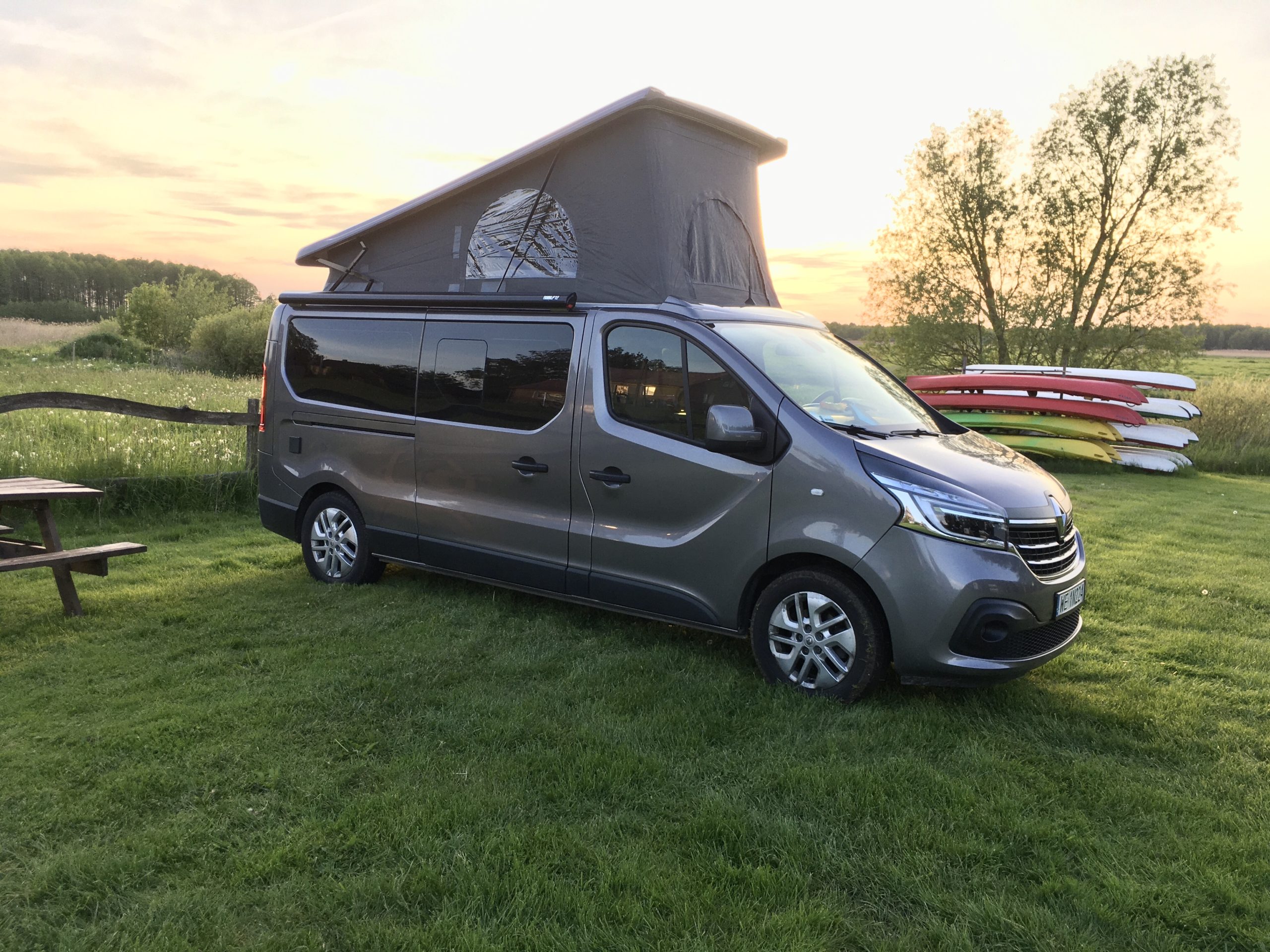
The camper I tested is based on the panel van version of the third-generation Renault Trafic. This vehicle made its debut 7 years ago. On the one hand that is a good thing, because it is a proven model that should not spring any nasty surprises, but on the other hand it may lack the latest solutions and may not meet the expectations of more demanding customers in terms of interior finish. Overall, the vehicle makes a very good impression when it comes to practicality and finish, but certain details come as an unpleasant surprise. One of them is the large handbrake lever mounted in the floor. It is both anachronistic and makes it harder to move around inside the vehicle.
The vehicle is relatively small, and its body outline is that of a well-known van. Manoeuvring it should not be a problem for people moving over from passenger cars who want to set off on holiday straight away. Larger camper vans, especially those with a "hump" on the roof concealing a bedroom, can be tricky. At times it can even be dangerous, if the driver forgets how tall and wide the vehicle is.

Driving and the 2.0 dCi 170 hp engine
The Trafic is very pleasant to drive: it is well soundproofed, predictable, soaks up bumps well and does not sway in corners. Over a few days I drove it on all kinds of roads in Podlasie: gravel tracks, narrow asphalt roads and a wide, fast expressway. In all these situations it behaved very well. Driving on the expressway with the cruise control set to 130 km/h is perfectly possible. It is quiet inside, you can hold a conversation, and thanks to the excellent visibility you can also admire the scenery. Another pleasant surprise is how few annoying noises reach the passengers from the whole camper conversion. The 2.0 dCi engine with 170 hp is mated to an automatic gearbox. That is another plus, as the driver can concentrate on driving rather than on choosing the right gear for the speed and the road situation. Drive goes to the front wheels, and the fuel tank holds 80 litres, which gives a good range and lets you "manage" your fuel stops along the way. Fuel prices can vary considerably from country to country, and with the Renault you can fill up where it is cheaper rather than where you have to.
Swivel seats and a folding table

Let us leave the "car" part and move on to the more interesting "camper" part. The vehicle I tested was designed to carry and accommodate four people. There are four individual seats: the two front ones swivel, and the two rear ones slide on rails fitted into the floor. While driving, all the seats face forward, and when you stop you can arrange them as you like. Before a meal you put up the table, which locks into a rail under the cupboards, so that its position can be adjusted smoothly. While driving, the table is folded and stowed behind the cupboards. I mentioned that the front seats swivel, but unfortunately, when you turn them, it turns out that they collide with the armrests in the doors and with the steering wheel. Turning them is a bit of a "dynamic Tetris", because you have to adjust the backrest angle and manoeuvre the seat so that it turns without catching on anything. The rear seats can be positioned almost to the centimetre. That is a good thing, because you have to remember that one of them will usually block access to the fridge or the cupboards. The truth is that you will be sliding these seats back and forth many times a day. My advice is that if you are not using the full passenger capacity and are travelling as two or three people, leave at least one of the unneeded seats at home. And remember that to fold out the lower bed you first have to slide the front seats back and fold down their backrests. That is yet another seat operation you cannot avoid.
Bed, kitchen, heating and shower

Once the bed frame is unfolded, you lay three mattress sections on it and fasten them with Velcro. Interestingly, the three modules are of different heights, but that height is designed to match the "uneven" bed frame. Either way, once laid out, they form an almost perfectly flat surface.
In the lower part of the vehicle, behind the driver, there is a fridge, plenty of cupboards, a two-burner gas hob and the table I mentioned. Add to that LED lighting and an Eberspächer parking heater control module. Two water canisters are stowed in the cupboards: one supplies the sink and the other the shower. In addition, one of the cupboards hides a modular, portable chemical toilet that looks like a large potty with a lid. I would also consider leaving this toilet at home, because it is of limited use and takes up a lot of space. The window in the tailgate and the two small side windows have curtains, and the side ones can also be opened. You cannot complain about the amount of light or ventilation inside.

The roof can be raised, giving enough headroom inside to stand up comfortably and cook on the gas hob. Even so, I had my doubts about cooking pots of boiling food on two burners in such a small space. It calls for great discipline from your fellow passengers, good coordination on the part of the cook and a certain amount of practice.
The floor is flat, apart from one step that makes it easier to get in. A flat floor has one drawback, though: luggage placed in the rear of the vehicle is not secured against sliding around while driving.
The interior can be heated when parked and at night. A very easy-to-use control module is used to set the heating. The system has a single heater outlet, located at floor level in the passenger-side pillar. On warm summer evenings it was impossible to judge whether enough heat reached the upstairs bedroom.

The vehicle can be hooked up to an external power supply; a lockable socket is located on the side of the body. The large tailgate lifts up and forms a natural canopy. That is also where the shower head holder is. Unfortunately, there is no curtain of any kind for this "shower cubicle".
The pop-up roof and the upstairs bedroom
I mentioned that the roof can be raised. To open it, all you have to do is unfasten the fabric flap that forms the cab ceiling at the front and release four catches. Then you simply push the roof up, helped by gas struts. Because a large amount of air has to be drawn in, the doors or windows of the vehicle should be open.
The pop-up roof option significantly increases how usable the interior is. Firstly, it lets you stand up in the front part of the vehicle, and secondly, it offers a comfortable "upstairs" bed. The bed is surprisingly comfortable despite its thin mattress. A clever system of plastic shock absorbers gives the sensation of sleeping on a large, comfortable bed. There is a lot of space up there; in my case three teenagers slept there. Unfortunately, getting up there requires a fair degree of fitness. Climbing up via the armrests and headrests of the front seats is a good workout.

It is worth highlighting the very good light and ventilation in the upper part too: there are 3 windows, including one made of hard plastic that can be left uncovered even when it is raining and windy. At night you pull the blinds across. The quality of the fabric used is excellent; despite heavy rain and having to fold the roof down while it was wet, I did not notice any leaks.
I recommend this video, where you can see the main features of the Renault Trafic Wavecamper:
 Watch on YouTube