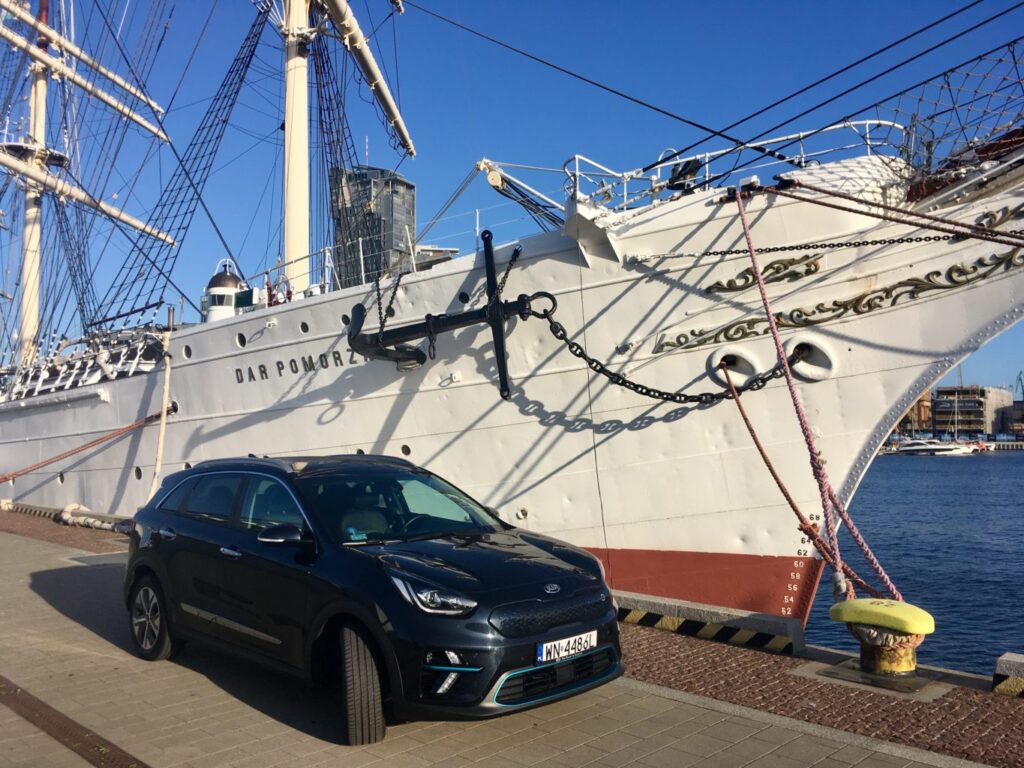
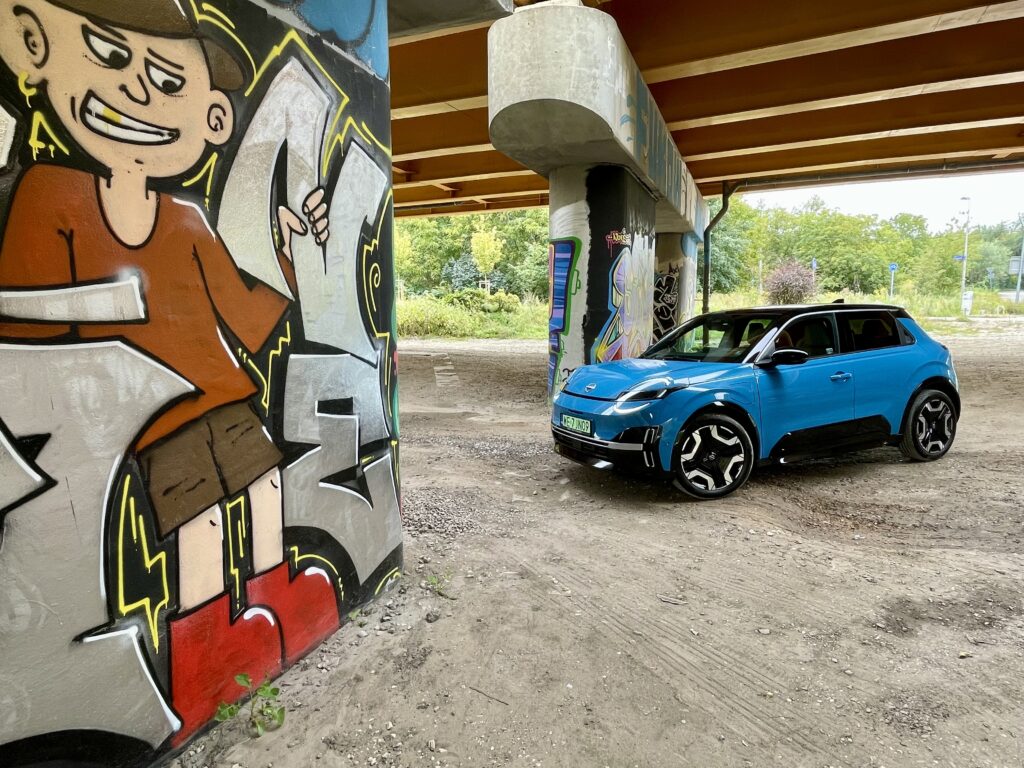
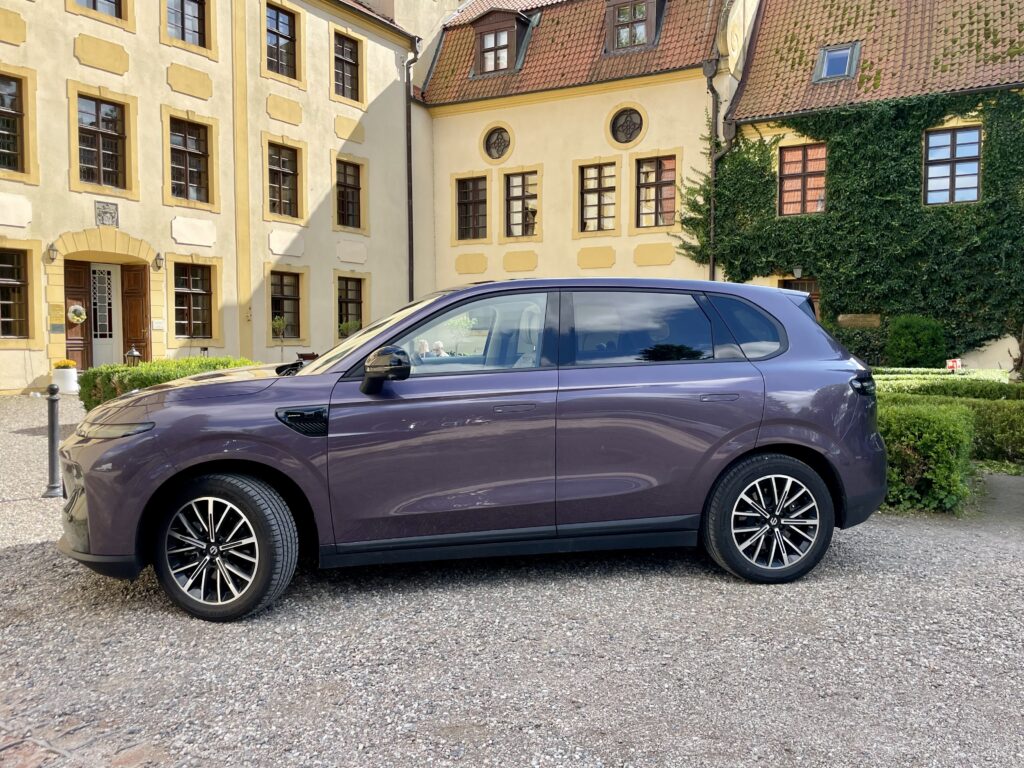
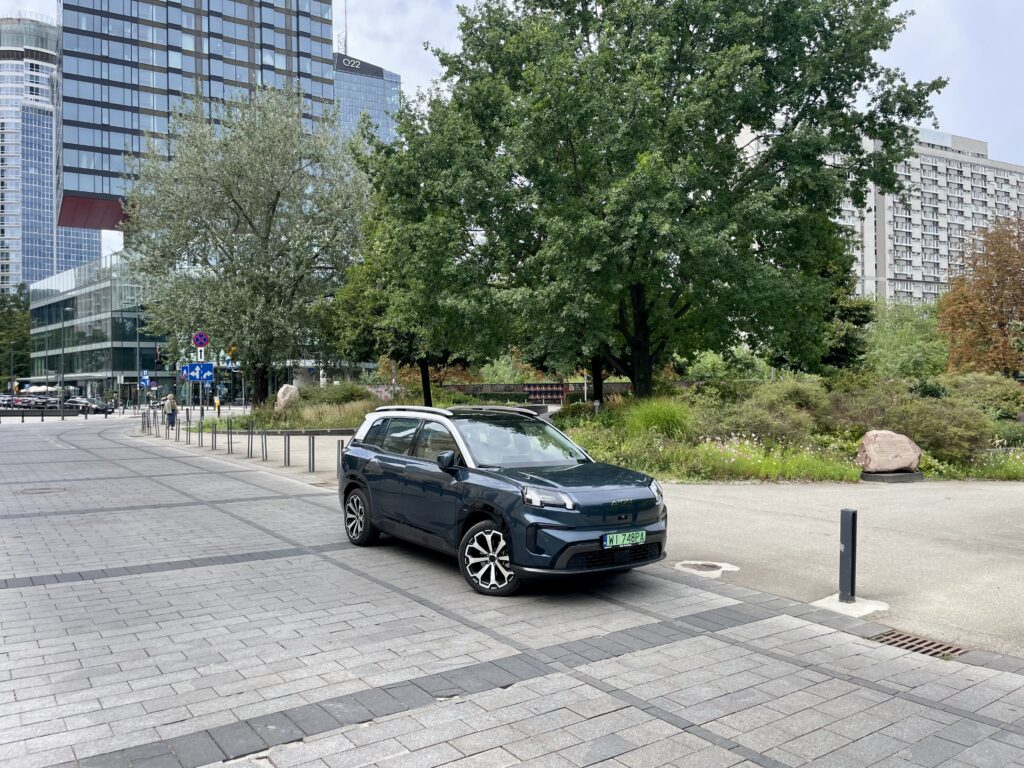
Renault Megane E-Tech - a report from the holiday trail
To the seaside by electric car: 570 km from Warsaw to Kołobrzeg. Google shows 6.5 hours of non-stop driving. The journey took me 1.5 hours longer, mainly because I had to charge the car. But isn't that only a little more than anyone would spend on stops anyway? All the GreenWay chargers worked, and at none of them was I held up by another car charging. Still, my advice is to spend some time planning before the trip, have the right app and drive a little slower. Besides, you need to be prepared for the unexpected, which I experienced too.

Along the A2 and A1: range and energy consumption
I set off from Warsaw at 6:30, with the Google app showing 6.5 hours of non-stop driving in a combustion-engined car. The battery is 100% charged, which the on-board computer converts into a range of 364 km. I remind myself that the homologated range of the Renault Megane E-TECH with the 60 kWh battery is 450 km. Why the difference? I am taking the car over from another driver, and the displayed range depends on previous journeys, driving style and speed. (remember that Renault also offers zero-emission vans - here is my test of the RENAULT KANGOO VAN E-TECH )

Ahead of me is a fairly long stretch of motorway, exactly the kind of road an EV likes least. Speed means air resistance, and add to that the almost complete lack of opportunities to recover energy, and I know the range will drop quickly. An electric car feels most at home in the city: at low speeds air resistance matters less, and every time you brake or pull up at the lights, you recover some of the energy used earlier. The Megane's four-level regenerative braking, adjusted with paddles, lets you match the level of braking to the conditions. At the highest level, which means sharp deceleration, the car itself makes sure the brake lights come on.

I have done my "homework" and I know that - using a combination of the A2 and A1 motorways - after 177 km I will reach the Dwór "Sójki" manor. This is where GreenWay recently installed a charger rated at 200 kW. I am pleased that I will have the chance to test it as one of its first users. On the motorways I have the cruise control set to 120 km/h. It is a compromise between journey time and energy consumption. I glance at the central screen, where the navigation, powered by Google Automotive, shows the estimated battery charge level on arrival. The system is very accurate - as I leave Warsaw, it estimates that I will have 33% battery left when I reach the first charging stop, while in reality it turns out to be 37%. The difference may have been due to driving slightly slower than the system assumed. I arrived at 8:38, not 8:23 (the arrival time predicted when I left the capital). Later it will turn out that the readings on the following stretches are even more accurate. On this stretch the car recorded energy consumption of 21 kWh/100 km - quite a lot, given the homologated figure of about 16 kWh/100 km. Interestingly, when switched to "eco" mode the car warns of under-inflated tyres, while in the other modes the tyre pressure is fine as far as the car is concerned.
First charging stop at Dwór Sójki
Time to start charging at Dwór "Sójki". The charger is very conveniently located by the buildings and the park - just 1.5 km from the A1 motorway exit. While charging, you can have a buffet breakfast, served from 7:00 to 10:00 (35 PLN), or enjoy a good coffee (12 PLN) sitting on the terrace or among the old trees.

The Delta charger can nominally reach 200 kW in DC CCS mode, as the sticker on the unit shows. While charging the Renault Megane, the maximum charging power reached 70 kW. Working out why the charging power was not higher would take further, more in-depth analysis. Perhaps the power was limited on the charger's side (power allocation?), or perhaps the car was unable to accept more power (it was not the final production version, only a "pre-production" model). Finally, it may have been that the computers of both devices, the car and the charger, decided that under the given conditions (battery temperature below the optimum) it was safer to reduce the charging power? Still, 70 kW is a very good result and allows you to top up your energy reserves very quickly. Let us remember that the power drawn from an ordinary socket is 2.3 kW...
When analysing charging speed, you have to take into account the capabilities of the particular charger and the particular car. This applies to both alternating current (AC) and direct current (DC) charging. It often happens that the car "throttles" the current it draws and charges more slowly than the charger's specifications would suggest. The Renault Megane E-TECH will take a maximum of 22 kW AC, which is a very good figure, and 130 kW DC.
During this charging session, the car took on 21 kWh of energy, which took 28 minutes. At exactly 9:11 I was able to continue my journey, with the battery at 80% and a range of 324 km.
Google Automotive and charging in Bydgoszcz

Ahead of me lie 148 km to the "Auchan" shopping centre in Bydgoszcz. Google Automotive, an enhanced version of the well-known Google Maps app, shows additional information that is useful when driving an electric car, such as the battery level on arrival or the locations of charging stations along the route. The system will also suggest specific stations if, after analysing the battery level, it notices that we will not be able to reach our destination. Google Automotive has already been introduced in Volvo (Polestar) vehicles, and is now making its debut at Renault.
The car calculated that the drive would take 1 hour 41 minutes and that I would arrive with the battery at 32%. Instead of 9:52, I arrive at 9:55, and the actual battery level is 30%, so once again the car's readings were very accurate. The 30% corresponded to a range of 109 km, and energy consumption came to 19.6 kWh per 100 km. The lower consumption was helped by the Toruń - Bydgoszcz section, which is not yet an expressway, hence the lower cruising speed. It is worth stressing that the designers of the Megane E-TECH decided to fit the car with a heat pump. This modern approach to managing thermal comfort increases range by 10% on the open road and by 30% in town (at a temperature of -5 degrees).
The half-hour charge is behind me, and now a stop twice as long awaits me. I park the car at 10:56 and, as it turns out, I will unplug it at 11:55. Is that time wasted? I spent it shopping: at the grocery store I buy the provisions I need for my stay, and at the sports shop I stock up on cycling gear. The charger is rated at 50 kW, and the maximum charging rate almost matches the declared figure, at 48 kW. Many GreenWay-branded chargers are located at large shopping centres. Sometimes in outdoor car parks, as in Bydgoszcz, and sometimes on one of the levels of a multi-storey car park.
The toughest stage: from Bydgoszcz to Kołobrzeg
After "filling up" with 33 kWh, I leave the shopping centre car park to tackle the most difficult stage. The only charger is in Piła, but that town was not on the route I had planned. I will be driving through an area with little charging infrastructure. I am reminded of the famous sign ("52 days") in Zagora, Morocco, pointing the way across the Sahara to Timbuktu in Mali, a journey with no chance of replenishing supplies...
The car shows a charge level of 96%, corresponding to a calculated range of 325 km, and I have 251 km to go, which according to Google should take me 4 hours. There are practically no expressway sections along the way, and the narrow road often winds between fields and cuts through villages and small towns.
The drive goes without a hitch, and seeing as I go that the estimated battery level at the end of the route leaves a safe reserve, I decide to skip the GreenWay charger in Koszalin, which I had only treated as a backup, located 40 km before my final destination.
I arrive with the battery showing 13%, which corresponds to a range of 46 km. The car used 19.5 kWh/100 km on this stretch.

Charging stations in Poland and accommodation without a charger
Are 2,300 charging stations for 25,000 EVs enough to make a long journey across Poland comfortable? Both numbers are growing strongly. Each "charging station" has 2-3 "charging points", in other words several cars can charge at the same time. Besides the quantitative changes and the growing number of stations, there are noticeable qualitative changes. Until recently, a 50 kW charger was "the height of luxury", while now they are being replaced with units of, for example, 200 kW. What does this mean? A car can reach the same charge level in a quarter of the time, or in a given amount of time not 1 but 4 cars can be charged.

In Kołobrzeg I stayed at the modern "Koło Brzegu" apartment complex, with a space in the underground car park. As soon as I arrived, I asked the apartment managers about charging the car, and the answer left no room for illusions: "No, we don't have that option here." I don't give up and check what the situation is like in the underground car park where I am parked. I find only one socket, and one that already has some device plugged into it. I plan to stay by the sea for 4 days, during which I won't need the car. Slow charging from an ordinary socket would be the best solution. That kind of electricity is the cheapest and can significantly reduce the - already low - cost of the trip. Estimates show that using the cheapest form of charging, driving 100 km will cost about 12 PLN, roughly the price of 1.5 litres of fuel. The amendment to the "Act on Electromobility and Alternative Fuels" partly solves the problem of the lack of charging points in buildings by specifying in which types of buildings, and in what numbers, they should be available.

Park Hotel Seaside - a charger for guests
But there are holiday places in Poland that have spotted the new trend and the growing number of electric models. They have installed chargers that make life easier for guests driving electric cars, while also building a positive image of a modern, eco-friendly attitude. In Kołobrzeg, one such place is the "Park Hotel Seaside"
While my car charges from a 22 kW AC charger operated by GreenWay, I talk to the hotel's Operations Director. Ewa Maszkało makes no secret of the fact that installing a public charger in the outdoor car park is part of a broader strategy of eco-friendly solutions at the hotel. The hotel, which stands right by the beach and opened 3 years ago, has water filters installed that have made it possible to eliminate bottled water from the rooms. Apart from the public charger, the hotel has several other charging points available only to guests, located in the underground part of the car park. It is worth noting that every car that is charging is exempt from the parking fee. Ewa Maszkało confirms that questions about charging an electric car come up during the booking process and can decide whether a guest confirms their stay. And indeed, as soon as I drive my Renault away from the charger, a Tesla belonging to one of the guests pulls up to it.

The return trip via Człuchów and Bydgoszcz
After a few days' stay, I leave Kołobrzeg and head for Warsaw. When I set off at 7:00 in the morning, the battery is fully charged (99%), which the on-board computer converts into a range of 304 km. Once again I head for Bydgoszcz, but this time to the "Zielone Arkady" shopping centre, where on one of the levels of the covered car park there is a well-signposted three-point charger (CCS, CHAdeMO, Type 2).

The journey goes smoothly, along a route I already know. The only detour is a drive through charming Człuchów, once home to a great castle of the Teutonic Knights that successfully rivalled Malbork. The Renault Megane E-TECH handles very well on winding roads. Like most electric cars, it is "pressed" onto the road by the massive, centrally placed battery, which lowers the car's centre of gravity. It is worth comparing the dimensions of the electric Megane and the French company's combustion-engined car. Despite sharing the same name, they are completely different vehicles, and the version with the conventional engine will be offered for another 2 years. The electric Megane is 16 cm shorter (4.20 m) with a wheelbase of 2.69 m, yet offers more space for passengers (an extra 3.5 cm for those on the rear seat). How is this possible? In electric cars, the front of the body can be made considerably shorter, because the electric motor is smaller and the drive is transmitted without the need for a conventional gearbox.
At 10:51 the car starts charging in Bydgoszcz, while I check out the shopping centre's August promotions. This time I tried to drive more economically, using "eco" mode and making more frequent use of regenerative braking. As a result, I managed to reduce energy consumption slightly (18.4 kWh), which translated into a greater range on arrival: 76 km and 21% charge. For comparison, I finished the route in the opposite direction with 46 km of range and 13% charge. Driving in "eco" mode reduces the responsiveness of the accelerator pedal and the performance of the air conditioning. It also limits the top speed to about 105 km/h, so to overtake more quickly you have to use the "kick down" function to deactivate this limit.

After less than an hour of charging - the session summary I receive from the GreenWay system shows that I took on 36 kWh in 56 minutes - I set off with the battery 95% full, which should let me drive another 311 km. The Megane's battery comes from LG Chem's Polish factory near Wrocław.
The final leg and lessons from the trip
I reach Dwór "Sójki", which I already know well - not least for its excellent coffee - after 1.5 hours of driving, and once again it turns out that Google Automotive is hardly ever wrong: instead of the estimated 43% charge level, I pull up at the charger with 46% still in the battery. After a session that lasted 22 minutes and could be followed live in the "My Renault" mobile app, I set off on the last leg of the route. I topped up the battery to 80%, which corresponds to 253 km of driving, so I head for Warsaw along the A1 and A2 motorways with peace of mind. I reach the city centre after an hour and three quarters, with 80 km of range still left (24% of the battery's capacity).
Looking back on the whole trip from Warsaw to the Polish seaside, a few conclusions can be drawn. Covering more than 1,100 km from the capital to Kołobrzeg and back is worth planning. Thanks to its modern Google Automotive software, the car will show you the nearest chargers, but this information is not complete. Before setting off on a long journey, it is worth knowing the locations of the chargers whose app or card you have. It is worth driving a little slower, because this has a very big impact on the car's range. During stops, we save time by not charging the car "to the full", but only as much as we need to reach the next planned stop, because charging above 80% of the battery's capacity takes a long time. The unpleasant surprise of this trip was the lack of any way to charge the car during a stay of several days at my destination - even modern accommodation still does not offer this. It was encouraging, however, that the number of places aware of these changes keeps growing and that more and more resort hotels offer charging. (if you want to know how I got on driving a Nissan LEAF along the German Alpine Road click this link)