









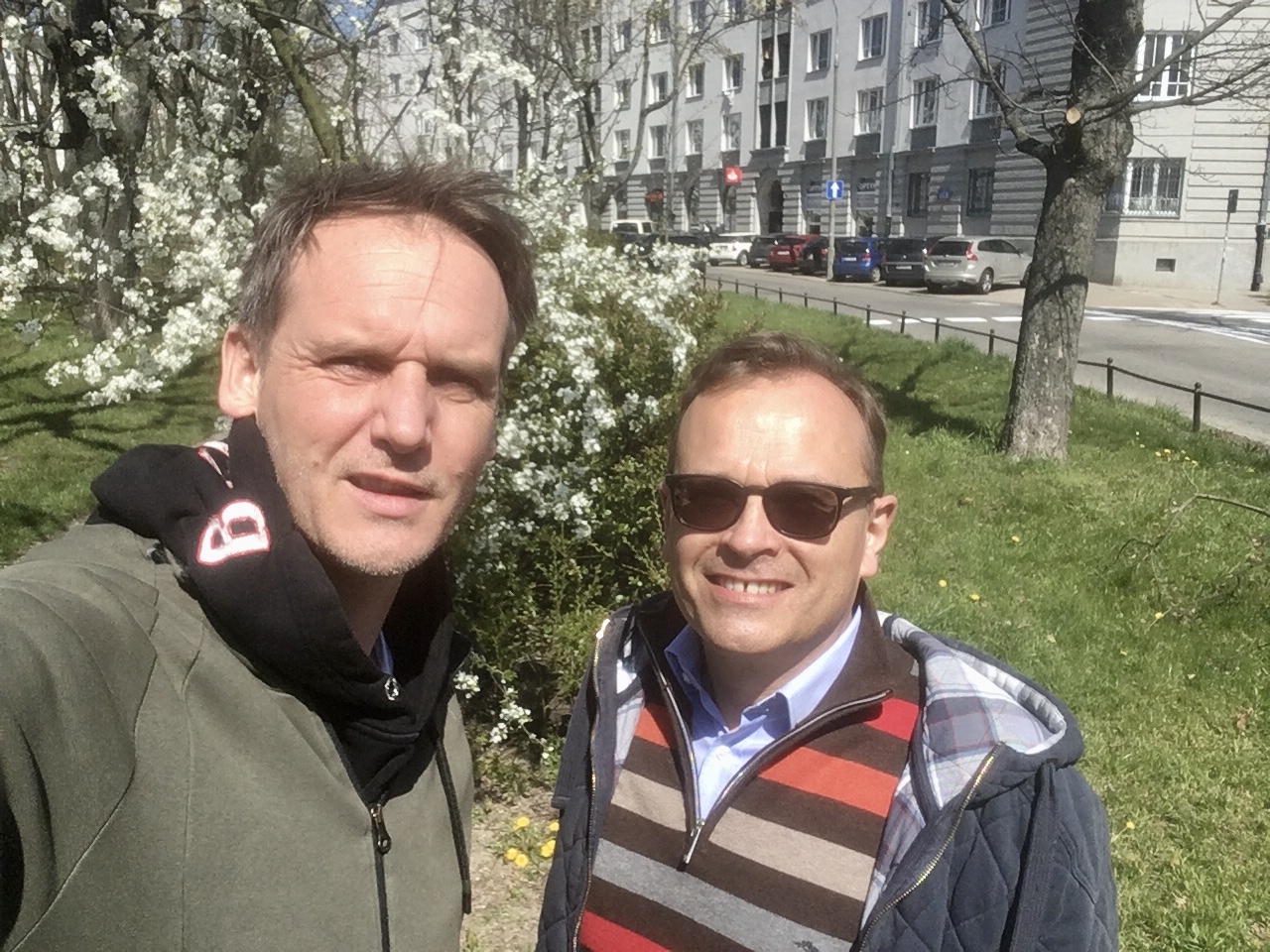
Pascal Brodnicki - travelling through food

Pascal Victor Raymond Brodnicki is a renowned French chef of Polish descent, a TV presenter and the author of cookery books. He learnt to cook at French culinary schools and has worked in many restaurants in the United States and France. He took part in the first series of Azja Express, the Polish edition of the travel reality show Asia Express broadcast on TVN. He runs his own cookery channel on YouTube, where he shares recipes and kitchen tricks.
justKowalski: Do you feel Polish or French?
Pascal Brodnicki: I have spent half my life in France and half in Poland. I feel partly Polish, but my accent suggests I am more French than Polish. Still, I feel at home in Poland. That's for sure!
justKowalski: I once had a boss - an aristocrat with a Belgian passport - who claimed that France is the only country where you can be guaranteed to eat well wherever you end up. Is that true?
Pascal Brodnicki: It is, if you look for places outside the typical tourist areas. I can't say it's true everywhere, but generally speaking most French restaurants maintain a good standard. I'd recommend checking a place on a reliable website such as "Tripadvisor", or following a blog whose author knows what they are talking about and writes about the region or city in question. It's also good to look for places that promote regional food, because every French region has its own specialities. Unfortunately, there are also places aimed solely at tourists; you will pay a lot there, and on top of that they don't use the best recipes or the best produce.

justKowalski: In which country did you have your biggest culinary surprise?
Pascal Brodnicki: Vietnam has an incredible variety of food, with a multitude of flavours and very fresh dishes. You can try all sorts of things that took my taste buds by surprise. Paradoxically, poor countries have very good cuisine. I also have a soft spot for Vietnam because there are quite strong French influences there; for example, you can buy very good baguettes. They also have lots of different kinds of meat. The dishes prepared in the villages are very well made, with lots of spices and lots of vegetables. Speaking of Vietnam, though, I have to mention that dog meat is also eaten there, especially in the areas close to the Chinese border, around Lao Cai. I wasn't tempted to try it, because I'm a dog lover. But I did try alligator, and in neighbouring Laos I ate a squirrel dish and rats. I've had insects and larvae on my plate too. That may shock many people, but it is worth putting it into perspective. Some Poles are still disgusted by the idea of eating prawns, yet they have no problem eating steak tartare, which is, after all, raw meat.
Overall, I can say that my biggest culinary surprises have been in Asia: Cambodia, Vietnam, Thailand, Laos.
justKowalski: And which country do you dream of?
Pascal Brodnicki: I would love to fly to faraway Vanuatu, beyond French Polynesia. The combination of exotic ingredients and the fact that these are volcanic islands produces unexpected results; for example, people there eat bats cooked in water heated by an active volcano. We associate fine, powdery sand with the colour white, but in Vanuatu the beaches are like icing sugar, with the difference that they are black. In Zanzibar the beaches are white because it is a coral island, while in Vanuatu they are black because it is a volcanic island.

justKowalski: Will people go on culinary journeys more often in the future? Trips where the main motive is tasting new dishes, meeting award-winning chefs and visiting famous restaurants or local food producers?
Pascal Brodnicki:Absolutely! When I choose a holiday, I check what people eat in that area. Even when I go skiing and have a choice between Austria and Italy, I'll pick Italy. Because of the food, of course. It really matters to me. I can see how successful agritourism has become; I know it very well in France, but agritourism is flourishing all over Europe. The owners of these places often grow vegetables and fruit and keep some animals. And it's not just Europe. I mentioned Asia, and the culinary travel segment is well developed there too. It's worth putting your culinary experiences into a wider context and asking yourself: where did this dish come from? Perhaps it was influenced by the country having been a colony of another state, or perhaps it is the result of particular trade routes? The flora and fauna surrounding a place matter too. The architecture and the landscape may also be important. And the cuisine will reflect many of these elements. I observe and notice that certain trees grow in particular regions; their wood and leaves are used to build homes, and their fruit is eaten. I try to understand the historical context. Another interesting observation linking nature and food is following the growing seasons. There are many places on earth where crops are harvested several times a year, because the climate allows it. We often don't stop to wonder where tomatoes, chocolate or potatoes came from. We say there is nothing more Polish than potatoes, but we forget that potatoes don't come from our continent.
Let me give you an example from France, which I know well. There is a region there - the Ardèche, not far from Lyon - where bread trees grow; these are chestnut trees. Geographically speaking, you could say it is where Provence begins. The chestnut trees provide timber, and cattle are fed on their leaves or nuts. You could organise a trip with the bread tree as its theme. And Madeira? What an interesting history it has! This Portuguese island lay on the route of the great voyages of discovery; ships returning from the New World brought back seeds of exotic plants. It turned out that they took to Madeira very well, and they still grow there today and form the basis of the local cuisine. And their famous espada fish? It's an absolute must to try it when you are on Madeira. But I had a truly unique experience with it. I took part in fishing for espada, and the fishermen prepared it right there on the boat. It's hard to imagine a fresher dish, made of the fish, garlic, onion and parsley. We see espada as black, but in nature it is blue. It is a deep-sea fish which, because of the change in pressure when it is caught, turns black at the surface. (justKowalski: I wrote about the espada fish here)

justKowalski: So you are a firm believer in trying local dishes, the kind traditionally eaten in a given area?
Pascal Brodnicki: Yes, absolutely! I remember a story from when I was in Morocco. I had found a "last minute" holiday deal, but I only used the flight. Once there, I hired a car and ate outside the hotel. The flight was to Agadir, which is a very touristy place. One day we were having breakfast and I happened to overhear a conversation at the next table. A lady who had come with her daughter was discussing what they could have for lunch, and they decided that pizza would be best. I looked at the menu and saw that it included chicken tagine. I couldn't help myself and joined the conversation, suggesting that they really should try the local dishes, and that tagine is a great example of Moroccan cuisine. I have nothing against pizza, but it's best in Italy. A few days later I met the lady at the airport. She thanked me, because she had let herself be persuaded and had tasted genuinely Moroccan flavours (justKowalski: you will find some inspiration for a trip to Morocco here)
justKowalski: Are you more of a traveller or a tourist?
Pascal Brodnicki: It depends who with, it depends when, it depends where. A backpack and meeting people suit me better, but there have been times when I went on so-called "all inclusive" holidays. That was usually when I travelled with my wife and our child was small. But as I said, I use certain elements of an "all inclusive" package; usually that means a cheap ticket and cheap accommodation, but I hire a car or a scooter and eat where the locals eat.

justKowalski: How do you remember your time on Azja Express?
Pascal Brodnicki: To be honest, I didn't watch the programme after it was edited; I only glanced at a few episodes because my son really wanted to watch me. It's a "reality show"; I experienced the adventure completely differently from what viewers eventually saw. Each episode was filmed over 4 days, often 12 hours a day, and the edited material lasted 23 minutes. For example, I clearly remember one story that is extraordinary to me, but it didn't make it into the broadcast. In Vietnam we were looking for somewhere to sleep, and a family invited us to stay the night in their home. Only the 13-year-old daughter spoke a little English, and she acted as our interpreter. We went to bed late, and on the way to our room we passed her bedroom. The light was still on. When we got up at 6.00, it turned out that the girl had spent the night knitting socks for us. She had also written a letter with her best wishes for us and our families, wishing us health and happiness. Sadly, that story didn't make it into the broadcast. My memories of Vietnam are wonderful; I remember that smile and that openness.
justKowalski: And which countries would you still like to visit?
Pascal Brodnicki: Definitely Vanuatu, which I mentioned earlier, and I also want to go to Australia and Japan, where I have never been. Scandinavia is in my plans too, and I think that may well be my next trip. When I sum up my travels, I have often gone very far away, and there are a few places relatively close by that I would now like to visit. I inherited a camper van from my father and I want to use it, because I like that way of travelling too. Or maybe I'll visit my friend Tomek Tryba, who lives in Tuscany and welcomes lots of guests there https://www.winoispiew.com
justKowalski: Thank you for talking to me, and I hope all your plans come true!


