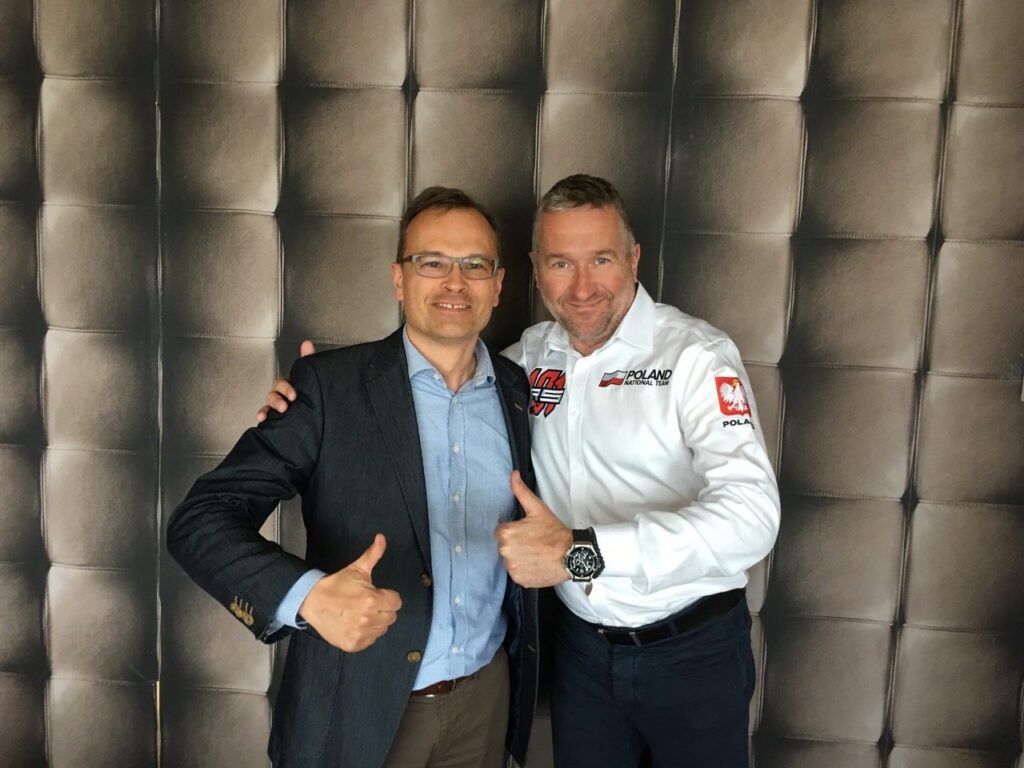
Przemek Saleta - in love with Thailand
justKowalski: You live in Thailand now. How long have you been there?
Przemek Saleta: I have lived in Thailand for 4 years. One of the reasons I left was very mundane: I wanted to escape the Polish winter. On the other hand, I felt close to Thailand because of muay thai. I wanted to learn Thai boxing and get through the winter. So at the turn of November and December I went to Thailand and stayed until the end of February. I fell in love with the country: the climate, the food and a philosophy of life in which people are always smiling won me over.
Ko Samui and the rainy season
justKowalski: You decided to live on Ko Samui. Was that chance or a carefully considered decision?
PS: Ko Samui was recommended to me by Rafał Szlachta, President of the Polish Muay Thai Association. I started working with a local Thai boxing club there. Later I had the chance to compare Ko Samui with other places in Thailand, and it confirmed that I had made the right choice. Ko Samui only began to develop rapidly after the 2004 tsunami, and it is certainly less commercialised and less spoilt than Phuket, not to mention Pattaya. It offers plenty of entertainment, but it also has places where you can simply relax in near solitude. The rainy season there is not a nuisance, and the mountainous interior of the island adds to its charm.
JustKowalski: You mentioned the rainy season. Some people say it is a time when travelling around Thailand is out of the question. What have you observed?
PS: The rainy season is not that much of a nuisance. It is not a constant “wall of rain”, as people think, unless we are talking about northern Thailand, where things are much worse than in the south. On Ko Samui it rains for an hour or half an hour a day, usually in the evening or even at night. In Poland rain goes hand in hand with cold, but on Ko Samui the temperature hardly varies; over the year it ranges between 28 and 32 degrees. What matters more is humidity, a somewhat abstract notion for Poles. High humidity is really uncomfortable.
Thai boxing on Ko Samui and Sak Yant tattoos
justKowalski: I look at you and think boxing, Thai boxing. Can you take up Thai boxing on Ko Samui?
PS: Absolutely. I run a project called Saleta Life Camp. We organise camps for groups of 10 to 20 people. You can also come for an individually arranged week-long stay. It is not only about getting to know Thai boxing and improving your general fitness, but also about exploring the island, doing self-development training, diving and cooking Thai food. What matters to me is that participants look at their lives differently and perhaps slow down a little.
justKowalski: And the tattoos? You have a lot of them. What do they mean to you?
PS: In Thailand tattoos have a special meaning. Some of them are the so-called Sak Yant, sacred tattoos made by Buddhist monks, which are regarded as a kind of amulet that can bring health, prosperity and perseverance in the struggles of everyday life. That is why each one is a little different, tailored to the individual and to the kind of support they are looking for. The whole process of preparing a tattoo takes around 6 hours, of which actually applying it to the body takes only 45 minutes. The monk decides what the tattoo will look like after getting to know the person better and meditating together. There are also elements of numerology in the whole process.
Buddhism, Thai food and tourism
justKowalski: And Buddhism. How does it affect the everyday life of Thais?
PS: A Buddhist knows that he cannot change the past and has little influence over the future, so what counts is today. The sum of a person's deeds in this life defines our future life. Material things should not matter so much; what is more important is what you see and what you experience.
justKowalski: When we are in Thailand, we rave about Thai food. Do you know it well?
PS: I even decided to take cookery courses to learn more about how the dishes are prepared. In Thailand it is assumed that food cannot be stored, and fridges are never full of ready meals. In the past there were no fridges, and the hot climate meant that food was always prepared for a specific number of hungry people. That has remained to this day. Nothing goes to waste. The food is very healthy because of the large amount of vegetables and fruit, which keep their nutritional value because they are only blanched.
justKowalski: Thais have come to the end of the period of mourning after the King's death. Will Thailand be different under the new reign?
PS: I do not think the country will change because of a change of monarch, even though Thais were deeply affected by the King's death and his recent funeral. What I see are changes brought about by tourism. There are already places in Thailand that are best avoided; I mentioned Pattaya. I felt the same on Ko Phi Phi, where there are simply too many tourists now. Thais who are in contact with tourists are changing and starting to chase money more. I think politics has little influence on how that society behaves. There was a period of unrest in the country, and a curfew was even imposed, but after a few days it existed only on paper and the bars stayed open late into the night.
justKowalski: All the best, both in Thailand and in Poland!