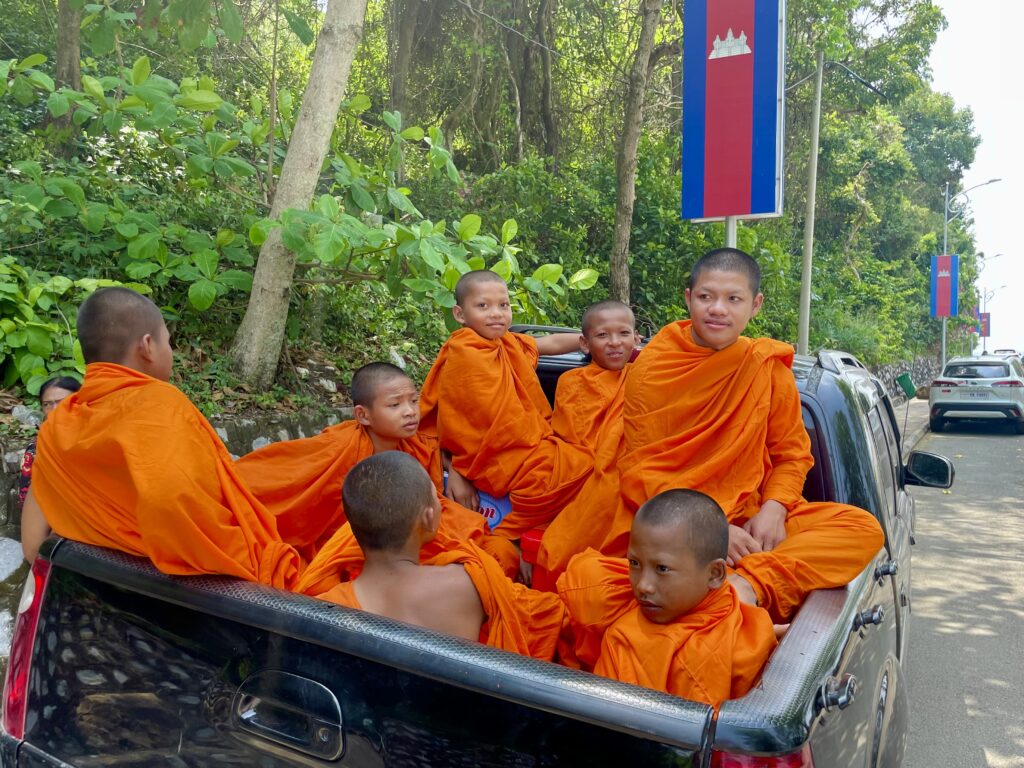
Phnom Penh - sights of Cambodia's capital
Many people considering a trip to Cambodia turn their thoughts to Siem Reap and the temples of Angkor Wat. The ruins of an ancient civilisation rightly deserve admiration and can be a destination in themselves. But Cambodia has much more to offer - for a start, it is worth visiting the country's capital, Phnom Penh. The city is changing at a dizzying pace while taking care to preserve its precious traditions.
Phnom Penh is a noisy, vibrant city that bears little resemblance to its former self. There are skyscrapers and chaotic traffic. Trade flourishes on the pavements, and elegant cafés have settled into post-colonial buildings along the river. There, on the riverside promenade, young people and tourists stroll in the evenings. Here and there you can hear music, and the lazily flowing river is brightened by colourful boats offering cruises at various times of the day and night. The smaller streets of the centre are full of lively bars with tables spilling out onto the street.
Lady Penh's Hill and the Royal Palace

The founding of Cambodia's capital, Phnom Penh, is tied to a legend about a flood that struck the area centuries ago. When the waters receded, the land had to be cleared. Among the fallen trees blocking the outflow of water, statues of the Buddha were found. Since this happened on land belonging to Lady Penh, she decided it was a sign that a city should be founded on the hill. The city was named Phnom Penh, meaning “Lady Penh's Hill”. Today the hill is crowned by two temples full of colour, sculptures, incense sticks and offerings. The lower one is visited by the Chinese community, while the one at the top has a national character. Inside is a statue of the smiling Lady Penh.

A visit to the Royal Palace grounds is a must when you are in the Cambodian capital. Here you can learn about the history of the kingdom and see several interesting buildings. Right at the entrance you are greeted by an unusual tree, the so-called “Buddha tree” (Pentacme siamensis), which has beautiful flowers on long shoots. It has a special status in Khmer society - a toast with an infusion of this plant accompanies celebrations of the news that a baby is on the way. Visitors can see the Throne Hall, but the smaller building next to it often escapes their attention. It has an added platform that the king used to mount his elephant during important ceremonies. Another intriguing building is a grey pavilion given to the king by the French (Cambodia was their colony until 1953).

Napoleon III exhibited this pavilion at the opening of the Suez Canal in 1869. It was then dismantled, shipped to Phnom Penh and rebuilt. Almost nobody in the palace grounds notices a small mound densely covered with vegetation. It turns out that, according to ancient beliefs, royal residences had to stand “on a hill”. The ground in the capital is as flat as a table, so a mound was built to stay true to tradition. The current king, Sihamoni, is a bachelor and at 70 can no longer count on marriage and children. His successor will therefore be chosen by the Royal Council, made up of 9 people from the 2 most distinguished families.
Champey Academy of Art and cyclo rickshaws

Despite extremely rapid development, in many parts of the city you can see the care taken over tradition. It is worth visiting the Champey Academy of Art, a cultural centre supported by foundations and donations. Here children and young people aged 5-22 can practise traditional dance and drawing. In dance, gestures are extremely important - hand movements can represent the successive stages of a plant's growth. This “code” will be incomprehensible to us, but on site you will be given a verbal explanation of how to read the gestures. It is worth buying a small item in the shop there - the proceeds go to support Cambodian young people.
Another example of nurturing tradition is the drive to bring back the local “cyclo” rickshaws, whose history goes back to the 1930s. The drivers who did this work always came from the lowest social classes. Usually, when they arrived in the Cambodian capital from the provinces, they were readily hired, because the job required brawn rather than professional qualifications.

That has remained the case to this day, and companies organising rides for tourists, such as Asian Trails, see a wider purpose in such initiatives. It is not only an interesting way to vary your sightseeing in Phnom Penh, but also a way of helping those who, through hard work, are reviving the traditions of years gone by.
The Khmer Rouge - S-21 prison and the Killing Fields

Cambodia has some very dark chapters in its history, from the time when the Khmer Rouge came to power - and that was quite recently, in 1975-79. They represented communism in its most radical form. City dwellers were displaced en masse and rural collectives were created. The cities emptied, and rural society was divided into groups - children were looked after not by their parents but by the elderly, that is, those no longer fit to work. As a result, child mortality was enormous, and adults died en masse from hunger and exhaustion. The S-21 facility is a former school converted into a prison and torture centre. Statistics and accounts indicate that of around 20,000 people imprisoned here, only 7 survived. They are the ones who wrote memoirs, which you can buy from them in person at S-21, also known as Tuol Sleng (there were as many as 196 such execution sites in Cambodia)

The Killing Fields on the outskirts of Phnom Penh are one of the places where people persecuted by the Khmer Rouge met their end. Anyone could be counted among the “class enemies”; often a city accent or wearing glasses was enough. What is shocking is that many of the Khmer Rouge leaders were well-educated people, some of them in Paris, but fictitious biographies were created for them for propaganda purposes. They were actors playing out a bloody spectacle. The backbone of the repressive apparatus was made up of the poorest, often minors. They were the executioners and guards, and after a few months they themselves could become victims. Many mass graves were discovered at the Killing Fields. The recovered remains have been gathered in a special building, and it is customary to lay a symbolic flower in memory of the victims. In one of the graves, the bodies of 166 soldiers of Pol Pot (the Khmer Rouge leader) were found. They were thought to have been heroes who opposed the policy of genocide. It turned out, however, that they fully supported the regime but showed a certain pragmatism, arguing that a few more years of such terror would wipe out the entire nation and leave no one to work (around 3 million people died in 4 years). For wanting to “optimise” the extermination, they were killed.
The National Museum, Psar Thmei and a Mekong cruise
It is worth visiting the National Museum of Cambodia in Phnom Penh. The building itself is beautiful, and its patio is full of tropical plants. The exhibits illustrate well the centuries of Khmer presence in South-East Asia. Some date back as far as the 4th century, many to the 9th-10th centuries and later. A fragment of a statue of the reclining god Vishnu has survived. Take a look at the fragment of stone cornice displayed next to it. Only then do you realise how enormous this statue was (it was found at Angkor Wat in 1936). The craftsmanship of the details carved in stone is breathtaking.

Phnom Penh has several markets, but the best one to visit is the Central Market, Psar Thmei. Why? Because the 1937 building - and especially its roof - was designed by the French to provide excellent ventilation and cooling. The Art Deco building was recently renovated and will probably serve for many years to come. Among the goods of every kind sold inside, your eye will surely be caught by stalls selling nutritious insects, ready to eat.

A boat trip on the tributaries and backwaters of the Mekong and Tonle Sap rivers is an interesting addition to a stay in the Cambodian capital. There are different boats and different cruise themes. You can sail during the day, to watch the sunset, or after dark. Only from the water do you see the effect of the investment boom the Cambodian capital is experiencing. Ten years ago the tallest building had 5 storeys; today there are dozens of high-rises. During the cruise you sail up to an artificial island that glitters with the lights of skyscrapers and lures you with a copy of the Paris Arc de Triomphe. Among the newly built skyscrapers, one stands out for its progressive architecture: the one that houses the “Fairfield by Marriott” hotel. With more than 40 floors, the hotel offers exceptional views of the city below. Its open-air “infinity” pool and fitness centre are on the 28th floor.

Getting to Phnom Penh and travelling around Cambodia
Phnom Penh does not have a large airport, and most good-value connections involve a change in Bangkok. The city is well connected to the rest of the country. To the south - where Cambodia's sandy beaches and gorgeous islands are - you drive along a comfortable motorway. There is also a train, whose route runs through the mountains. A clear boon for travellers around the kingdom will be the (already announced) launch of domestic flights by Air Asia. They will serve 3 domestic airports: Phnom Penh, Sihanoukville and Siem Reap.
I also recommend my articles about Laos, which you will find here: LAOS - A PRACTICAL GUIDE and here: THE TOP SIGHTS OF LAOS IN A WEEK
Practical tips on planning and making a trip to Cambodia can be found here. Thanks to the Asia experts at Asian Trails and their Polish representative, Polhotrep, for their help in organising the trip.