Singapore's 5 greatest attractions
Singapore is a phenomenon on a global scale, an ethnic and cultural collage, a city-state where people of different races and cultures live together in harmony in a small space. The Lion City, as it is known, is home to many communities. The most important are the Chinese, the Malays and the Indians. Things get a little more complicated when you look at how many languages the residents use: there are as many as 7 main ones. On top of that, there are at least 5 distinct religions.

Anyone who likes places where every block can mean finding yourself among different people, different colours and different smells should definitely visit Singapore. Besides, it is a clean and safe city, and apart from its own appeal it is a great stopover point for other countries in South-East Asia.
The main attractions? Below is my subjective pick of Singapore's 5 greatest attractions:
1. Gardens by the Bay

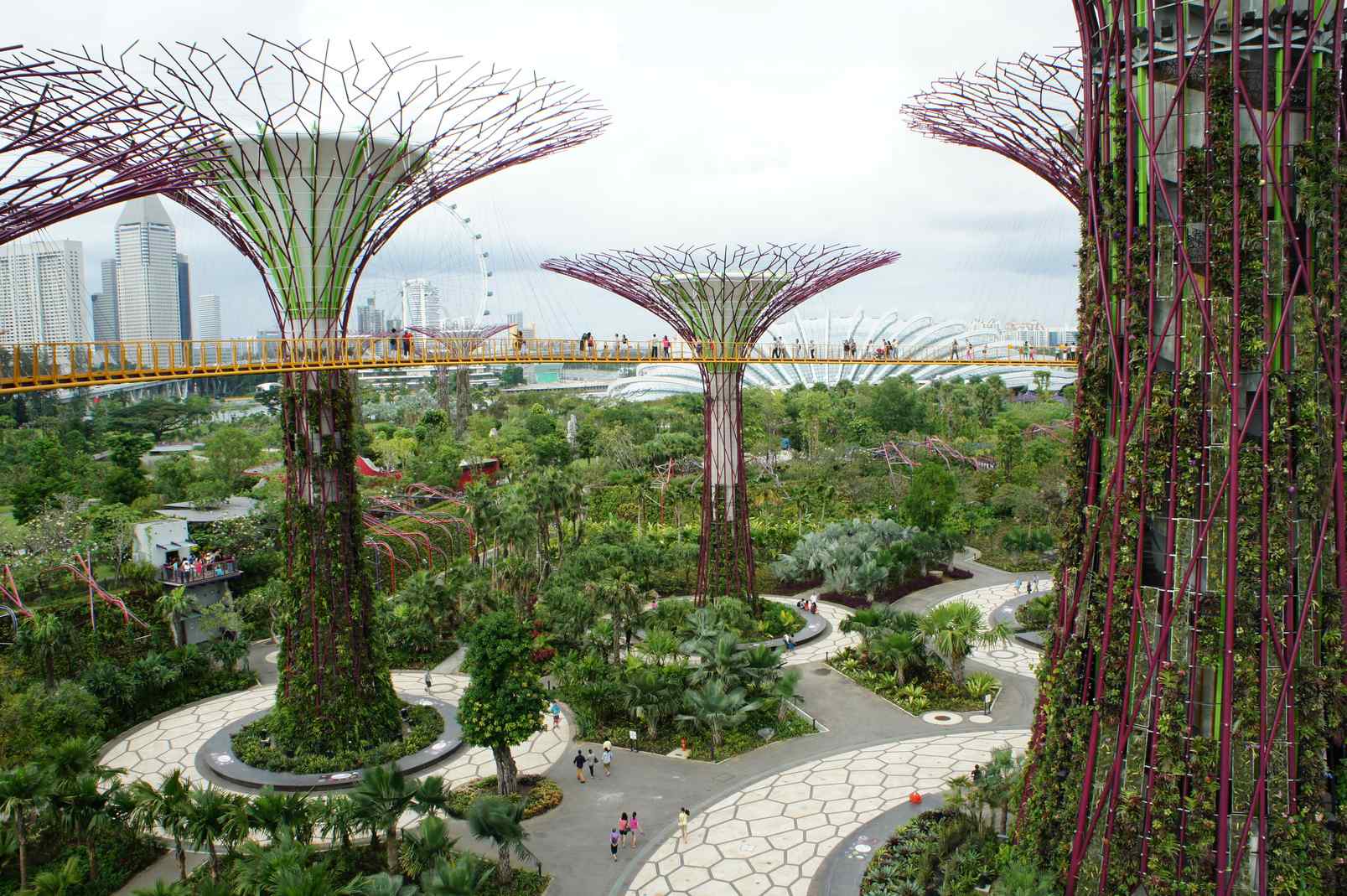
This is a relatively new project: following an international competition, the design for these unusual gardens was built in 2012 on land reclaimed from the sea. You can get there easily via a suspended walkway through another icon of Singapore's skyline, the Marina Bay Sands hotel. To say that Gardens by the Bay is a 100-hectare botanical garden is to say far too little. Of course, there are huge, futuristic glasshouses where you can see plants from all over the world. Outdoors, the vegetation is also incredibly lush, which is no surprise given Singapore's climate. The whole site is criss-crossed by flowing streams that run into artificial lakes. But the biggest attraction is the monstrous Supertrees. These are special openwork metal structures that look like symmetrical trees with outspread branches. They are gigantic and completely covered in plants growing at different levels. A suspended walkway runs among the treetops, letting you look out over the area from a height of 22 metres. In the evening, after dark, the Supertrees light up and take part in a big sound and light show.
A ticket for the skywalk costs 5 Singapore dollars, and to enter the air-conditioned glasshouses you pay 28 SGD. Children under 12 get discounts. Walking around the gardens is free.
2. A night boat cruise

Singapore's skyline, seen at night from the river and the bay, is one of the most spectacular in the world and can rival those of Hong Kong, New York and Shanghai. The boat starts its cruise on the relatively narrow river in the city centre and soon sails out into the waters of the bay. The illuminated skyscrapers and futuristic architecture are impressive. On one side you see a forest of high-rises and a promenade whose centrepiece is a huge lion statue. Bathed in light, the beast spouts hectolitres of water, reminding you that it is the one in charge here. After all, this is the Lion City. On the other side of the bay you see the distinctive silhouette of the Marina Bay Sands hotel. It is not just a hotel but a shopping and conference centre, a cluster of exclusive restaurants, a museum, two theatres and... an ice rink. What catches the eye, and sets this development apart from any other in the world, is the monstrous pool shaped like a rounded spaceship, parked on top of the three hotel towers. It is 150 metres long and designed as an infinity pool; in other words, it has no visible edges and the water flows freely over the side, giving the impression of tumbling into the abyss. An architecturally very refined building is the ArtScience Museum, shaped like a huge lotus flower.
A combo ticket covering the boat cruise and the hop-on/hop-off buses costs 27 SGD. I strongly recommend this option, as it is valid for 24 hours and the buses run on several themed routes. Just remember to make sure you take the boat cruise after dark, because that is when the city is at its most impressive.
3. The Hindu Sri Mariamman Temple

There are many places of worship in Singapore: mosques, Christian churches and Buddhist temples. It is worth seeing at least a few of them, such as the Abdul Gaffoor Mosque or the Malabar Mosque, a little way from the centre. You won't be disappointed by a visit to the Buddha Tooth Relic Temple either.
Sri Mariamman, however, is special: its architecture is captivating and its location surprising. This oldest Hindu temple is not in Little India but right in the middle of... Chinatown (get off at Chinatown metro station). It creates an extraordinary contrast with its Chinese surroundings. It is more than a place of worship; it is the centre of life for the whole community, with its own holidays and festivals. Built in 1827, it stands out with its vivid colours and rich decoration. The exterior is made up of distinctive structures: pyramids filled with sculptures and figures of gods and heroes from Hindu mythology. The entrance tower is also very spectacular, with each tier slightly smaller than the one below. To emphasise the perspective, the scale of the precisely carved sculptures changes too.
4. Colonial architecture

The British left behind an impressive legacy of majestic 19th-century buildings from the era when they ruled Singapore. The heart of the colonial district is the Padang. Here you will find the Cricket Club building and the Supreme Court. Nearby are the concert hall and Parliament, as well as two hotels: the Fullerton and the Raffles. The former underwent a thorough renovation at the turn of the 21st century; perhaps one reason for it was the discovery that the venerable rooms of the Ministry of Finance turned into an illegal gambling club at night. And so, since 2001, it has been welcoming guests to its luxurious interiors. Its façade, lit up at night, looks beautiful from the cruise boat. The second hotel, the Raffles, is even more impressive. Renovated for the astronomical sum of 140 million Singapore dollars, it is a beautiful, opulent colonial-style palace. You can visit the interiors, and we happened to arrive during a concert of Christmas carols, which may explain our great fondness for the place.
5. Food

It is estimated that there are at least 6,000 places to eat in Singapore. In the ethnic districts whole streets have been turned into eateries. You can choose not only Chinese, Indian, Malay or European cuisine, but also dishes that combine many culinary threads. A love of cooking and eating together unites the people of Singapore. For them, food is much more than just satisfying hunger; it is an activity that forms part of their identity and a thread that links different cultures. Cooks experiment with dishes: a Chinese chef will often season his food the Malay way, and an Indian restaurateur will use Chinese ingredients. Such mosaic dishes are becoming characteristic of Singapore's cultural melting pot and are now promoted as the country's intangible heritage.

Although in size Singapore is a city rather than a country, it is well worth a visit. It is a melting pot of different cultures and people with many different roots. It is a good place for both adults and children. Safe and full of attractions. We were there in December, so we could also enjoy the Christmas decorations on the main streets.