A Brazilian mix: Rio de Janeiro, Paraty and Ilha Grande
Rio de Janeiro is a vibrant metropolis with stunning views and iconic beaches. A stay in the "January River" can be combined with exploring the colonial town of Paraty and relaxing on the wild and beautiful island of Ilha Grande. A mix like this guarantees a wealth of very different experiences.

Rio de Janeiro
Why is Rio de Janeiro the "January River"? Because the Portuguese sailor who discovered it in 1500 mistook the bay for a river, and it all happened in January. A resident of Rio is a "carioca", and in an indigenous language carioca means "the white people's town". These days they are rarely white, and it is hard to say which skin colour predominates. Some are "European" white, others "African" black. A true racial melting pot. A turbulent history, the eclectic architecture of the centre, poverty and wealth, opulence and fear for your own safety: you can find or experience all of this in Rio. At the beginning of the 19th century the city was the capital of the entire Kingdom of Portugal, and today it competes with São Paulo for the title of the country's number one. People usually either love it or hate it; there is rarely anything in between. This is a city that inspires. The animated "Rio", the tragic "City of God", the mysterious Karioka from the Polish cult TV series "Stawiam na Tolka Banana", and Michael Jackson's high-energy music video shot in one of the local favelas. Carnival, crime and the joy of life. Rio gets under your skin.....

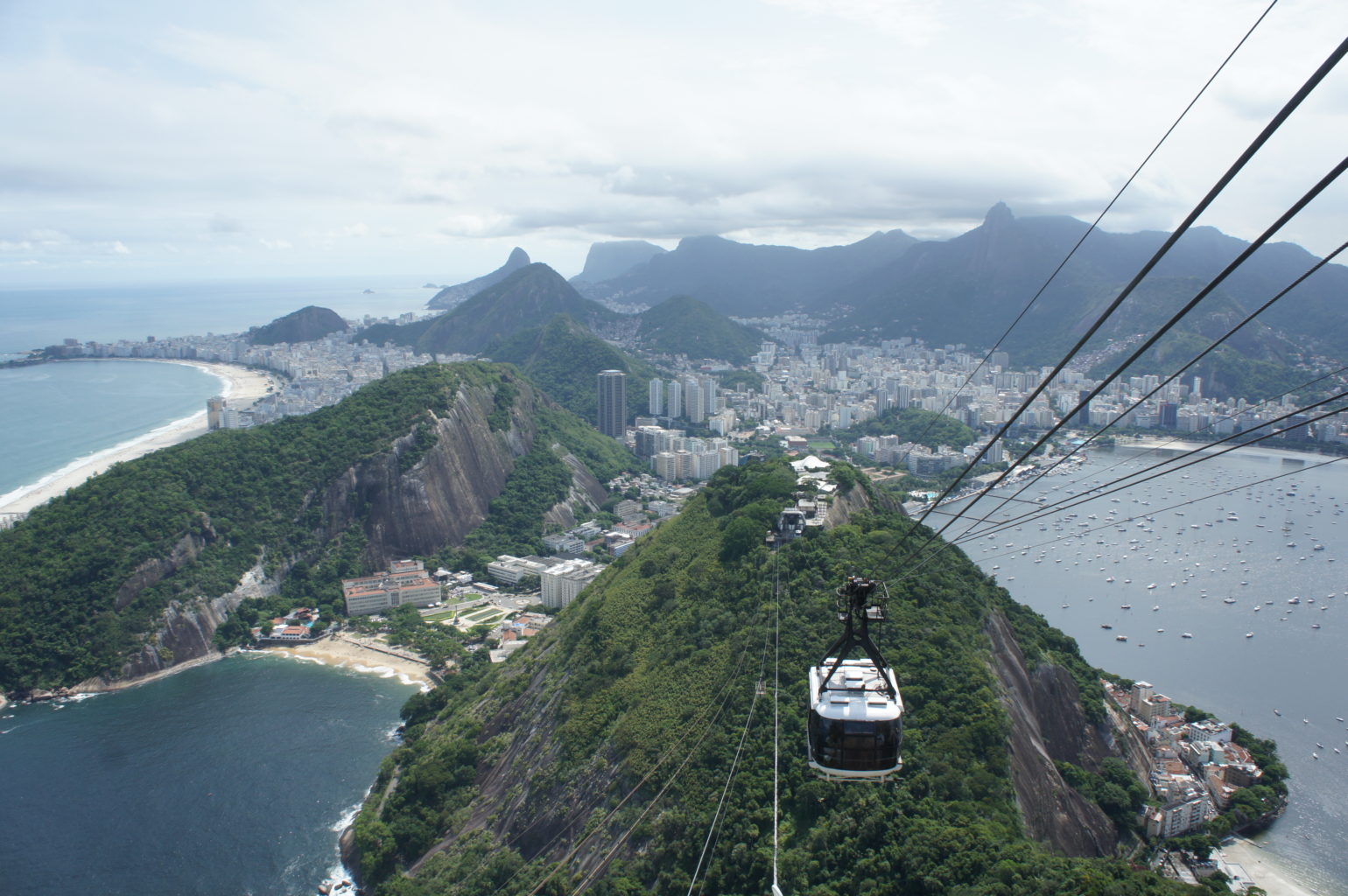
Rio's beaches - Copacabana or Ipanema? Which is better? It is a bit like arguing whether Easter is better than Christmas. Many people believe that Ipanema is more elegant and therefore more worth visiting, while Copacabana is plebeian. I don't share that view. Copacabana is more varied and there is more going on. It is closed off on the left by hills, among which you will spot the famous Sugarloaf Mountain. The front row of buildings is often made up of hotels, whereas on Ipanema these are usually apartment blocks. Among the hotels on Copacabana is the most famous of them all - the "Copacabana Palace" from 1923. So which beach should you choose? Ideally both, especially as a kind of "link" between the two is a headland whose edges have become the favourite spot of weather-beaten fishermen. There, in the shade of the trees, they moor their traditional boats and untangle their nets.

Looking down on Rio from above is a must. Should you go up Sugarloaf Mountain or to the statue of Christ on Corcovado? Which is the better choice? You have to visit Christ, but Sugarloaf is more interesting.....It has better views, and the journey is an attraction in itself: you ride up in cable car gondolas, admiring gorgeous views first on the left, then on the right. To reach the statue of Christ you take a rack railway (a little like the Gubałówka funicular in Zakopane) through dense forest. The world-famous 30-metre statue of Christ with outstretched arms was built in 1931 to mark the centenary of Brazil's independence. The "hunchbacked" Corcovado mountain on which it stands is 730 metres high. Its rival, Sugarloaf, is somewhat lower at 396 metres, but the views from the top are simply breathtaking. Once you come back down, it is worth taking a walk along Guanabara Bay, where houses clinging to the rocks amid lush vegetation make up the Urca district. Don't forget to visit the cult bar of the same name. We ate the fish dishes and seafood we ordered there outside, watching the ships sailing across the bay.

Opinions differ on visiting Rio's favelas. The favelas, often called "slums", are partly lawless places, run by the local community but also by gangs. Some people are afraid to go there, while others think it immoral to gawk at poverty. Wealthy residents of Rio will certainly advise you against a favela tour. On the other hand, they have no problem with favela residents being their nannies, caretakers, cleaners and cooks. They open their doors to them, yet at the same time they are afraid to spend time in that community.

Rocinha is one of the notorious districts of Rio. Clusters of houses, often cobbled together from whatever was to hand, cover the hillsides. The tour, which lasts a few hours, usually starts with a hotel pick-up. A minibus carries about a dozen people and the local guide accompanying them. The 3-hour trip begins with a drive up to the highest part of the district, followed by a walk down narrow, steep and winding "pavements", with several stops along the way. We called in at a modern art studio, a local bakery, a craft centre and a nursery school, where the kids put on a show of energetic dancing for us.

You must follow your guide's instructions to the letter; taking photos where quarters controlled by rival gangs meet is absolutely forbidden. Slogans and symbols sprayed on the walls, known to insiders, tell you which boss is in charge here. You can see people carrying guns; after a brief improvement, things are bad in the favelas again. I advise against going on your own - it is better to go with a guide. The cost? 100 reais per adult, and children under 10 join the tour free of charge.

Central Rio is astonishing. It is not a pretty part of the city, but it is definitely worth seeing. You will come across squares where a centuries-old church stands next to an ageing skyscraper, with a fountain, a few homeless people, a market and a handful of shops selling all sorts of odds and ends. Don't miss the cathedral (Catedral Metropolitana de São Sebastião), a pyramid of greyed concrete. From a distance it looks off-putting, but the closer you get, the better it becomes. The huge main entrance doors are decorated with bronze reliefs, and the interior is adorned with 4 enormous stained-glass windows. In the city centre, don't miss the old Portuguese library, the Real Gabinete Português de Leitura. To say that it holds a rich collection of books is an understatement. Heavy brown shelves of solid wood sag under the weight of many hundreds of old volumes. In the hall stand massive tables for reading historical works. The whole place is very impressive.

It is worth looking into one of the clubs in the very heart of the city. Even if nightlife isn't really your thing, spend a few moments taking in the eclectic decor of one of them. Perhaps the best one to visit is Rio Scenarium at Rua do Lavradio 20. An old 19th-century house is home to a multi-level complex of bars with several dance floors. It is ranked among the 10 most important clubs in the world. The interior is decorated with dolls, clocks, colonial furniture, mirrors and other antiques. The old wooden stairs creak, and people gather around the central stairwell, from which you can watch what is going on on the other levels.

While in Rio, it is worth setting aside a few hours to take the tram up the hill to the Santa Teresa district. The route starts in the Lapa district, right next to the aqueduct (Arcos da Lapa). It once supplied water to 16 city fountains, and later a sightseeing tram line was laid along it. A few years ago a tram derailed and the service was suspended, but it is now running again, and it is definitely worth riding it up to the top of the charming Santa Teresa district, a favourite of many artists and writers.
Ilha Grande
Ilha Grande is Brazil's third-largest island. To get there, you leave Rio and drive south along the coast for 1.5 hours, then take a boat for about another half an hour from the ferry pier at Conceição de Jacareí. The island was once a pirates' hideout, and later, until 1994, a prison cut off from the world, with its only port at Abraão. The prison was then closed and blown up, and Abraão remained the only place served by regular ferries. Other very charming beaches, cabins and guesthouses are reached by small boats that run only when needed.

There are practically no roads on the island, and only 4 vehicles: a police car, an ambulance, a fire engine and a bus that takes students from the port to a branch campus of a university from Rio. If you want to explore the island, you can do so only on foot, along narrow paths through the jungle, or by boat, hopping from beach to beach. The route around the island is 30 km long and takes a whole day. I stayed at the idyllic Cabanas Paraiso: a few simple cabins, a shared shower and toilet block, a little restaurant and a completely private beach. All surrounded by jungle and rocks. Bear in mind that the island is more expensive than the mainland: a large bottle of water costs 10 reais, a 0.5-litre beer 16 reais and a caipirinha 15 reais.

When you want a good meal in the port of Abraão, remember that in Brazil menu prices are usually for a portion for 2 people. As it was logically explained to me, it is easier for the cook to prepare a bigger portion of "the same" than "something different" twice. The price of a single portion is 60% of the price for two. You can usually pay by credit card.
How do you get back to Rio? I got the boat from the resort's beach for free, and then an "Uber" from the pier to my hotel door for 300 reais (my driver was Ronaldo.gente.fina@hotmail.com). Adverts in Abraão offered transfers for 110 reais per person (boat + bus to Rio), while the bus alone cost 85 reais per person.

Paraty
Paraty is a jewel of the colonial era, with perfectly preserved architecture and street layout. The best way to get here from Rio is by bus, which covers the route in 4 hours and ends its journey at a bus station 500 metres from the historic centre. The town is beautifully situated by the sea, with forests as its backdrop and mountain ranges in the distance. In the evenings it is full of people, music, dancing and capoeira displays. At dawn it is quiet and mysterious. That is when you can try to capture the atmosphere of bygone times and imagine the clatter of hooves, the sailors' chatter and the bustle of great sailing ships being unloaded.

One of the anecdotes about the town says that the stones used to pave its streets were ballast on the ships that came here. They were left behind because gold was loaded in their place, in a 1:1 ratio. Paraty was indeed an important port for shipping this precious metal from America to Europe. This was the end of a 40-day trail from the gold mines in the interior. But in 1710 a new, much shorter route was established from the mining areas to the coast. The trail was shortened by as much as 15 days, and Paraty collapsed almost overnight. The merchants moved away and ships stopped calling at the port. A side effect of such a sudden change was that the town survived in exactly the form in which it had been built all those years before. In fact, it was only in 1970 that it could once again be reached by a new paved road along the coast, and the colonial town was rediscovered as a tourist attraction. It has many white-fronted churches and tile-roofed houses. Between them are small squares and soaring palm trees.

In the evenings, capoeira clubs in Paraty put on displays. Teenagers and children "dance" in pairs. But is it a dance, or a dramatised, theatrical fight? Capoeira is believed to have been created so as to contain many elements useful in martial arts. In the 18th and 19th centuries, slaves acquired attacking and self-defence skills while dancing. It is full of acrobatic moves and feinted kicks and sweeps. An opponent's blows are very rarely blocked; instead there is a whole range of dodges.

Rio de Janeiro, combined with Paraty and Ilha Grande, makes a unique mix and a condensed overview of what Brazil has to offer. You will experience a vibrant, beautifully situated metropolis with beaches where you can sunbathe and enjoy the sea. The very well-preserved colonial town of Paraty fills with people in the evenings, and then in the morning, in its sleepy lethargy, you can explore it as if travelling back in time. The wild and beautiful island of Ilha Grande completes the picture.
But Brazil is not just Rio, Paraty or Ilha Grande.... Read about the mighty Iguazu Falls here and the magical Amazon here