The mysterious emirate of Sharjah
Sharjah is one of the 7 emirates that make up the United Arab Emirates, and one of the least known. The authorities of Sharjah (Szardża in Polish) hope this will soon change. The emirate is promoting itself as a holiday destination with plenty of assets: sunshine when it is cold back home, 20 museums, centres caring for endangered species and places where you can get to know authentic Arab culture. Add to that a warm sea, mangrove forests and the desert. Of course, there are also theme parks, shopping centres and affordable hotels. All of this within easy reach of Dubai airport.
Arab traditions
Sharjah cherishes places where you can experience traditional aspects of Arab life. I had the chance to visit a genuine, wealthy Arab home, which is not easy to do in the Emirates. Fatima's house is in Khorfakkan on the east coast, on the Gulf of Oman. From the outside it is unremarkable, like many similar houses, with few windows and architecture that seems designed to discourage anyone from paying it any attention. Inside, it is full of opulence.

Fatima greeted me in the courtyard. It began with being wreathed in the smoke of burning herbs and showered with flower petals mixed with little sweets. Then I washed my hands in rose water.
Inside the house, a flask full of lightly roasted coffee was already waiting, and the table was laden with sweets. I sat down on a comfortable sofa and listened, rapt, to Fatima's stories. She is one of the first women in the UAE who decided to get an education. It was not easy for her, but she gained both a degree and excellent English. The rooms I was able to see were dominated by a Byzantine-meets-Disney decor, with no fear of bold colours. Bottles of designer perfume holding several litres each stood on the benches. During our conversation, my hostess revealed that every citizen of Sharjah can apply for a grant of around PLN 1 million to build their own home. They also receive the plot from the state.

Unfortunately, I couldn't count on welcome drinks at Fatima's house, because alcohol cannot be bought anywhere in Sharjah. You may drink it, but it may not be sold. This also applies to restaurants and hotels. Sharjah's rulers believe this makes their province ideal for holidays with children, for a stay to unwind and get away from stimulants. Some call it a detox.
Weather
When should you go to Sharjah? In summer the heat is unbearable, although bear in mind that most indoor spaces are air-conditioned and the air is not very humid. The bazaar in the emirate's capital, rebuilt in an old-fashioned style, is covered and.....air-conditioned. I was in the emirate in October, and temperatures reached 40 degrees. It is best to plan your trip between November and April. The last good window is the Polish May Day long weekend at the start of May. When planning your trip, remember that Ramadan is a very particular period. From dawn to dusk, devout Muslims may not eat. Does this also apply to tourists? Absolutely not, but there are some inconveniences. Many restaurants will be closed, and those that are open will pull down their blinds, curtains or shutters so that the sight of people eating does not irritate those mortifying themselves with the fast.

Religion
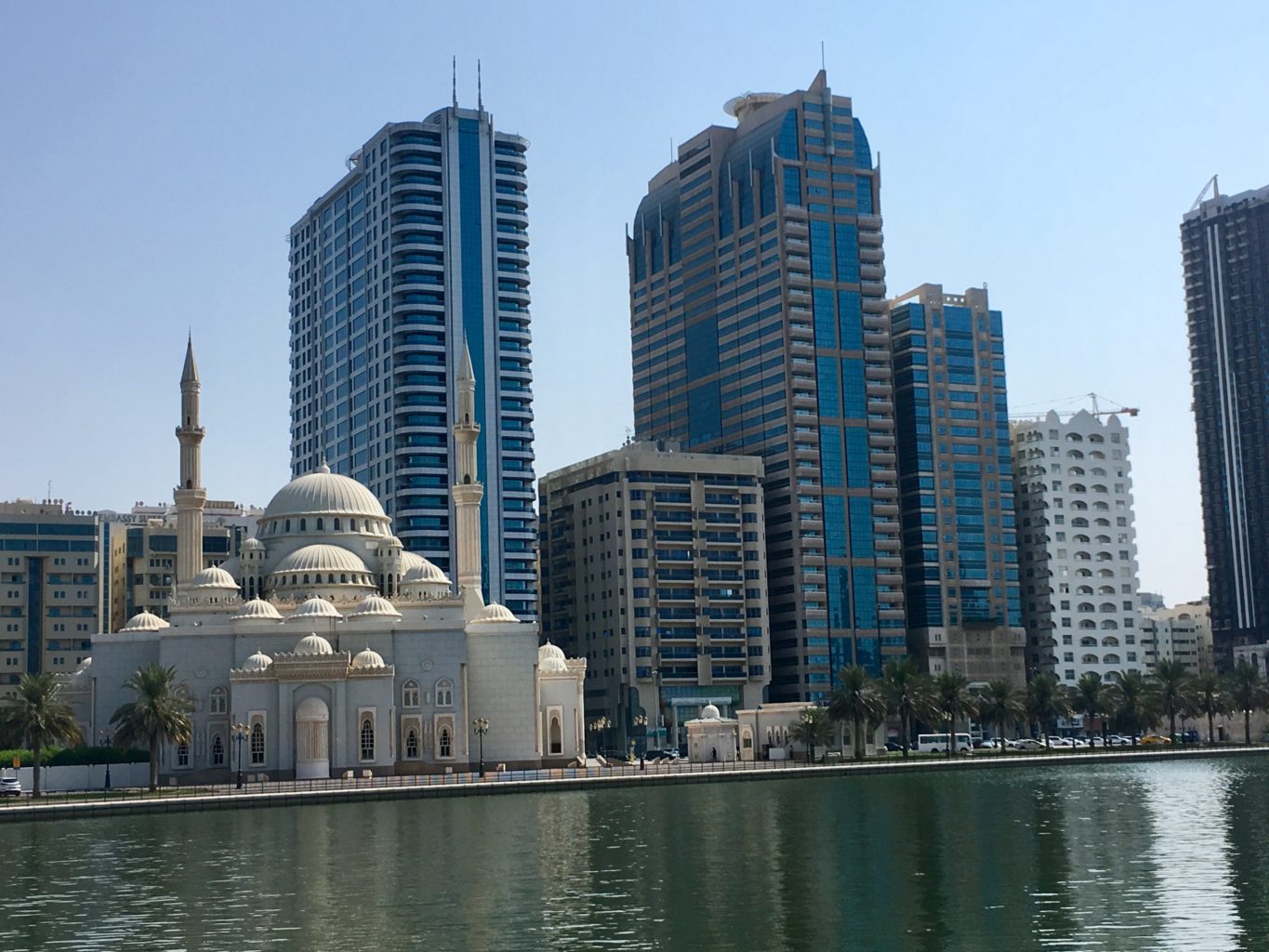
Sharjah is a traditional Muslim province of the United Arab Emirates. Its citizens can worship at some 700 mosques, but only 2 are open to "infidels". You absolutely must visit Al Noor in the city of Sharjah, on the lagoon, amid beautiful tropical greenery. It is open on Mondays and Thursdays (10.00-11.00), and photography and filming are allowed. A gripping presentation explained the links between dress, culture and the Islamic religion. Of course, it could not do without refreshments of Arabic coffee and sweets. Don't worry about being inappropriately dressed, as there is a clothing hire point at the entrance.

Sea and mountains
Sharjah is the only emirate in the UAE with access to both the Persian Gulf (west) and the Gulf of Oman (east). Both coasts are suitable for swimming, and the sea is just as warm. If you head east, the landscape may surprise you. After about 1.5 hours' drive - from Dubai airport or from the city of Sharjah - you reach the area around Khorfakkan or Kalba. The closer you get to your destination, the higher the mountains. The motorway begins to wind its way around ever larger hills, until finally it has to run through tunnels. In the east it is also always a few degrees cooler. The UAE's highest mountain is 1527 m above sea level, yet the highest point in the country lies at 1910 m. Illogical? In the latter case we are talking about the slope of a mountain whose higher summit already belongs to neighbouring Oman.
Nature
Sharjah places great importance on preserving biodiversity. Neighbouring centres for the protection of birds and other animals aim to reintroduce endangered species and to educate. I visited the shelter for birds of prey (Birds of Prey Centre). Its spacious aviaries are meant to give these beautiful desert birds a semblance of freedom. Next door is a small amphitheatre where displays of the birds' hunting skills are held. They can be seen in winter, but in October it was still too hot to expose the stars of the show to the heat. Right next door is the "Al Hefaiyah Mountain Conservation Centre", which is a refuge for mammals. Some of them are brought in from Saudi Arabia so that, once they have bred, they can be released into the wild.

On Al Noor Island (the island is not marked on all maps) in the lagoon in the city of Sharjah there is an interesting butterfly house, reached by a footbridge behind the mosque of the same name. It may not be overwhelmingly large, but the number and colours of the butterflies can be impressive. The butterflies are transported in hibernation from Costa Rica and Indonesia, but they emerge from their chrysalises in their new home on the island.

Another interesting island lies near the town of Kalba. It is a nature reserve, and thanks to its preserved mangrove forests you can spot birds, sizeable crabs hiding in the sand, and sea turtles. Although October is not a good season, I managed to observe a few of these remarkable creatures from the bridge linking the island to the mainland. There are no buildings on the island apart from a very exclusive (and eco-friendly) hotel resort.
The desert
From Mleiha you can set off on a wild ride across the desert dunes. The desert is said to be at its most beautiful in this area, because traces of iron and magnesium give it a reddish tint. A skilled local driver glides from dune to dune like a surfer riding sandy waves. Every so often there is a stop to admire rock outcrops and fossils (yes, there was once a sea here!). In the evening, a candlelit dinner and stargazing through a telescope. The moon was eating out of my hand - magic squared.

Museums
Twenty modern educational and museum venues are one of Sharjah's calling cards. They are interactive, with audiovisual presentation of the highest standard, and will draw in children and adults alike. Archaeology, classic cars, marine life, art, maritime history. In one of the venues designed for children, several stations present, in an accessible form, the areas key to understanding how their country works. There was a little road-safety town and a TV studio, but pride of place went to a model of an oil refinery. Admission is cheap, at around PLN 10 per person.

Of the "museum" attractions, I was most impressed by the Rain Room. Sharjah is the only place you will find such a space. In a room the size of a sports hall, it rains non-stop. The drops fall from sprinklers fixed beneath the ceiling. But as you start to approach the wall of water, something astonishing happens: the water parts, leaving a dry pocket of air a few centimetres wide around you. The sensation is incredible and stays with you for a long time. This art installation is well worth experiencing.

Hotels
The Emirate of Sharjah is investing heavily in hotel infrastructure, often as co-owner of the hotels being built. Popular brands such as Ibis, Novotel, Sheraton and Radisson Blu are here. Prices start at PLN 180. There are also representatives of the very top, niche end of the market, such as the Al Bait hotel, part of the LHW group, in the restored old part of the city of Sharjah.

I fell for the Kingfisher Lodge complex by Mysk. Its glamping-style tents are the only buildings on an island off the east coast, to which you are taken by golf buggy. Each tasteful bungalow comes with 2 bicycles, a free minibar and....its own pool. The price per night....well...1200EUR, if you choose the option with 3 bedrooms and 2 bathrooms.
Sharjah has chosen its own path and its own way of attracting tourists. Nearby Dubai focuses on offices and business, and its attractions have to be the "biggest and best". Sharjah is more intimate and low-key, with the aim of bringing Arab culture closer to visitors. It has attractions for adults and children alike. Its territory stretches from the Persian Gulf to the Gulf of Oman, with desert filling the central part. Its wealth of museums and affordably priced hotels may mean that it will soon become an interesting complement or alternative to the much-hyped Dubai.