


Trekking in the Thai mountains
If you are in northern Thailand, a trek is definitely worth considering. For me it was the highlight of a week-long stay. Elephants, waterfalls, jungle, hill tribes, rafting, wonderful views and a scout-camp way of life.
You can choose between one-, two- and three-day treks. We chose the longest version: 3 days and 2 nights. We decided to book our trek in Chiang Mai, but you can also do it in Chiang Rai or Mae Hong Son. There are lots of tourist service stalls, and each has the full range: from elephants, snakes, quads, monkeys, orchids and cookery classes to bus, train and plane tickets, accommodation, transfers and, of course, treks. It is hard to get your bearings: you are never quite sure whether you are buying from the organiser or from a middleman. But you won't be cheated; this is Thailand. Apparently treks north of the city are better than those heading south. That is because the rivers are no longer so clean once they have flowed through the city. Trek offers vary in price, but in general they are very good value for money, with prices ranging between 1,500 and 2,500 baht. Without much haggling, we went for a package at 1,500 baht (150 PLN) per person, and we found it hard to believe that we would get all our meals, elephant riding and bathing, a raft trip and some serious white-water rafting, plus a guide and 2 spartan nights in mountain villages. As a bonus there was a visit to an orchid garden and a butterfly farm (with no pushy pressure to buy anything). Our group consisted of 12 people; apart from the three of us Poles, the rest were French, and our guide was a member of the Lahu tribe with the charming name Som Chai ("call me Sunshine"). In fact, it was to his village that we were driven on the first day in no-frills pickups, and that is where the trek began.

What to pack for a trek in Thailand
As a rule, guests are picked up from their hotels and taken to the meeting point. Some companies require you to bring your own sleeping bag; we had ours and slept more comfortably, but the sleeping huts were equipped with blankets and sheets, though not of the utmost freshness. As for the required kit, which has to fit on you and in your rucksack, you need drinking water (you can buy it at markets and in the villages), toiletries, towels, mosquito spray, a torch (there is no electricity in the huts), something warm for the evening, ideally a sweatshirt and long trousers, toilet paper and money for extras (such as an evening beer on the terrace). A power bank will come in handy, as will an eye mask if the first rays of sunshine might wake you; the walls and floors of the huts are made of bamboo, which creaks when you walk and lets the light through. The sleeping places in the huts are for 2 - 3 people and are marked out by a mosquito net hanging from a frame.

Day one: the jungle and a night in a hill village
The first day was about getting supplies: the guide bought the ingredients from which he later cooked our meals, and we bought water. From the Lahu village, which we had been able to wander around first, we set off over the hills to our overnight spot. We passed wild papayas and banana plants, which Som Chai deftly prepared for us, we passed wild tobacco and tried the mercilessly bitter fruit of some plant or other that, in an emergency, could stave off thirst. The path revealed new vistas; we passed woodcutters, forded small streams and pushed our way through bamboo groves. We looked at rubber trees, while the guide told stories about the fearless cobras and huge anacondas living in the jungle around us. The first night was spent in a small village of 3 families: two Lahu and one Karen. All of them were elephant keepers. That evening we met a "giraffe woman", a woman with rings around her neck. She lived in that village.
 Watch on YouTube
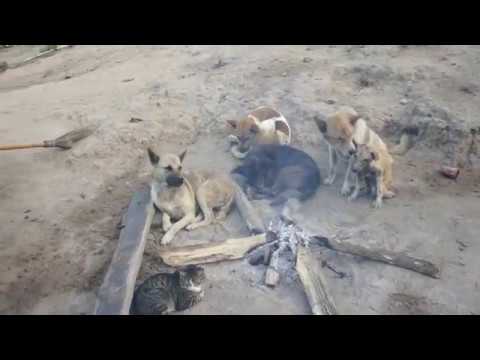
She set out a few souvenirs for sale and sat modestly next to one of the huts. The next morning she joined us as we warmed ourselves by the embers of the campfire. It is worth mentioning that the mornings are really fresh, probably just over ten degrees. A fleece comes in handy, and it is definitely better to shower in the evening warmth of the passing day than in the morning chill after the night. The village had many times more dogs and poultry than people. Pointing at the four-legged animals, the guide told colourful stories about them: this one will track an anaconda in the jungle, you can count on that one because he barks loudly when he sees a cobra at night, this one is afraid of everything, and that one is a "ladyboy" because of all his equipment only the "banana" is left...

Day two: a waterfall, bamboo rafts and elephant rides
On the second day, after a modest breakfast (an egg, toast, jam and "3in1" coffee), we walked to the elephant farm. On the way, somewhere in the jungle, we stopped at a waterfall. It turned out that not only could you bathe at its foot, but you could also slide down a rock chute of about 6 metres in a stream of icy water into a small but very deep pool. There was a bit of adrenaline, and of course it was refreshing. Before we got to know the elephants, we were invited on a bamboo raft trip. Two raftsmen, one at the front and one at the back, steered us. Everything was quiet, lazy and calm.

A keen eye will notice that beneath the bamboo poles there is a solid hull, completely filled with polystyrene. Well, there may be a group of tourists with the excess weight that is so fashionable these days, and the equipment has to cope...

At last we reached the elephants. What surprised us was that we were to ride the elephants bareback. No harness, seat or saddle. The only thing that helped you keep steady was a rope running under the animal's belly, which you could grip hard with your hands. Although Asian elephants are smaller than African ones, your first impression when you sit on one is that it is... high. When the elephant walks on the flat it's fine, and the climbs are no big deal, but steep descents are quite a challenge. You slide forward, towards where the animal's keeper and "driver" sits. A dubious attraction is the chance to plaster the elephants with mud; apparently they love it. I suspect, though, that it is meant to be the first act of a two-act show. The second act, after the trek through the jungle, is the chance to wash an elephant in the nearby river. You get a plastic pot and a proper scrubbing brush, with which you should scrub the bristles and thick skin of the mammal without any qualms.

Day three: rafting and the long-necked women's village
We say goodbye to the elephants and head for our overnight stop in a village on a hilltop. "Hilltop" sounds innocent, but to get there we slog up a more or less steep climb for a good 2 hours. At last we reach our lodging. We know the drill by now: choose a sleeping spot, shower, dinner, campfire, sleep.
The next morning is magical: we are on top of the hill, and below us the valleys are wrapped in mist that slowly spills from one end to the other. Breakfast done, drinks settled up: a self-service cooler with chilled fizzy drinks, beer and water stood on the terrace. Every drink you take is written down in a notebook to be paid for later.
We set off. After a few hundred metres, a stop for reflection at a small tribal cemetery. The graves are unmarked, but next to each one cooking pots and a little food and drink have been left. Ahead of us is the rafting. The briefing is short. "Forward", "backward", "stop" and "jump in!" are supposed to be enough to get safely through a few rapids. There are thrills, a few screams from frightened women, a bit of tribal water fighting when another raft comes close, but overall it's fun and refreshing once again...
The last item on the programme is a village of long-necked women. That description is a big exaggeration. It is a row of stalls with products we have already seen many times. What shocks us is that we see the same faces we remember from the Baan Tong Luang open-air museum. It seems we are dealing with sales assistants who take turns staffing different tourist spots.

Trekking is a great adventure for young and old alike. The inconveniences of the basic facilities are more than made up for by the wonderful views, contact with the authentic village life of the hill tribes, nature and other attractions such as rafting, elephants and bathing in a waterfall. Highly recommended!


