










Wild Malaysia, or meeting proboscis monkeys on Borneo
What comes to mind when you think of Borneo? An inaccessible, exotic island, wild jungle, headhunters and bizarre animals.... I wanted to see what it is really like and whether you can actually see proboscis monkeys up close. Borneo is the third largest island in the world, shared by 3 countries: Malaysia, Indonesia and Brunei (I described the Sultanate of Brunei in a separate post here ). Malaysian Borneo consists of two states: Sarawak in the west and Sabah in the east. This post is about Sarawak, as I have saved a trip to Sabah for another time.
It turns out you can fly to Borneo.... on a low-cost airline. It is no joke: taking off from Berlin's Tegel airport (TXL), with a short connection in Singapore, you can fly with FlyScoot to Kuching, the capital of Sarawak. Fly Scoot is the low-cost arm of the renowned Singapore Airlines, although the differences are considerable. As befits a budget airline, there are not even simple seatback screens on board, let alone a full entertainment system. No blankets and no eye masks. You will not get any free drinks or food. You also pay for checked baggage. But there is plenty of legroom and, unlike on short budget flights, the seats recline, and the aircraft is top-flight too, a Boeing 787 Dreamliner. And then there is the price: Berlin to Borneo for 1700 zlotys.
Kuching - the Waterfront, Chinatown and the city of cats

The capital of Sarawak is Kuching. It is a great base for several worthwhile attractions in the state. It is amazing how many interesting places you can visit not far from the city. I hired a car at Kuching airport and, driving intensively for 7 days, covered just under 350 km. Kuching is the seat of the state government, housed in a picturesque building on the riverbank. Its style is so intriguing that it has earned the nickname "the umbrella". It can be seen perfectly both from the riverside promenade, known here as the "Waterfront", and from the footbridge linking the two banks. At night the bridge is lit up in all the colours of the rainbow and forms the backdrop for fountain shows held every day (the first "show" at 20.30).
Kuching will surprise travellers with restored buildings that bear witness to its colonial past, a picturesque riverside promenade and a Chinatown district offering food from many corners of the world.

The colonial past is linked with the charismatic figure of the English adventurer James Brooke, who defended and developed the city. Kuching is the "city of cats" and, surprisingly, you will find statues of them in many squares. There are plenty of places to eat well, and those tired of Asian food will be seduced by the excellent pizza made by a Serb who has settled on Borneo, in the Old Bazaar.
The well-organised tourist information centre in the city centre, near the river, is a great help in planning a stay in the national parks. It is worth booking accommodation in Bako National Park through them. There you can also find out whether the famous rafflesia is in bloom anywhere in the state.
Orangutans at Semenggoh Nature Reserve

20 km south of Kuching lies the Semenggoh Nature Reserve. It is the only place in Sarawak where you can come face to face with orangutans. If not here, that leaves Sepilok in the neighbouring state of Sabah or the island of Sumatra in Indonesia. Tourists arrive at the reserve for 9.00 or 15.00, because that is when the apes are called out of the jungle for feeding. There is, however, a small "but"..... From December to March there is plenty of food in the jungle, and the orangutans turn their noses up at the prepared meal and ignore the keepers' calls for weeks. When I was there, the chance of meeting an ape was close to zero, as a board at the main entrance honestly informed visitors. Nevertheless, the rangers carried out the full procedure. It was an interesting briefing on safety and the animals' habits. Then we went deep into the jungle, where you wait for the orangutans at a certain distance. The park staff called them and laid out food on a special platform, but, as predicted, the orangutans did not show up.

Where tourists wait, there is a large board describing the whole group. 33 orangutans live in the park, and each of them has its own distinctive features, foibles and a set position in the group. Was the visit wasted? Certainly not: it was packed with information and also gave me plenty to think about regarding who we are, where we come from and what our responsibility is.....
Serikin, Siniawan Night Market and KBS Buddhist Village
It is always worth straying a little off the beaten track.... somewhere I found a short note about the market in the village of Serikin. Formally it is still Malaysia, but it feels as if it is already Indonesia. Traders from across the border flock to this last village in the country, bringing all kinds of goods, from vegetables and fruit to rattan furniture. It is colourful, noisy and exotic, and the heat and dust make themselves felt.

If you fancy it, you can hunt down a perfect fake of a designer rucksack or a pair of jeans. Indonesians come here under local border traffic rules, but tourists cannot cross the border. Driving from Kuching, practically halfway along, it is worth making 2 stops, ideally one in each direction. On one side of the road you will find the Siniawan Night Market , and on the other the KBS Buddhist Village. The first is a charmingly situated historic settlement of the Chinese community on the riverbank, which from 17.00 until late at night turns into a huge open-air bar and restaurant. Distinctive two-storey wooden houses line both sides of the street, and behind them the river flows unhurriedly.

The second is a modern Buddhist centre, but beautifully laid out. It is crying out for a photo shoot: small and large temples, Buddha statues among the greenery, ponds big and small with colourful fish....

Sarawak Cultural Village - an open-air museum of Borneo's cultures
Travelling by boat along the tributaries of the Amazon in Brazil (I described that story here ), or walking through the jungle of northern Thailand (I wrote about trekking in Thailand here ), I realised that "wild tribes" no longer exist. Today we are left with open-air museums and folk dance shows. It leaves a rather bad taste, but the Sarawak Cultural Village is nonetheless worth a visit. For 80MYR you can see in one place the various types of traditional dwellings of the different ethnic groups that once inhabited Borneo. The huts are set around a pond, with a waterfall and mountains in the background. Some of the houses sell local souvenirs, and you can find out which community once built such homes. The place is interesting for adults and children alike. Kids can climb steep wooden ladders and walk across the little bridges dotted here and there. The highlight of the visit is a 45-minute dance performance with a demonstration, and an impressive one, of shooting with a blowpipe.

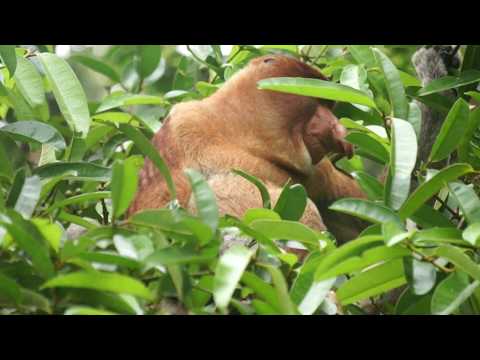
Proboscis monkeys in Bako National Park

Damai Beach and The Culvert hotel

Miri and Lambir Hills National Park


