










Sri Lanka - live your own Asia Express
2 weeks of the Polish winter to see Sri Lanka properly? Of course. Let me tell you how.
A long flight, a change in Doha and a pre-dawn landing at Colombo airport. An airport like any other, but what is astonishing is the wide range of household appliances on offer in the arrivals hall. Washing machines, fridges, air conditioners, fans and freezers greet new arrivals.

All ready to buy. What is it all about? I am not sure, but it seems that a Sri Lankan returning from a trip is obliged to bring back a suitable present. But a fridge?... every country has its customs.
Dawn at the Negombo fish market
We land, go out and look around for the car we had booked in advance, whose keys were supposed to be handed over to us by a member of staff sent for the purpose. Surprise, surprise, nobody is waiting for us. A few phone calls, someone sleepy picks up, help from the locals, attempts to sort things out, but there is still no car. Finally a decision is made: we are given a taxi to take us to a hotel in the capital at the rental company's expense. Fine, but our plan had been different and more ambitious from the start. I know that a fish market will open soon, not far away. Despite his instructions, the driver sets off towards the seaside town of Negombo. What we see in the rays of the rising sun was worth the sleepless night.

Huge tuna, sharks, rays cut in half, heaps of grey prawns, fish big and small from the Indian Ocean. Apart from us, there is only a small group of Japanese. Commotion, boats mooring, fishermen calling to each other to haul the bigger specimens onto the quay together..

Cleavers, knives and axes for preparing the seafood are in action, but so are notebooks and calculators. We witness a tuna auction. In just a few hours these huge fish will be in the best hotels and restaurants in the country.

Negombo is worth a visit, and the best way to do it is on the day you arrive or leave.
A Sri Lankan driving permit and the Colombo parade
A short nap at the hotel we finally reach, brutally interrupted by a knock at the door. Our car has arrived. The Toyota looks fine, with just over 100,000 km on the clock. Only later does it turn out that at around 70 - 80 km per hour the automatic gearbox starts to vibrate unpleasantly. Luckily, in a way, such speeds are hard to reach on the island. 4 February is Sri Lanka's Independence Day. We don't know what to expect or whether it is worth spending hours taking part. For now, I have to make a trip to the city centre anyway: it turns out that the international driving permit I got in Poland before the trip (an old-fashioned grey booklet) is not enough. On the basis of it you have to obtain permission to drive from the Sri Lankan authorities. While dealing with the formalities, we can watch the preparations for the military parade. The seafront boulevard is already closed, and all kinds of military vehicles are lined up. It promises to be a big event.
A surprising variety of branches of the armed forces, each in its own distinctive uniform. Some units are accompanied by... elephants draped in colourful embroidered cloths.

Watching the parade is also an interesting history lesson: British influence on the island is reflected in the fact that some units march in Scottish kilts.

Mount Lavinia Hotel and a sea turtle sanctuary
Staying in a colonial mood, we head south of the capital to see the well-preserved, luxurious Mount Lavinia Hotel. A hotel like any other, with a colonial exterior; in general there is not much to see inside the building, which dates from 1877. It turns out that the nearby beach hides an extra attraction. If you are not planning to visit another sea turtle sanctuary in the south of the island, you can do it right here. For 500 rupees per person you can visit a small centre right on the beach, a few hundred metres south of the hotel (http://ourturtleproject.wixsite.com/otcp).

A few tanks of seawater hold various species of turtle, including a whole colony of tiny ones that have only just come into the world. As part of the centre's mission, the staff educate fishermen, making them aware that turtles are an important part of the ecosystem. Turtles eat jellyfish, which feed on small fish and stop them from growing up, thereby reducing the income of coastal communities that live from fishing.
The Golden Cave Temple in Dambulla

 Watch on YouTube
The next morning we set off towards Dambulla. Halfway there, a majestically striding monitor lizard blocks our way. Undisturbed, testing the ground with its long tongue, it crosses the busy road, heading for quieter places. After 5 hours of laborious driving we reach our destination. A massive rock 340 m high forms the roof of the so-called Golden Temple, a temple made up of five caves, the oldest of which date from the 1st century AD.

Barefoot, we explore the complex, admiring the frescoes and almost 60 statues of the Buddha. A troop of monkeys watches us, hoping for a donated piece of fruit. We watch them too; a carelessly abandoned camera can quickly become their booty. Not far from Dambulla is Sigiriya, an extraordinary fortress and city built on top of a rock outcrop by Kassapa, king and parricide. The whole complex, which also includes extensive gardens, is considered one of the boldest feats of urban planning in history. At the top of the rock you will see the ruins of the palace, stone pools and the remains of gardens.
Sigiriya and the climb up Pidurangala

What has not survived to our times is the enormous lion's head and its paws. Set on the rock, they were meant to frighten off the king's brother, who had sworn to avenge their father's death. We reach Sigiriya, a UNESCO World Heritage Site, too late to climb to the top. All that is left is a tuk-tuk ride around the gardens surrounding it. Driving along the moat, past the remains of the fortifications, our attention is caught by a hut built high up a tree trunk. It turns out that it is used by a night watchman to keep an eye on the surroundings and protect the monuments and crops from wild elephants, which like to venture into the area once the last tourists have left. Seeing our interest, we are encouraged to climb up to the high platform. The flimsy little planks don't inspire confidence; I am not convinced they will hold the weight of a medium-built European. Fortunately, both the climb up and the climb down end without injury. Satisfied on the one hand with our evening tour of the site, and put off on the other by the high price of a ticket to the island's biggest attraction, we take the bold decision simply not to visit it the next day. There is an interesting alternative: climbing its sister peak, Pidurangala. From this rock, 1.5 km to the south, you can see Sigiriya as clear as day. On top of that, on the way up you pass an atmospheric temple. We are lucky, because a service combined with the presentation of offerings is just taking place.
 Watch on YouTube
Further up the path, we pass a statue of a reclining Buddha under a rock overhang. The last stretch before the summit is a solid dose of scrambling: fallen boulders block the way and you have to watch out for their sharp edges.

Polonnaruwa and Minneriya National Park without elephants
At Sigiriya we are right in the middle of the so-called Cultural Triangle. Invisible lines between three former capitals of Sri Lanka, Anuradhapura, Polonnaruwa and Kandy, mark out the area with the greatest concentration of historic sites. We decide to skip the first of these capitals and concentrate on the other two. Exploring Polonnaruwa, you have in mind the photos and descriptions of Cambodia's Angkor Wat. We have never been there, but it seems to be a scaled-down copy of those temples and palaces. What impressed us most were the mighty ruins of the palace, with large holes in the walls. That is where the beams ran that supported the upper floors of the building, which have not survived. The statues of the Buddha carved into solid rock and the mysterious phallus temple (yes, it's what you think) are also very impressive.

We rush through Polonnaruwa; after all, today we are supposed to see the great herds of elephants living in the wild in Minneriya National Park. The park's vast plains can feed thousands of these mighty animals; some herds are said to number as many as 300. We hurry to the park, buy tickets (7,400 rupees entry and 3,500 for the off-road vehicle) and look out for the huge mammals. The sad faces of Japanese tourists returning in several jeeps give us food for thought; something has clearly gone wrong. The truth is cruel: there are no elephants here! In February there are simply no elephants in the national park that is famous for them. The great plains are flooded; all the vegetation is under the surface of huge expanses of water. After the event we learn that elephants migrate between areas depending on the season, staying wherever there is more food available. Special corridors guide them between the national parks. Our guide, trying to save the situation, points to a barely discernible silhouette a good few kilometres away. Without much conviction, he says it is an elephant. That only deepens our bitterness. A bitterness so great that I decide to write an official complaint: a complaint to the Sri Lankan embassy in Poland and to the management of Sri Lanka's national parks. A complaint about the lack of elephants. They have probably never received a more absurd grievance, but I felt better, much better. I never received any reply.
Kandy - the Temple of the Tooth Relic and dance shows
The Dambulla - Kandy route is another 2.5 hours' drive. Fortified by boiled corn on the cob from roadside stalls (remember: only eat food that has been cooked), we bravely approach the island's next attraction.

In Kandy you have to do two things: visit the Temple of the Sacred Tooth Relic and go to a show of traditional Sri Lankan dance. Legend has it that the Buddha's tooth magically reached Sri Lanka in the 4th century. Since 1592 it has been kept in Kandy. It can be seen once every 15 years (the next opportunity is in May 2019), but every day you can imagine it by looking at the golden reliquary shown to the faithful. The dance shows take place every evening in halls behind the famous temple. Wherever you are staying, you will certainly be offered the chance to attend a show promoted by the owner of the place. In our case we were given tickets that we could return if we didn't use them. And in the end we did choose a different show from the one recommended: quite simply, more trustworthy-looking tourists were heading to the other hall. The performances at the "Kandyan Cultural Centre" cost 1,000 rupees per person and consisted of 12 acts. Apart from singing and dancing there was drumming, a bit of acrobatics and a finale of fire-walking over glowing coals.

 Watch on YouTube
Although it was all a bit like open-air-museum folklore, it was definitely worth experiencing. The island's whole culture of dance and song in a nutshell.
Nuwara Eliya and the tea plantations
From Kandy to Nuwara Eliya is 2.5 hours. The place known as "Little England" is famous for its colonial buildings, such as the red-brick post office, and its beautiful tea fields. Seen from afar, only rice fields can match their charm.

It is no problem to stop by a plantation and walk among the clumps of tea bushes. You can take a close look at the work of the leaf pickers: women who usually come from the Tamil minority. Whole families live in poor villages among the tea fields. They often sell vegetables and fruit from their gardens. It is worth visiting one of the many tea factories. We ended up at "Mackwood", where, after touring the factory halls, we could relax with a Sri Lankan brownie and, of course, a cup of tea. Nuwara Eliya is one of the cooler places on the island, so you can buy warmer clothes here. Before the trip we had read that these were high-quality branded goods available at good prices. Nothing of the sort. They are mass-produced fakes; the logo may be right, but the quality is dreadful, so don't kid yourself that you will buy anything decent there. Leaving the tea fields and driving towards the town of Ella, we come across land covered in terraced rice fields, some of the most beautiful rice fields we have ever seen.

We saw similar ones in Bali: they stretch over the hills, run down into the valleys and close off the horizon beautifully.
Ella and Little Adam's Peak
Ella is real mountain country. Despite a hitch with our accommodation (a correctly made booking is not honoured), this area will stay in our memory as one of the nicest places in Sri Lanka. Breakfast at the new place offered by the contrite owner of the overbooked lodging makes up for the previous day's inconvenience: the terrace has a beautiful view of the surrounding mountains. Wrapped in fleeces, we enjoy an invigorating coffee in the crisp morning air.
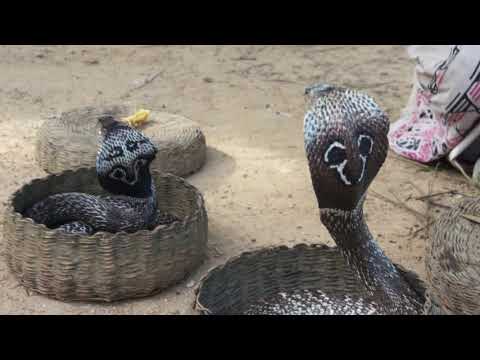
Nearby are the Ravana Falls and the goal of today's outing, Little Adam's Peak. On some local maps it is labelled "Little Adam Speak" 😊. Many tourists decide to climb the real Adam's Peak, but we can't afford such a climb; "Little Adam" will have to do. We walk up a wide path. Around one of the bends, a mysterious character is sitting on a spread-out tarpaulin. In front of him are two round boxes with lids. As we approach, he whips off the lids and two cobras appear before our eyes, rearing up in an instant, ready to fight.

 Watch on YouTube
Despite encouragement to get better acquainted with the snakes, we carry on towards the summit and, of course, reach it in the end.
Elephants in Udawalawe National Park
Remembering our disappointment over the failed safari in Minneriya Park, we decide to visit Udawalawe National Park, which we had not planned before. It is in the south of the island, on the way to the coast, where we want to spend the last days of our stay. We book a room through Booking.com and, guided by satnav maps downloaded earlier for offline use, drive straight to the hotel. We leave the mountains behind, and the satnav leads us straight to the park gate, showing that the hotel is still some way off. Without much thought, we try to "force" our way through the park gate. We stubbornly show the guards the route marked on the screen. They look at us in amazement. After a moment the absurdity of the situation dawns on us: you can't just drive among wild animals in an unprepared car without a guide. You have to treat satnav, even the best, with a critical eye. Some people, following it blindly, have ended up in a lake, and we would have put ourselves in similar danger. After asking around, we find the right road to the hotel, which, as it happens, we had passed earlier on the way. At last the long-awaited safari, and the uncertainty: will they be there, or will we go away empty-handed again? The first one is in the distance, beyond a sizeable lake, walking majestically along its shore. Then another two; they are small, and one of them also has a leather collar fastened around its neck. Perhaps it is an elephant that spent its early years in an orphanage and is now preparing for life in the wild? We are not alone; cameras are firing from several vehicles at the cornered pair of animals.

We are already happy, but we want more. We head for a more remote part of the park, and suddenly we see a whole herd. There is a tiny baby elephant too. While the adults sprinkle sand over their backs, he is busy playing, running figures of eight between the legs of his older relatives. At one point he trips and lands clumsily in a small hollow. It is a comical sight, and we are now completely satisfied.

Weligama, Unawatuna and colonial Galle
We can head south for our planned three days of idleness. On the way there is one more bloodless hunt, for a gorgeous sapphire-blue kingfisher which, despite the telephoto lens, keeps escaping from the frame. Our first stop is Weligama and a walk along a rather dirty beach where rainbow-coloured fishing boats have been pulled up onto the shore.

The rolled-up fishing nets are in even more intense colours. At the next beach, beyond the dunes, a characteristic postcard view appears: fishermen sitting on strange wooden structures, fishing with rods. Before we can line up a photo, the managers of these fisherman-actors come running up and demand payment for pictures. The spell is broken, the camera goes away; we don't want to take part in this sham. Our assertiveness pays off. A few days later we will come across fishermen in another secluded cove and capture the postcard view in our photos.
We arrive at our guesthouse, near the famous Unawatuna beach. The windows of our room look out over the ocean: golden sand on one side, waves crashing against the rocks on the other. It is one of those views you could call a million-dollar view.

Lazing on the beach, chatting with the vendors pestering us with fruit and tablecloths, swimming and walking along the shore: that is the plan for these days. But of course we can't miss one of the greatest attractions of the south-west coast, the beautiful colonial town of Galle. It is reminiscent of Old Goa in India or Trinidad in Cuba, with blocks of old post-Portuguese buildings, churches, little squares and fortifications. It is worth visiting both by day and in the evening, when it is lit up by artificial light. You can stroll for a long time along the cobbled streets, stopping at stalls and visiting shops selling jewellery, art and clothes. Nice design and good quality (for example Odel T-shirts).

What to see in Sri Lanka in two weeks
2 intense weeks. We saw a lot: the Independence Day parade, the Dambulla cave temples; we admired Sigiriya, climbed Pidurangala Rock and explored one of the former capitals, Polonnaruwa. On top of that, two national parks, the island's cultural capital, Kandy, and a factory among the tea-covered hills around colonial Nuwara Eliya. We climbed Little Adam's Peak, watched the rice harvest and wandered around seaside Galle. We even spent time on the beach...
Sri Lanka offers an Indian atmosphere with more European standards. If you are not yet ready to experience the particularities of India, choose Sri Lanka. You will find a few tips here
I would gladly return to Sri Lanka, if only to visit Ambalangoda, the centre of mask making. As amulets, masks can bring good luck, protect against evil and illness, and even turn your enemies into friends.
If you have already done Sri Lanka or are looking for more extreme experiences, consider India. Perhaps start with Mumbai


