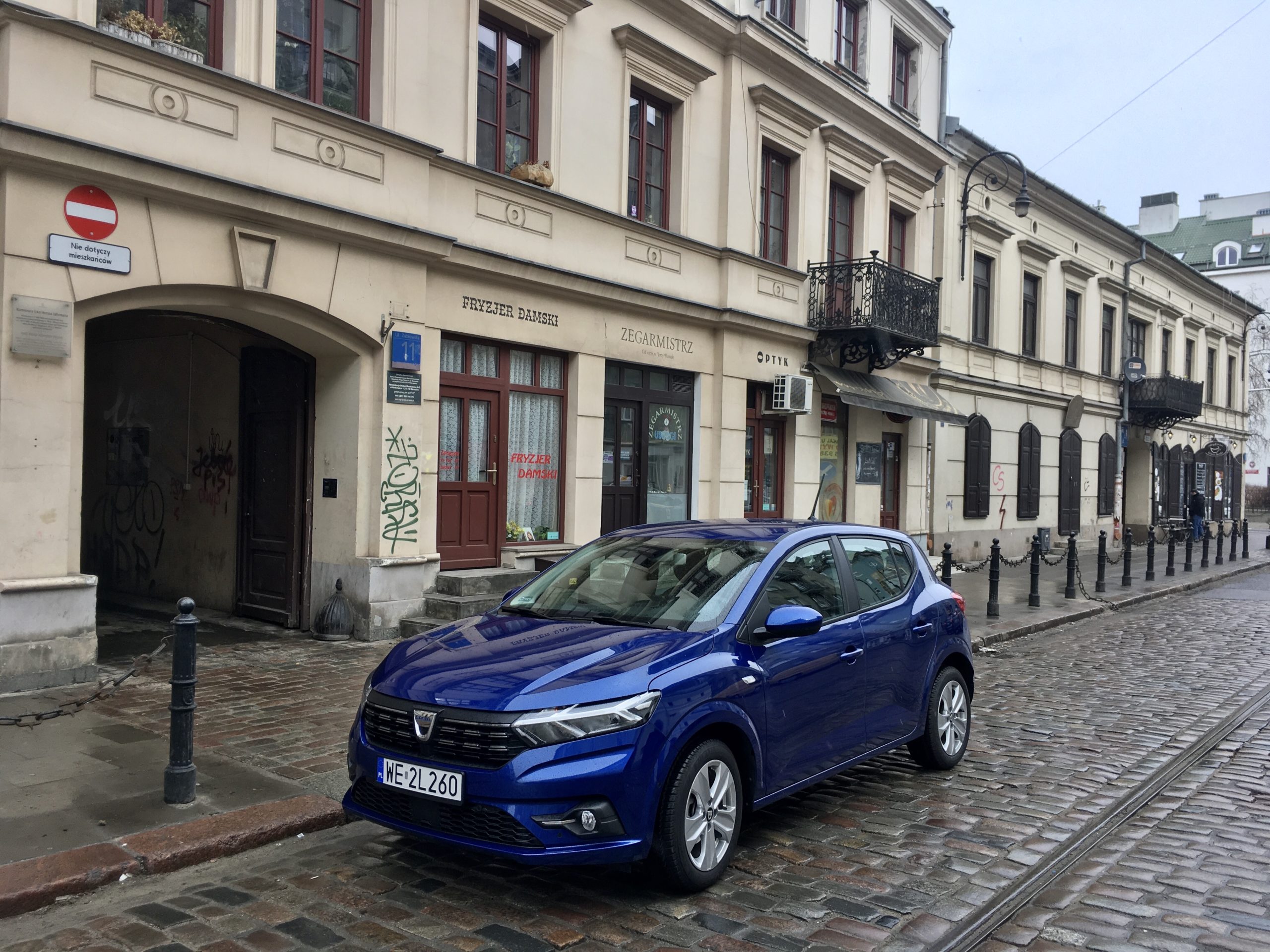
Dacia Sandero TCe 100 LPG - an unusual hybrid with a 1300km range
The Dacia Sandero with a factory-fitted LPG system can surprise you again and again. The Romanian brand consistently builds budget cars. The TCe 100 LPG version has an unusual powertrain and generous equipment, but the cost-cutting is visible at every turn.

The Sandero looks very good, and its looks improve from generation to generation. Its proportions are much better, thanks to the increased length and width. The attractive look is rounded off by elegantly drawn front and rear lights with LED segments.
The Dacia Sandero I tested had everything we expect from a modern car: a 6-speed gearbox that keeps revs low on the motorway, a reversing camera, automatic air conditioning, electric windows all round, front and rear parking sensors, cruise control, keyless entry and locking, and smartphone mirroring via Apple Car play. It is worth noting that despite this feature, the car also has a practical phone holder, which lets you choose between portrait and landscape orientation.

Interior, boot and cost-cutting
The car is practical: all the storage compartments are where they should be, with a total capacity of more than 20 l, and next to the front passenger's left knee there is a folding shopping bag hook. The boot officially holds only 328 l, but it is very well shaped.
On the other hand, you notice that savings were made at every turn: the plastics are hard, and the driver's seat has limited adjustment. The front seats are also exceptionally soft, which may cause discomfort on longer journeys, although the driver's armrest is worth a mention. Cheap upholstery fabric has been used, and the seat belt anchorages cannot be adjusted. Dacia was very consistent in cutting costs; it even dropped the red marking of the danger rev range on the very traditional instrument panel, which probably saved a few euro cents per car.

Many components in this car come from other brands. As Dacia belongs to the Renault group, which is in an alliance with Nissan and develops shared technologies with Mercedes, it is only natural that solutions from all these brands are used in the Romanian car. You can see straight away that the ergonomic air vent and air conditioning knobs are borrowed from the Clio.
Petrol and LPG - how to switch fuels

The Dacia SanderoTCe 100 LPG is a "hybrid" because, as you drive out of the showroom, you have a car adapted to use two types of fuel: petrol and LPG. The LPG system is supplied by Landi Renzo. Driving on petrol and on LPG feels no different, although remember that a cold engine is always started on petrol. How do you switch between fuels? It is very simple. On the left, below the steering wheel, there is a button marked "LPG". When you press it, a green light flashes for a while. If you start the engine after a cold night, the flashing stops after a few minutes; if the engine is warm, after a few seconds. When the light glows steady green, you know you are running on gas. While driving you do not feel any interruption in power delivery; the switchover is very smooth.
Another curiosity of this car is.... the absence of a tailpipe, which usually ends level with the rear bumper. In this car the end of the exhaust system is located roughly level with the rear bench seat.
A 1300 km range and LPG running costs

The combined range of the two fuel systems gives an impressive 1300 km when both tanks are full. I drove 950 km in this car, roughly half in the city and half on the open road. Of that, 500 km were on petrol and 450 on LPG. The two fuel systems "report" their driving statistics independently. When you are running on petrol, the instrument panel shows the range, average consumption and distance covered on petrol. When you switch to gas, the same statistics refer to driving on LPG. After 500 km on petrol, I had fuel left for another 300km. With gas, after 450 km the LPG was almost used up; I could only drive another 50 km on it. Either way, after 950 km I still had enough range for another 350 km. Impressive!

And what about costs? Gas is cheaper, but the car uses more of it. With consumption of 8.9 l/100km and an LPG price of 2.57PLN per litre, covering 100 km costs 22.90PLN. With petrol, at a consumption of 6.4l/100 and a price of 5.38PLN/litre, covering one hundred kilometres costs considerably more: 34.40 PLN. The savings are real!
This kept nagging at me, so, with the total cost of driving those 950 kilometres (the combined cost of the petrol and LPG used), I calculated how many litres of petrol I could have bought for that amount. Dividing by the kilometres driven gave me a hypothetical consumption, expressed in petrol, of 5.4 l/ 100km.
Test summary

Does "budget" mean worse? The Dacia Sandero TCe 100 LPG proves that you can go your own way and offer an interesting product that looks good and feels solid. Add a practical body, a low price, cheap running costs and a long range, and you have an extremely interesting proposition for a wide range of customers.