Alpine test of the Nissan Leaf - German Alpine Road
The German Alpine Road has been voted the most romantic driving route in the world. At the turn of September and October 2022, I drove its entire length: from Lindau to Berchtesgaden, 450 km in total.
This summer I had already checked how an electric car copes on a long trip, driving a Renault Megane E-TECH from Warsaw to Kołobrzeg and back, so I decided it was time to test a zero-emission car abroad. I chose the Nissan LEAF, which has a well-established position among electric compacts.

From Munich to Lindau: range and charging
Munich is the gateway to the German part of the Alps. From the Bavarian capital I headed towards Lindau, where the Alpine adventure really began. The direction of travel matters - it is best to drive from west to east. You start in the lower parts of the mountains and finish in Berchtesgaden National Park, full of rocky cliffs and steep slopes. The version of the LEAF I was given had the basic 40 kWh battery (there is also a 60 kWh version), and when I collected the car it was not fully charged. This meant that covering the 180 km from Munich to Lindau could be risky, because at 75% the car showed a range of 210 km (on a full charge the Nissan will do 270 km). So I decided to top up along the way. In the Nissan's navigation system, the charger in Landsberg was marked as free of charge, but in reality it had to be activated with a Plugsurfing card, which I had been handed together with the car.
Driving on the motorway was quiet, vibration-free and very pleasant. I used ProPILOT Assist, an advanced cruise control system that helps keep a set distance from the car in front based on the speed of the surrounding traffic. On the motorway, ProPILOT Assist helps keep the car in the centre of the lane on straight stretches and gentle bends.
The large car park for visitors to Lindau is right next to the bridge leading to the island, and the spaces for electric cars are in the front row. The 22 kW AC charger worked flawlessly once activated with the Plugsurfing RFID card.

Füssen, e-Pedal and the Hans-Peter Porsche Traumwerk
A place well worth recommending along the Alpine Road is Füssen. This is where Germany's most beautiful scenic routes cross: the Alpine Road (east - west) and the Romantic Road (north - south). In Füssen I stayed at the Hotel Sonne, where for a reasonable fee of 10 EUR you can charge your car overnight from a socket in the underground garage.
Leaving town, I tried out Nissan's e-Pedal system, which slows the car down as soon as you ease off the accelerator. Thanks to it, you can hold the car on a slope without touching the pedals. In many situations you can control the car's speed without having to press the brake pedal (the traditional pedal is, of course, still there).

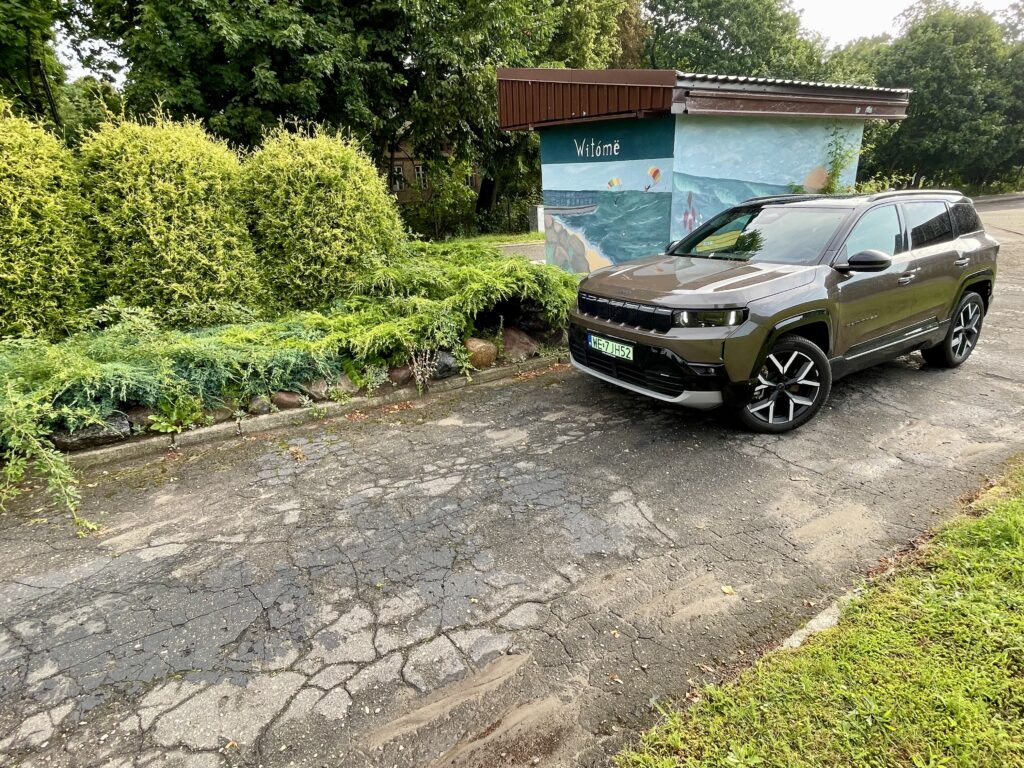
When I got to Bad Tölz, I parked the car on the street. Electric cars have to pay for parking unless they are charging. Unlike in Poland, EVs in Germany do not stand out with green number plates.
The Hans-Peter Porsche Traumwerk is one of those places you might associate with German sports cars. Once there, it turns out that there are literally only a few Porsches, and the main part of the exhibition consists of collections of meticulously crafted miniatures in various scales. It is still well worth stopping here, though. The most impressive sight is a huge indoor model layout with a network of miniature tracks as long as 2.7 km, on which 180 trains run. Add to that 80 tiny cars moving along mini roads and 8,000 "little people". At the Hans Peter Porsche Traumwerk museum, charging is free during opening hours, and in front of the gate there is another charger, available round the clock (paid)

Hotels with charging and the best time to go
When it was time for my last overnight stay, I headed to Bischofswiesen. At the Naturhotel I was offered charging included in the price of the room. I left the car plugged into an ordinary socket overnight under a covered shelter. Free EV charging for hotel guests is also offered by the Arabella Brauneck Hotel in Lenggries, where the car stays in an underground garage. In Germany, you should mention that you want to charge your car when booking - you will be allocated a specific space, often marked with a sign bearing your name.

Apart from the Plugsurfing app mentioned above, another roaming app worth recommending for charging electric cars is EnBW. According to users, it offers a very good ratio of price to the number of supported chargers. What stands out in Germany is the large number of charging points in the main car parks at tourist attractions, for example in Lindau or by Lake Königssee.

The best time to drive the Alpine Road is from May to October. The Deutsche Alpenstrasse can be covered in four to seven days, depending on the pace we choose and how many stops and excursions we plan. Be prepared for the fact that there are fewer petrol stations along the road than in other parts of Germany, but the number of charging points for electric cars is growing fast.
You can find another test of the Nissan LEAF here