Nissan Ariya - comfort for long journeys
Expectations were sky-high when the Nissan ARIYA was unveiled. It may be in a different segment, but the bar had been set high by the Nissan Leaf, a car that for many years was the best-selling EV in the world. We tested the ARIYA in demanding conditions: high summer temperatures, long motorway runs and the winding Alpine roads of Austria's Carinthia.
Design in the spirit of Japanese futurism
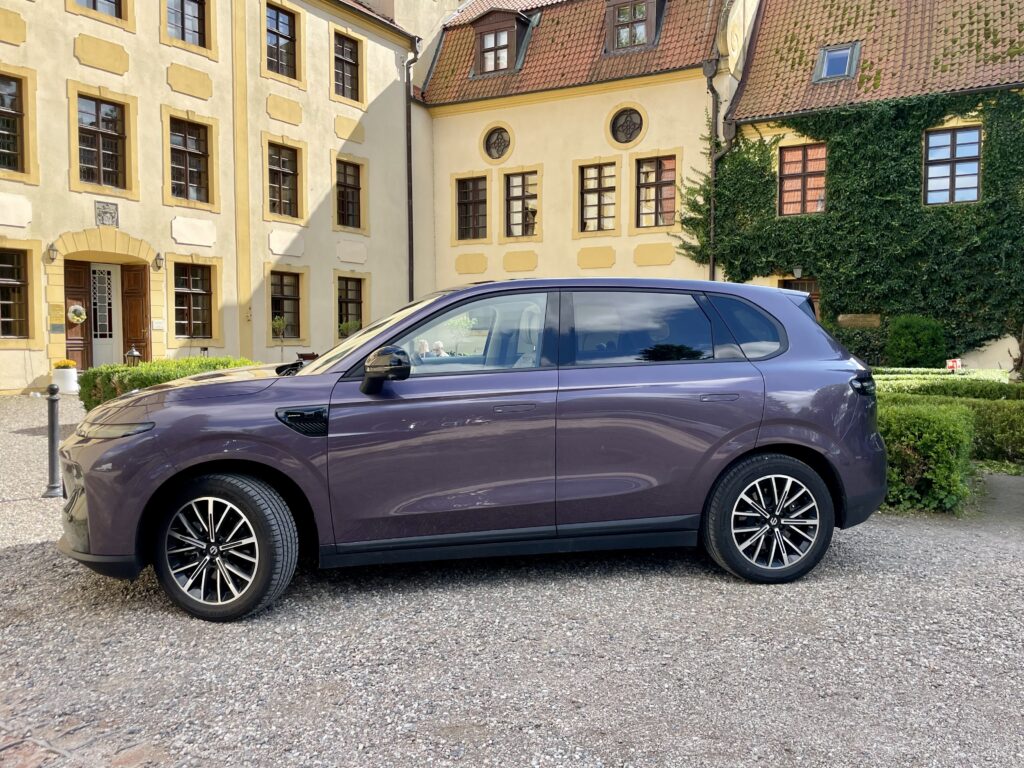
The all-electric Nissan ARIYA was designed in the spirit of timeless Japanese futurism, which seems to have become the brand's new styling canon. And indeed, the spacious Japanese crossover has gained a unique character, expressed in a bold, modern way. Inside the car you can feel a commitment to the principles of minimalism.

Besides the futuristic design, you notice touches that lift this car into the 'premium' segment. The washer jets do not spoil the lines of the bonnet or the scuttle panel, because they are integrated into the wipers. The huge armrest module between the front seats slides electrically by about 20 cm, creating a genuine 'wow' effect. The central storage compartment also opens electrically, and small motors help set the steering wheel in the optimum position in two planes.
Unfortunately, the consistent care taken over uninterrupted lines and futuristic form means that functionality suffers. The glovebox in front of the passenger is very small, and the floor between the front occupants is almost flat. This heightens the sense of space, but if the passenger puts something down by their feet, it can easily slide into the area where the pedals are.
With the interior so consistently built to a premium standard, it is surprising that the locations of the 'Bose' speakers are not marked by elegant metal grilles. The manufacturer was content to place them behind simple perforated panels of thick black plastic.

Seats and handling
The seats deserve credit for their many convenience features. The ventilation function - very useful on hot days - has three levels. The seat heating also has three settings. The electric lumbar support adjustment worked very well, moving smoothly in four directions. Settings can be saved in user profiles, which is particularly handy when several people use the car. Rear passengers can heat the two outer seats. Add the roominess of the interior, and it turns out that on long motorway journeys the front occupants can comfortably stretch their legs, while those in the back can even cross their legs, which clearly shows that there is more space than usual.
Unfortunately, it has to be said that the seats offered very limited lateral support, which, combined with considerable body roll, meant that the driver did not have a good feel for the car. Nissan says it did an enormous amount of work to give European customers sharper steering response and better stability at higher speeds. In the ARIYA versions intended for Europe, the damping force was therefore increased and the anti-roll bars and spring characteristics were modified to reduce body roll. For some reason this work was not seen through to the end, and the car drives in an 'American' way. The body roll is all the more surprising given that an inherent feature of modern electric cars is a low centre of gravity, thanks to the heavy battery module mounted low in the floor.
An interior without physical buttons

Nissan stresses that in developing the ARIYA's interior the designers drew on elements of the Japanese philosophies of 'ma' and 'iki'. This consistency has produced solutions that are modern, fresh, elegant and futuristic. The aim was not to spoil the look of the cabin with any protruding buttons (the exception being the switches on the steering wheel). All functions have to be controlled via the touchscreen. The climate control panel - the only one 'cloned' in analogue form - is fully integrated into the surface of the dashboard and is sometimes invisible. Hitting the right switch is impossible without taking your eyes off the road. The touchscreen displays could also do with some revision. The colours are subtle and pastel, which, combined with ambiguous graphics, means that it is sometimes hard to tell whether a function is on or off.
The car's software was not free of bugs either. Every time it emerged from a tunnel, the car changed the cruise control settings of its own accord, switching to 140 km/h. The route from Vienna into the Carinthian Alps included many tunnels, so this kept happening, taking the driver by surprise and requiring an immediate reaction.
Testing in Carinthia: range and mountain driving
Is Carinthia a good place to test an electric car? It is Austria's southernmost region, and a very varied one. From other parts of Europe you get here by motorway, and once there you often have to climb high into the Alps on some of the most beautiful scenic roads on the Continent. A very large share of the energy used in the region comes from clean, renewable sources, mainly power harnessed from tamed mountain rivers. Carinthia appreciates electric car drivers. There are a great many chargers (mostly AC), including in the resorts on its numerous warm lakes. Chargers along the scenic roads are completely free of charge, and hotels have charging points where a token fee is charged for a full charge, for example 5 euros.

The ARIYA is available with two- or four-wheel drive (e-4ORCE) and is offered in four trim levels, with several power outputs (from 214 to 394 hp) and two battery capacities (63 and 87 kWh). The version we tested had a rich array of advanced driver-assistance equipment and the larger battery. After the design, battery capacity is the car's greatest strength. The range claimed by the manufacturer is up to 533 km, and in reality it is not much less.
Covering 350 km at motorway speeds in this 'Japanese' is perfectly feasible. When the author of this article drove that distance on the motorway from Villach to Vienna with the cruise control set to 120 km/h and the air conditioning on, in an outside temperature of around 30 degrees, the car used 18 kWh/100 km. On arrival there was still enough range left for another 100 km.
Thanks to its fully electric powertrain, the ARIYA offers instantly available high torque, which means smooth, dynamic and almost silent acceleration and impressive flexibility. The powertrain is exceptionally quiet, and even at speed no unwanted noise came through. Motorway driving is aided by a head-up display.

In the mountains the car behaved in the way typical of zero-emission vehicles. Drives along Carinthia's Alpine scenic roads - such as the Nockalmstrasse and the Grossglocknerstrasse - were real 'rollercoasters', literally and figuratively. Going uphill the car used a lot of electricity, as much as 80 kWh/100 km. Coming back down, however, it recovered most of the energy, up to 80%. On occasion a longer descent added 15-20 km of range. Skilful switching between the 'D' and 'B' modes, which deliver different levels of regeneration, helped here. It is a pity the car was not fitted with paddles that would allow the level of energy recovery to be adjusted more precisely.
Charging and the CCS connector
The maximum charging power the ARIYA can use is 130 kW. That too is a very good figure, as it allows the car to be charged quickly. On the motorway it means reaching your destination sooner. When travelling around Carinthia, however, rushing is not advisable, because the locals' Mediterranean way of life obliges you to savour coffee, desserts or tasty regional dishes. There is an LED on the scuttle panel that confirms charging is in progress (blue). This is a helpful touch, as a glance at the car from a distance is enough to check the situation. Even a child can tell whether and how charging is progressing. The only pity is that there is just one LED, whereas the first generations of the LEAF had three, which gave an even clearer picture. Here too, presumably, 'minimalism' had its say.

The sight of the charging socket will come as a shock to fans of zero-emission Nissans. The CHAdeMO DC plug has been replaced by the CCS / Combo system, which is more common in Europe. With that, Nissan joins the leading brands of the Old Continent. Is the ARIYA driving a nail into the coffin of its sibling, the LEAF? This policy may contribute to a fall in the value of the world's pioneer of mass-market electromobility.
Safety systems
The ARIYA is equipped with a package of intelligent safety systems. Standard features include, among others: automatic emergency braking with pedestrian and cyclist detection, forward collision warning, driver fatigue detection, intervention in the event of an unintended lane change, blind spot warning and intervention, traffic sign recognition, and rear cross-traffic alert with emergency braking. The cruise control in the Nissan is the advanced ProPILOT Assist linked to Navi-link. Standard equipment also includes a 360° camera system and the I-Key smart key, and the top trim levels also feature adaptive Full LED headlights.
A new feature is intelligent route planning, which takes various factors into account in real time, such as traffic volume, road conditions, the availability of charging stations and the energy remaining in the traction battery.
Test summary
The Nissan ARIYA offers excellent range and a very high level of comfort on long journeys. Its design - both outside and in - sets it apart from the competition. For some users, the focus on minimalism and the subordination to futurism may mean reduced functionality and less convenient operation of the systems. That does not change the fact that the ARIYA is currently one of the most interesting propositions in the zero-emission crossover segment.