The island of Kos - a great Greek-style holiday
Greece is a "safe bet" when we think about an enjoyable summer holiday. Kos means a warm climate, sandy beaches, historic sites, delicious food, good infrastructure and locals who for years have been ready to make visitors' stays easier and more pleasant. Add a short flight and the widespread knowledge of English in the tourist trade, and Greece may turn out to be the ideal place for a successful holiday. I spent a week on Kos. Here are my impressions.

Getting to Kos and the island's location
The summer of 2020 was one big muddle when it came to making and carrying out holiday plans. "Business" destinations, mainly the big cities of Western Europe, disappeared from the LOT Polish Airlines network, and airports in typical holiday spots unexpectedly appeared. As part of its "Lot na wakacje" ("Fly on holiday") campaign the airline launched routes to as many as 12 Greek airports, including some it had never flown to before. One of them was the island of Kos, and that is exactly the route I took. (if you want to combine sightseeing in Athens with a nearby island, I recommend this post)
When we think of Kos, two things may come to mind. There is the island of Kos and there is the town of Kos. The island of Kos is one of the most remote Greek islands in the Mediterranean. From its shores Turkey is only 5 km away, and Cyprus is not far either. Kos belongs to the same group of islands as Rhodes, part of the Dodecanese. Kos Town is the largest and most interesting town on the island; it has the harbour from which boats set off on interesting cruises around the smaller neighbouring islands. From here you can also take a day trip to..... another continent. Yes, if you opt for a cruise to Bodrum in Turkey, you cross the border between Europe and Asia. Unfortunately, in the summer of 2020 such cruises were not running because of the pandemic.
Kos Town and the plane tree of Hippocrates

The charming town of Kos is a good place to start exploring the island. A beautiful harbour enclosed in the crescent of a bay, an old castle, architectural remains from Hellenistic times and Turkish mosques. The latter, sadly, are falling into decay. Kos is famous for its nightlife and even has a distinct district of bars and clubs. And again the mark of 2020: the district was empty both by day and by night. The spirit of Hippocrates hovers over the town; he is said to have laid the foundations of medical science here, as his life and teaching are linked with the island. A plane tree grows in the town centre, and locals claim that it was in its shade, almost 2,500 years ago, that he refined the principles of diagnosis and treatment surrounded by his students. It is a nice legend, since the tree is "only" 600 years old.... It looks like a huge bush, its thick boughs propped up in many places.

The Asklepieion, the Agora and the Therme hot springs
A trip for connoisseurs is a visit to the Asklepieion (8€ admission), which lies close to the town. It is only 4 km from town, yet you go back in time a good 2-3 thousand years. The Asklepieion was an ancient "sanatorium". Today there are plenty of "stones" here, a few columns, steps and basins in which people took healing baths. In general, lovers of ancient ruins will not be disappointed on Kos, because even in the very centre of town there are large sections of uncovered and protected ancient excavations. One of them is the "Agora", which owes its present-day exposure to the earthquake of 1933. The collapse of medieval buildings then revealed an even older, ancient part of the town, which we can visit today (free admission).

Not far from Kos Town lies an unusual attraction of the island. These are the thermal springs, marked on signs and maps as Therme. Hot fresh water flows from deep underground into a small pool, where it mixes with salty seawater. A dam of boulders and stones naturally lets in cooler water from the open sea every now and then, creating a mixture at a bearable temperature. The smell of rotten eggs hanging in the air is sure proof of the healing properties of the bath. Unfortunately, there is no infrastructure of any kind at the bathing spot, and the surroundings are spoiled by an abandoned residential building (a former guesthouse?) and a smaller stone outbuilding.

The mountain village of Zia and Plaka Forest
The island of Kos is tiny (50x20 km), yet it seems to have "everything", even mountains. The mountain village of Zia has been heavily adapted to the needs of tourists, but you cannot deny its charm. There are too many tacky souvenir shops and too many little restaurants crammed together, but the views are superb. On one side high mountains (from here you can climb Dikeos, 846 m), on the other a distant view of the sea, Turkey and the surrounding islands. It is always most crowded here before sunset, but that is hardly surprising, because it really is impressive.

Another place worth seeing is the Plaka Forest, which lies in the western part of the island, near the airport. Do not expect a sea of trees; it is more of a grove, but the plants are not the point here. Peacocks have made themselves at home in the lowest part of the area; there are at least several dozen of them, used to people. But that is not all. Cats doze among the stately strolling peacocks. And that is still not all. Turtles swim in a small pond. This colony of utterly mismatched "forest" animals is astonishing.

Kefalos peninsula beaches and the old windmill
The wildest part of Kos is the Kefalos peninsula in the west of the island. This is where there are the fewest people and the most beaches; it is ideal for a quiet, chilled-out holiday. It is good to have a car (30EUR/day), a scooter (17EUR) or a quad bike (19EUR), so you can spend the day on your favourite beaches (2 sunloungers with a parasol cost about 7EUR) and feast in seaside tavernas in the evening. Among the beaches I remember most fondly is the small and somewhat windy "Agios Theologos" at the very tip of the peninsula. On the way there you pass a beautifully situated little church with whitewashed walls and blue doors and window frames. A few colourfully flowering shrubs complete the picture-postcard view.

Another beach is "Paradise", which has a water sports centre. There you will find jet skis, parasailing and "banana boats" towed out towards the open sea by a motorboat. Next is the cramped, wild but gorgeous "Camel Beach"; there are few parasols and sunloungers, so it is best to arrive early to make sure you get one.

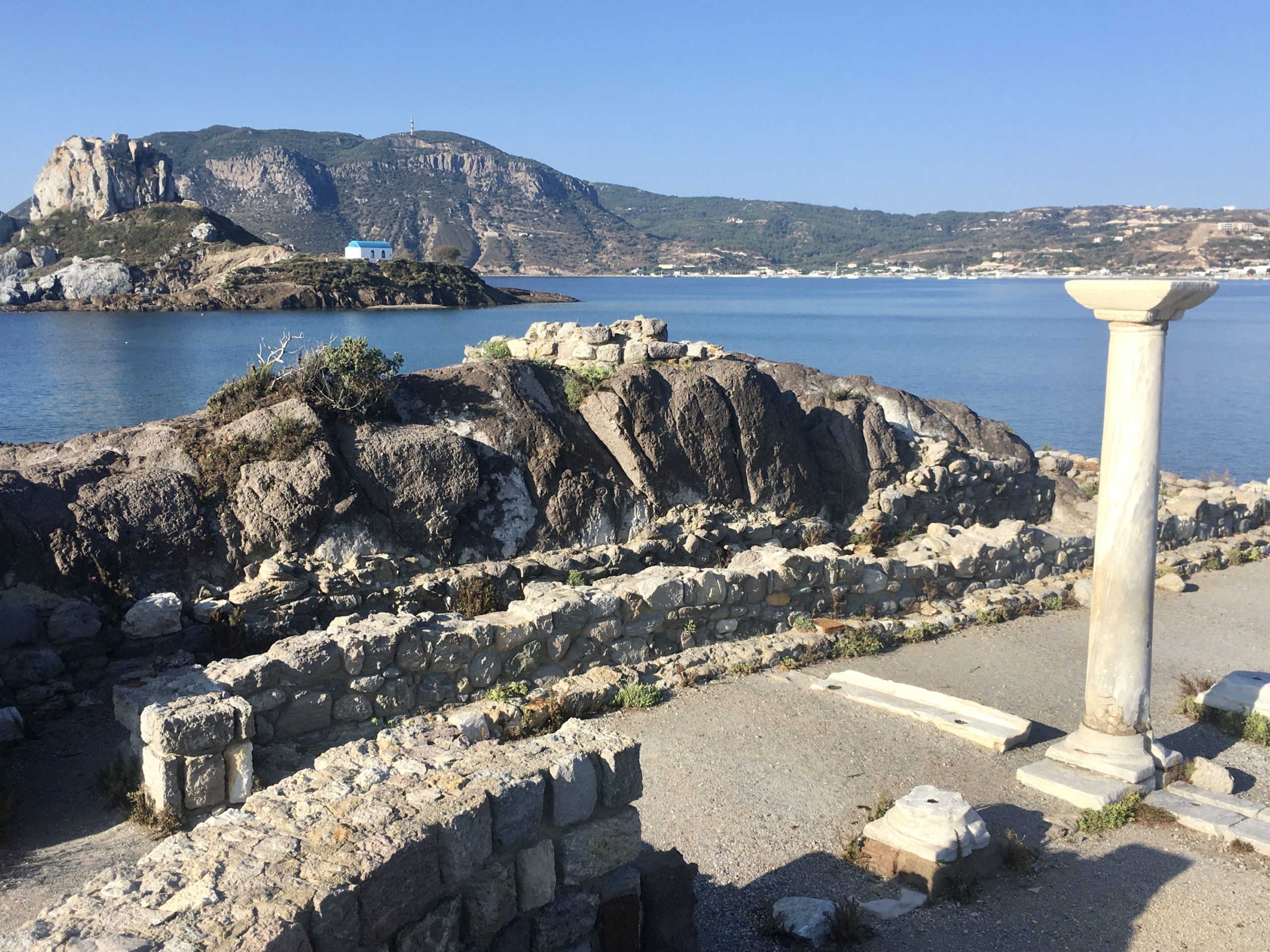
Close to Kamari is "Agios Stefanos", where you have the ruins of a Greek temple behind you and, in front of you, a rocky islet with a white and blue church. Many "daredevils" swim from the beach to the islet. It is not that big a challenge, because for at least a third of the way you can touch the bottom. My favourite beach became "Lagadas", where you can walk for kilometres, with a "colony" of sunloungers and parasols every few hundred metres and, by the car park, a food truck with a little restaurant knocked together from pallets and planks. All in white and blue, of course.

The village of Kefalos is up on the hilltop, while the part closer to the beach is Kamari. And it is from Kamari, looking up at the hills of Kefalos, that you will see the silhouette of a windmill in the distance. The beautifully restored 400-year-old building, some of whose wooden mechanism parts are 800 years old, is the oldest windmill on the island of Kos. Once you have bought a ticket (5EUR) you can explore the whole site, go inside the building and climb the stairs to its upper floors. You can also look inside the old house of an island family. It is essentially a single room, once home to 8 people, but painstakingly recreated along with its furnishings. At the very end you will be treated to cinnamon juice served with local cheese. Cinnamon juice tastes completely different from what you would expect. Worth it!

Cruise to Kalymnos, Pserimos and Plati
When you are on Kos, it is worth taking a cruise around 3 islands. In my opinion it is an absolute must during your stay. The boat sails to Kalymnos, Pserimos and Plati. The package includes lunch, swimming in the sea, jumping off the boat and watching wild dolphins. The price at many small travel agencies is 30€, and in the west of the island a little more, 35€, but after some friendly haggling you will pay 25€, and children half that.

The cruise starts at around 10.00. Several boats set off at the same time, but they follow the same programme in a different order. The first stop may be Vathi, a charming village on the island of Kalymnos. The boat sails into a beautiful natural fjord. There is a little time to explore the area, stroll through the quiet lanes, try local delicacies or watch fishermen untangling their colourful nets. In the harbour you can drink freshly squeezed orange juice. Some boats offer lunch on board, others in a harbourside restaurant. The standard menu is chicken souvlaki, salad, tzatziki and bread. There is also a vegetarian option with beans and dolmades (vine leaves stuffed like cabbage rolls) instead of meat. After the meal the boat heads towards nearby fish farms. Their smell attracts dolphins, so there is a good chance you will see these intriguing mammals leaping out of the water. The next stop is the islet of Plati. The boat moors very close to the shore, and as soon as the engines stop you can jump into the water and swim. The water around here is incredibly clear, and through the blue and turquoise colours of the sea you can see the sandy bottom. Meanwhile a happy hour starts on board, with cocktails served at a discount. The last stop is the island of Pserimos, where only 15 families live outside the season. In summer, though, it gets a little busier. You get an hour of free time to explore. You can swim in the shallow water by the sandy beach, discover hidden corners or simply relax in a local taverna over a glass of well-chilled white "Retsina" wine. The boat returns to Kos at around 17.30.

Greek food on Kos: gyros, moussaka and kleftiko
Greece offers plenty of joy to lovers of good food, and Kos is no exception. I fondly remember the thick yogurt I ate with honey for breakfast, and the wonderful olives. The best Greek tangy "cabbage rolls", that is rice wrapped in vine leaves, were served at "Maria" in Kefalos. This simple family restaurant has a beautiful view of the bay. For something quick, cheap and to take away you could always count on gyros, or as we would call it.... a kebab, available both in roadside bars as a "handheld" wrap and as a "plated" version in restaurants. You will often come across Greek moussaka, something reminiscent of Italian lasagne. An interesting dish was Kleftiko, baked lamb, perhaps a little dry but wonderfully tasty, with feta cheese. Stifado, in my case, meant mussels or prawns in an onion and tomato sauce. And seafood and fish? My thoughts turn to the restaurant Ta Votsalakia in Kos Town; most of the fish restaurants are in the part of town stretching north from the centre. And I cannot leave out the fresh figs picked straight from roadside trees.

The Greek island of Kos, small as it is, will give you plenty of holiday memories. The warm climate, the variety of sandy and rocky beaches, the historic sites, the food and the views can together make the perfect mix for a successful holiday.
But remember that Greece is not just islands..... read about a completely different, fascinating Greece here