








Southern Croatia - Neretva, Dubrovnik, Konavle
Times change, but Croatia's southern Adriatic coast still draws crowds of tourists. They used to come with tents, often bringing their own food. Today they can count on luxury hotels, motor yachts and top-class restaurants. Bridges, ferries, motorways and an airport make travelling comfortable. What has not changed is the beautiful scenery, the hospitality, the smiles, the excellent wine and olive oil, the fresh fruit and vegetables.Dubrovnik-Neretva County (županija) is the southernmost part of Croatia, with its capital in Dubrovnik. It is the only county to border Montenegro, and it also has Bosnia and Herzegovina as a neighbour.

The Neretva Delta
The Neretva Valley is a place where time has stood still. Although the river flows mostly through Bosnia and Herzegovina, its beautiful wetlands lie in Croatia. This is untouched nature, a place where you can feel the call of the wild, but also get to know hospitable hosts.
Gliding through the narrow channels and backwaters of the Neretva in a traditional boat can be an unforgettable experience that brings a feeling of peace and complete relaxation. In the past, children were born in boats like these, weddings took place in them, and people often lived to a ripe old age in them. The Neretva boat once meant life itself; today it is a source of pride and a memorable symbol of a tradition that once again delights every welcome guest in the river delta.

The boat will be steered by a local host, who will charm you with stories of life in the Neretva Valley and show you how the locals fish and grow mandarins, figs and grapes. He will reveal the secrets of the Neretva's famous delicacies, raise a toast, treat you to a jug of Neretva wine and, of course, sing to the accompaniment of a guitar. In the colourful labyrinth of Neretva channels decorated with gorgeous water lilies, hidden behind the reeds and rushes, lie the habitats of unique bird species.
The Neretva river is in the northern part of Dubrovnik-Neretva County. To get there from Dubrovnik, you have to cross a narrow strip of land belonging to Bosnia and Herzegovina, but the border formalities are kept to an absolute minimum. From next year, using the cross-border corridor will no longer be necessary, as the two parts of Croatia will be linked by a bridge that is currently under construction.
Wines - The Pelješac Peninsula

The Pelješac Peninsula is covered with vineyards, and wine production is one of its most important activities, with a long tradition behind it. Wine routes and guided tours of vineyards and wineries are a unique way to experience the locals' deep attachment to grapes, wine and life, and their love for the Pelješac Peninsula. It is worth stressing that after years in which the winemaker's craft was stifled in communist Yugoslavia, the devotion with which local winemakers treat their wines has been reborn.
It is no surprise that some of Croatia's best wines are made on the Pelješac Peninsula. Some say you will not find a farm there that does not make wine. And indeed, there is a vineyard and a place to taste wine at every turn. Besides tastings, you can buy wine and olive oil from family vineyards and olive groves. The producers are ready to welcome both groups and individual visitors. Although wine tastings follow a fairly standard routine, every vineyard and cellar looks different. You will often see an old section with venerable solid-wood barrels, and right next to them modern vats of gleaming stainless steel. This combination of tradition and present-day technology gives the best results.

Several grape varieties are grown on the Pelješac Peninsula. Local producers are particularly proud of the superb Plavac Mali, because it finds some of its best sites here, growing on the peninsula's southern slopes. The very colour of this wine, a deep ruby with a violet sheen, hints at its power and stature. Connoisseurs say that under the intense sunshine it has managed to keep its fruitiness and a certain "cheerfulness". The wine has a slightly higher alcohol content and a discreet touch of residual sugar, a combination that gives it a wonderfully velvety taste. As you drink it, you can taste red berries (blueberry, raspberry), and it is only natural that, while enjoying it, you want another sip. Plavac Mali goes perfectly with game, fish and seafood.
Medieval, Fortified Ston
When on the Pelješac Peninsula, you really must visit the town of Ston, which sits in a strategic spot on the isthmus linking the mainland with the peninsula. To the north lies Stari Ston. Both towns are surrounded by walls dating from the days of the Republic of Dubrovnik. The fortifications that have survived to this day justify calling them, without any exaggeration, the "European Great Wall of China".

The wall was originally 7 km long and consisted of several sections: the stone town walls around Ston, those surrounding Mali Ston, and the so-called "Great Wall". Its forts and towers were reinforced with 10 round and 31 square flanking towers and 6 semicircular bastions. These complex defensive walls took almost four centuries to complete, because the builders had to adapt to the difficult terrain and update the fortifications to keep pace with advances in military technology. The walls were last used for defence in the 19th century, and today they are a priceless monument of enormous architectural and cultural value.
The reason for building the fortifications was the constant threat on the remote fringes of the Republic of Dubrovnik's territory. Construction of the defensive walls began in 1333, and the town of Ston was built in 1335 according to carefully thought-out plans, which were further modified in 1370. Today the town is considered one of the best-planned and best-organised towns of its kind in Europe.
Today Ston is being rediscovered, and the walls serve as a backdrop for many cultural and sporting events. One of the most interesting is a marathon whose route runs along the centuries-old stone fortifications.
The revitalisation of Ston is allowing us to discover the full layout of the fortification belt, and the town's unique medieval fabric is also being restored. It is worth noting that the Adriatic surrounding the town made it possible to harvest sea salt, which laid the foundations for the salt works. This was one of the reasons why establishing and maintaining Ston was a priority for the Republic of Dubrovnik. Many of the builders employed here had gained their experience building the city walls and other structures in Dubrovnik.
Oysters

Ston is not just mighty fortifications, a medieval town centre and salt pans. The municipality of Ston includes an area famous for farming top-quality mussels and oysters. According to surviving records, oysters have been farmed here since the 17th century, harvesting them began as much as a hundred years earlier, and they were already a culinary delicacy in Roman times. Mali Ston Bay proved particularly well suited to farming these delicious shellfish thanks to the freshwater Neretva flowing into the sea and the frequent winter rainfall, which together create ideal conditions for their growth. The best time to harvest oysters is March, because that is when these precious shellfish have the most meat. That is also when Mali Ston hosts a food festival promoting oysters. The tastings are accompanied by good wine and good fun for the locals and the growing numbers of visiting tourists.
Oysters, which are after all foreign to Polish culinary tradition, have to be prepared following special procedures. When cleaning fresh oysters, it is important to open them carefully over a bowl, so as not to spill the salty juice hidden inside. Hold each oyster firmly in a cloth, then insert the tip of a knife between the upper and lower shell. To open it, twist the knife, separating the two halves. The meat is then cut free, the flat half of the shell is discarded, and the meat is put back into the rounded half together with the juice the oyster released when it was opened.

Oysters can be grilled, fried, baked with cheese in the oven, added to many soups along with other shellfish, or cooked in a sauce for pasta or risotto, but they are tastiest served raw on ice with a few drops of lemon juice. Oysters are most often served by the half-dozen or the dozen, they can be paired with both red and white wine, and with perfectly chilled sparkling wine they make for an exceptional taste experience. Many consider oysters a natural aphrodisiac, which is one of the secrets of their popularity.
Iconic And Luxurious Dubrovnik
The biggest attraction of Dubrovnik-Neretva County is iconic Dubrovnik. It is undoubtedly one of the most beautiful cities in the Mediterranean, with its monumental defensive walls washed by the waters of the Adriatic. Its old town has been the setting for several cult films and has been enchanting visitors for centuries.

Admittedly, there are many beautiful places on earth, but looking at Dubrovnik with its old palaces, squares and red-tiled roofs, you get the impression that such beauty cannot be found anywhere else. Add to that the warm southern climate, the clear blue sky, the emerald-green and dark-blue depths of the sea lapping at the stone shores and spilling into countless coves, and the steep slopes covered with lush, subtropical Mediterranean vegetation, and you can be almost certain that this combination cannot be copied.
The city enjoys more than 250 sunny days a year, with an average annual temperature of 17°C, while the average temperature in the winter months is 10°C and in summer around 26°C. The average summer sea temperature is around 21°C. The outdoor swimming season starts as early as April, sometimes even earlier, and lasts until the end of October, often longer. Many hotels have indoor pools where you can swim all year round.

It is worth taking a look at Dubrovnik's history. Several thousand years BC (some say 6000 years, others 3000 to 2000 years before Christ), there was already life in the immediate vicinity of Dubrovnik. The city's origins are lost in the mists of time, legends mingle with historical facts, and records from ancient times either have not survived or are so scarce that historians and archaeologists still have much work ahead of them to shed light on how the city came into being. What is certain, though, is that any account of Dubrovnik should refer to nearby Cavtat, 18 km south-east of Dubrovnik. That is where the Greek city of Epidaurum was founded. According to some theories, the Greeks established it as early as the 7th century BC. Amid the clash of eras, peoples, wars and migrations, the city ceased to exist, and its few remaining inhabitants sought refuge closer by, in the area now called Župa Dubrovačka, where the settlements of Spilan and Gradac (Burnum) existed at the time, while on the rocky islet of Laus, which was also inhabited, the first centre of old Dubrovnik gradually took shape. The rapid settlement of Laus gave rise to a new city, today's Dubrovnik (7th century), which put down its deepest roots here, on a small rocky patch of land, and over centuries of restless change built up its glorious history. During the 7th century, Slavic tribes, the Croats among them, settled permanently on the eastern coast of the Adriatic. It was then that the Roman towns became "ethnic islands" in a flood of Slavic population.
As the population grew and the Roman towns developed, a settlement with a Croatian name, Dubrovnik, grew up near Ragusium, beneath Srđ hill. It was named after the oak forests that are still called dubrave in this area today. During the 10th and 11th centuries, the sea channel between the two villages became ever shallower as silt built up, and it was eventually filled in. When, at the end of the 12th century, the two settlements were joined, strengthened and surrounded by common fortifications, Dubrovnik acquired the urban outline that has survived to this day.

Dubrovnik's beauty draws visitors from all over the world. The city is ready to welcome even those with the highest expectations. There are 19 five-star hotels with full facilities in the city and its immediate surroundings, and local tourist organisations are often recognised for their standard of service. The Dubrovnik Tourist Board won the Best Stay 2017 award in the "Best luxury tourism destination" category at the Best Stay conference held in Split. Dubrovnik was also singled out, by 250 experts, as a leading luxury tourism destination thanks to its offer and professional presentation.
Among Dubrovnik's most luxurious hotels, a few deserve a mention, as they will meet the expectations of the most discerning guests. They include the Dubrovnik President Valamar Collection Hotel, the Sheraton Dubrovnik Riviera Hotel and the Royal Princess Hotel Dubrovnik. And one cannot leave out the Hotel Excelsior Dubrovnik, the choice of celebrities from all over the world. The latter owns Villa Sheherezade, one of the most luxurious seaside residences in Europe. It is worth mentioning that renting it for one night costs 12,000 euros.
Dubrovnik Panorama - The View From Srđ Hill

The cable car up the hill towering over Dubrovnik was built in 1969. At the time it was the only cable car on Croatia's Adriatic coast. It once carried just 15 people, whereas today 2 modern cabins carry up to 32 passengers and need less than 4 minutes to cover the 778-metre distance between the lower and upper stations, passing a single support pylon.
The lower station offers convenient space for guests to get off two coaches at the same time, with suitable facilities. The upper station, at 405 m above sea level, has three terraces equipped with binoculars, a panoramic restaurant and a souvenir shop. There is also an amphitheatre seating 120 people, which can be used for special events or corporate presentations.
The top station of the cable car is on Srđ hill. The view of the city from there is magnificent, but when you turn around you can take in a vast area stretching all the way to the country's border, once known as Dubrava. In the local dialect Dubrava means forest, and that is exactly what it was: lots of oaks and pines grew here.
Local Specialities And Dishes
Konoba Dubrava, which borrowed its name from that ancient land, is only 10 minutes from Dubrovnik's old town, on the eastern side of Srđ hill. Despite being so close to the city, you feel as if you have landed in a village tavern deep in the Croatian interior. The interior is filled with large benches of solid wood and an open hearth. That is where food is cooked the "peka" way, under a large bell covered with hot embers. Add drinks, music and folk dancing....
But before the "peka" arrives at the table, you will certainly be served starters, the best known and most appreciated of which is Dalmatian pršut. This dry-cured meat speciality is eaten just as eagerly every day as on special occasions, as an obligatory starter with an intense sweet and salty flavour.

Pršut is made from the fresh leg of a specially fed pig. A leg can weigh as much as 16 kilograms. After slaughter, the cleaned legs are placed for one day in a special room at a maximum temperature of six degrees Celsius. It is important to turn the skin side of the leg upwards so that the meat begins the proper drying process. Large amounts of fine and coarse sea salt are then rubbed into the pršut. The seasoned legs must be left to rest for at least a week, after which they are salted again. To speed up the drying process, the pršuts are weighed down, and this is how the meat acquires its delicate tenderness. It is also a good idea to place the leg between two boards and load the top one more heavily day by day. While the pršut is resting, the meat is rubbed with a mixture of pepper and vinegar, or oil and garlic.
The pršuts are then hung on hooks in a smoking room, where the smoke comes from smouldering beech, oak or hornbeam wood. After smoking, the pršut is dried for at least a month, and the meat naturally reaches the required firmness. Then the pršut matures, hanging in a room with a stable microclimate and a constant flow of air, but to keep the meat from drying out too much, it is exposed to the south-easterly jugo wind. The dry-cured ham is usually ready to eat after a year of drying. Its quality shows in an even colour, from dark to light pink, with white or slightly pink fat. On the plate it is usually cut into thin slices and served with homemade bread and cheese.
"Peka" is a traditional and still very popular way of preparing many specialities throughout Croatia; it involves cooking food over an open fire in a clay or cast-iron dish. The "peka" has been used for many purposes throughout Croatia's culinary history. The specialities cooked under a peka include bread (kruh ispod peke), roast veal and lamb, and octopus. Meat cooked this way has a special flavour: it is juicy and tender and comes away easily from the bone. An essential accompaniment to the meat dishes is potatoes, which, cooked and roasted in the meat juices, have a wonderfully delicious aroma.

The "peka" dish consists of two parts: a base, which is placed on the hot hearth and on which the food to be cooked is laid, and a heavy lid, which allows the contents to roast and stew in their own juices at the same time.
The peka lid is dome-shaped and has a handle on top, so it can be lifted off once it is hot. Once the food is covered, the peka bell is buried in glowing embers. To cook food like this on a hearth, you need good embers from pieces of wood such as hornbeam or beech, which give heat not only from above but also smoulder beneath the bottom of the peka, so that the contents cook evenly.

Cooking "ispod peke" is one of the slower roasting methods, so depending on the amount and type of meat, the peka may stay under the embers for several hours, and its contents have to be turned several times so that they roast evenly on all sides, and basted with wine or sauce to give the meat a wonderful flavour. That is why the embers had to be watched over, so that they would last through many hours of cooking. Tending the peka was an excuse to drink a few glasses of good wine and get into the mood for the feast to come.
Konavle
The south of the country, bordering Montenegro, is largely roadless terrain, wild meadows and marshland. That makes Konavle the perfect place for a quad bike expedition. This adrenaline-packed excursion can be recommended to anyone. For the tough there are open quads from the renowned Bombardier brand, and for everyone else four-wheel off-road buggies. The organisers take safety very seriously. The safari instructor introduces guests to the quads and shows them how to control them. He also teaches them a few hand signals he will use to communicate with the rest of the group. During the ride you experience four completely different types of terrain. The route starts in the fields of Konavle and continues along the Ljuta river, which you cross at a ford. It is quite exciting, because the riverbed is stony and reaching the other bank means climbing a fairly steep embankment. Next, the route leads through the wetlands and meadows of Konavle. A stop is planned in the picturesque village of Čilipi, where you can have a good coffee and visit the regional museum. The way back is just as varied. It leads to a mighty cliff with a view over kilometres of turquoise Adriatic. It is another great spot for photos. We finish the route by riding around pastures where herds of horses graze freely.
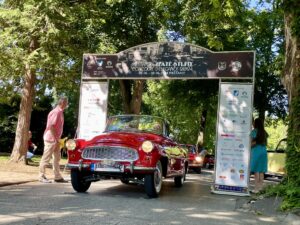
Another option is a convoy drive in "youngtimers". There may be less adrenaline here, but there are plenty of references to the past that may bring back memories of our fathers' and grandfathers' stories about their trips to the Adriatic. You have restored Renault R4s at your disposal. Remember that what the Fiat 126p was to Poles, the Renault R4 was to the people of the former Yugoslavia. Produced in what is now Slovenia, the car put the Balkan country on wheels and was nicknamed the "little giant" ("mali div"). Just like the "little Fiat", it was used for everything: commuting to work, family celebrations, delivering equipment to farmers and taking farm produce to market.

If you are travelling in a large group, you can have as many as 22 restored, fully working Renault R4s at your disposal. The cars are almost identical; each has 32 horsepower and they all have opening canvas roofs, but one has been converted locally into a "buggy"-style convertible. The Renault R4 fleet can be delivered to Dubrovnik airport, so you can set off straight after landing. The route can be tailored individually to take in the most picturesque parts of southern Croatia.
Sea Activities

The beautiful Croatian coast looks one way from land and another, perhaps even more beautiful, from the sea. One way to admire the coves, islands, beaches and mountains is a cruise on a chartered motor boat. A full-day cruise lets you sail around the islands of Šipan, Lopud and Koločep. Along the way you stop for a swim, the yacht moors in a picturesque harbour, and you can walk up to the highest point of the island to admire the wild cliffs and Mediterranean vegetation. Some of the coves you pass will seem forbidding and inaccessible, while others, with their shallow, warm water, will positively invite you in for a swim. You will also call at places where the coastline hides rock caves. Snorkelling equipment is provided on board, and local guides will point out where the underwater life is most interesting.

Dubrovnik Čilipi Airport
The gateway to Dubrovnik, the Pelješac Peninsula, the Neretva river and Konavle is Dubrovnik airport. It is conveniently located just 20 km from the city and in season handles flights from all over the world. There are car rental desks in front of the terminal. The modern terminal does not overwhelm you with its size, but it has been designed tastefully and functionally. The grounds around the airport are beautifully landscaped; you feel as if the buildings have been set into a lovely park full of colourful flowers and lush greenery.

Direct flights from Poland make southern Croatia a great holiday destination, especially for a holiday that combines time on the beach with a range of activities. Beautiful Dubrovnik awaits, with its superb food scene, the vineyards of the Pelješac Peninsula, the meandering Neretva river, the fortified town of Ston and many, many other attractions. The hotels are top-notch too. When planning a trip to Dubrovnik-Neretva County, it is best to rely on the professional support of local partners, such as the RebranD agency.


