New Zealand - the North Island
A great brown gateway of solid wood. The gateway, and beside it a wooden pole topped with a carved bird with outstretched wings. Faces with gleaming eyes and open mouths, neither human nor ape. Everything studded with shining stones. “Welcome to Auckland”, says New Zealand's largest international airport, and straight away it pays tribute to the first inhabitants of these lands, the Māori. I will devote a separate story to my thoughts about the Māori.

24 hours and then some of travelling are behind us. Had it not been for an exceptionally cheap ticket from London to Auckland, it would probably have been a long time before we made it to this end of the world. As it was, we first flew Warsaw to London (thanks to a LOT promotion, 300 PLN per person return). Then Thai Airways to Bangkok, a change of planes and on with Thai again to the North Island (2100 PLN per person return).

It is mid-February 2017, and ahead of us lie 2 weeks of intensive exploring in the land that lies furthest from Poland. A destination that many travellers dream of: remote, beautiful and mysterious. Yet at the same time friendly, part of European civilisation, English-speaking and predictable.
Our plan was to travel from north to south. The North Island came first, then a ferry crossing to the South Island and on down to Christchurch. In Christchurch we returned the car to the hire company. Do check how much extra you will pay if you return the car somewhere other than where you picked it up; we managed to get this included in a special offer. From there we took a budget flight north to Auckland, where our long-haul flight back to Europe was waiting. I will write about the South Island next time.
Since we had decided to skip the cities altogether, we do not even give Auckland a second glance. As soon as we have picked up the car we drive around the Firth of Thames and head north to Coromandel.
The Coromandel Peninsula and Fletcher Bay

The 165-kilometre drive takes us 2.5 hours. Motorways are few and far between in New Zealand, but traffic is light, with a few jams in the bigger towns. We check in at our backpacker motel, walk down to a nearby cove and… collapse. We are completely worn out by the journey.
First impressions? Hmm… people here are completely laid-back. When we pick up the car, wise from past experience, we meticulously check every scratch and dent. Then it turns out the employee signs whatever we put in front of him without checking a thing. In a large supermarket along the way we see several people walking around… barefoot. Barefoot from the car across the car park, barefoot around the shop. Another time we watch a farmer in an old pick-up who has pulled up to adjust his irrigation system. He is barefoot too.
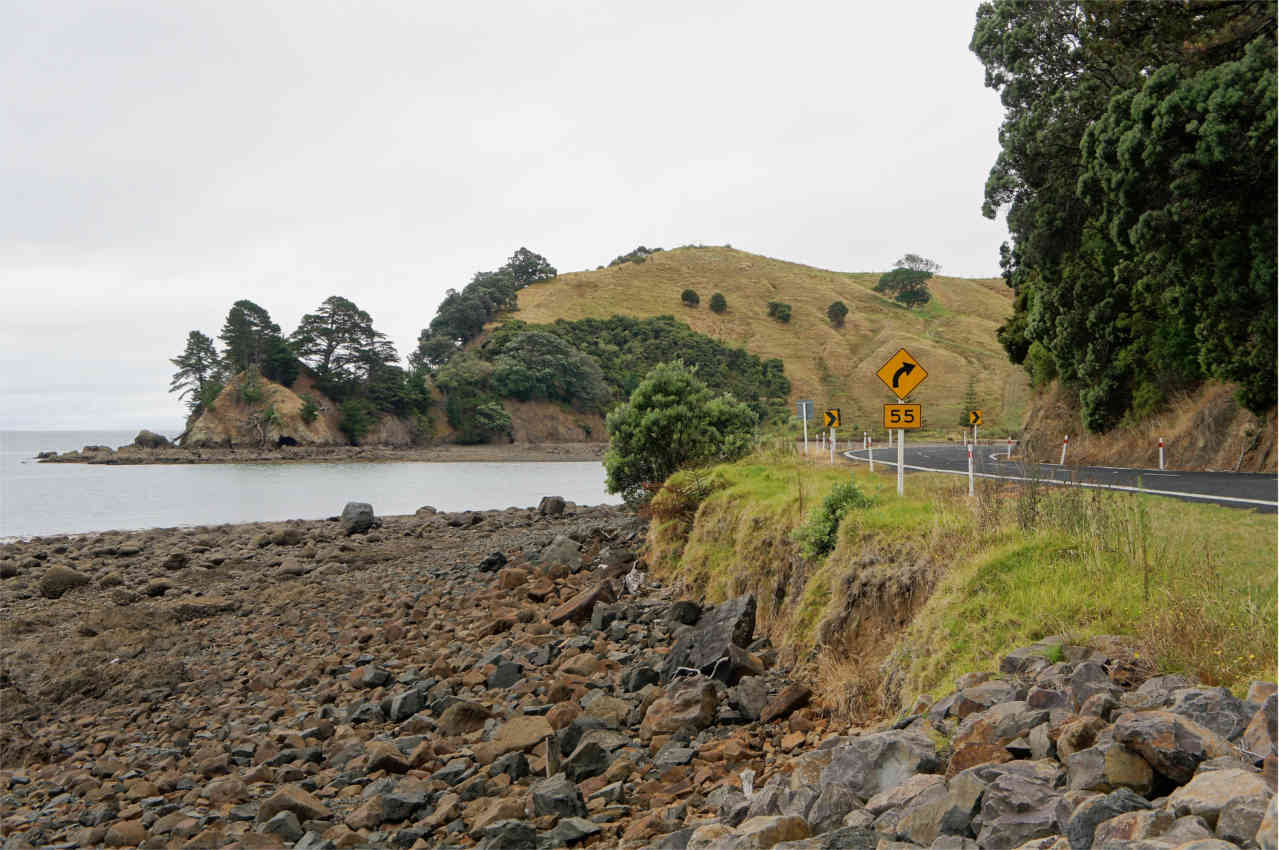
The little town of Coromandel looks like something out of the westerns we remember. Low wooden buildings, verandas, plenty of old-fashioned signs. We change our euros at 1.39 and get a wad of New Zealand dollars. We drive to the very northern tip of the peninsula. The tarmac ends and gravel begins, the houses run out, with the coast on our left and meadows on our right, and huge trees hung with what might be branches or might be roots. Among them are monstrously large ferns. Was this where they filmed “The Lord of the Rings”?

 Watch on YouTube
We park the car by the last campsite and set off for a short walk near Fletcher Bay. An ambitious plan, but we are still very tired from the journey. A slightly hazy sky and a pleasant temperature lull us into a false sense of security; we turn back halfway because we are running out of water.

Hot Water Beach and Cathedral Cove
We fill our bottles from the tap at the campsite and head for one of the island's most unusual attractions: Hot Water Beach. Time and again we will come across geothermal phenomena here, and this peculiar beach is our first taste of them. A huge, empty expanse of sand with one small patch covered in a tangle of bodies. A spade is essential, as is some knowledge of… fluid thermodynamics. Then again, anyone who has ever used a British washbasin, where continental Europeans wrestle with two taps to get the right temperature, already knows enough. You have to dig with your spade and channel the streams so that the hot water welling up from deep underground mixes with the water cooled at the surface. Together with the young Germans we share our “pool” with, we keep the inflows just right. Germans are the nationality we will meet most often in New Zealand. The yelps of mildly scalded people bring smiles to our faces. Team work! Jawohl!

Nearby is Cathedral Cove, a rock arch on the coast. We want to see it up close, but it turns out, and the guidebooks do not mention this, that it is another 45 minutes' walk from the car park. We give up, as evening is drawing in and the light is fading.
Rotorua: Whakarewarewa and Waimangu Volcanic Valley
The next day we travel to Rotorua. The town and its surroundings are the heartland of Māori culture and geothermal activity. We opt for a “two in one” package: a tour of the Whakarewarewa living village and open-air museum combined with a show of traditional Māori songs and dances. As if that were not enough, the village sits on top of a very active geothermal area.

We start our tour just as it starts to rain. We do not yet know that the rain will keep us company for the next few days. We buy a corn cob freshly pulled out of a bubbling hot spring.

We wait on a specially built platform for the geyser to erupt. It goes off regularly, but the rain turns into a downpour and we decide to look for another chance to see a plume of hot water shooting high into the air. We head back to the hall where the performances are about to begin. The climax, of course, is the haka (I will describe it in a separate text about the Māori).

 Watch on YouTube
( if you would also like to read about the Māori and their culture, you will find it here )
Knowing that the area around Rotorua lets you see many different faces of geothermal activity in one place, we decide to round off the subject here. We head for the nearby Waimangu Volcanic Valley and walk down into the valley, taking in our surroundings. What looks like a beautiful lake of azure water is in fact a pool of acidic water containing countless chemical compounds.

An innocent-looking stream is steaming, because the water is close to boiling point. Water bubbles away in countless crevices, forming micro-geysers. The edges of the many pools are covered in green algae or rocky crusts formed by precipitating minerals.

Tongariro National Park and Tawhai Falls
Our goal is Tongariro National Park, and in particular the Tongariro Alpine Crossing. This 18.5 km route crosses volcanic, mountainous terrain with spectacular views, and is widely described as the best one-day trek in New Zealand. That is tomorrow's goal; for now, 420 km are behind us, we have found somewhere to stay and it is time to rest. Even though we park right opposite the entrance to our hostel, the luggage we carry in gets thoroughly soaked. We ask about the weather. “It'll be much the same, maybe a little worse”, the receptionist, a woman of Asian appearance, tells us with a smile. Hmm…
The next morning her forecast comes true. We give up on the trek and decide to move on. We lose a great attraction, but we gain a day. The glass is half full, isn't it?
Before turning south we decide on a little reconnaissance of the area. We drive up to a ski resort high among the volcanic mountains.

Taking advantage of a “weather window”, we tick off the lovely Tawhai Falls. In the national park museum we play with a huge globe; there, once again, it dawns on us how far from home we are and that all this time we have been walking around upside down without any ill effects.

The Whanganui River, Wellington and the night ferry
That is also where we buy our ferry ticket to the South Island. It is not so simple: most ferries leaving Wellington are full. We buy one of the last places on a ferry leaving in the middle of the night, at 3.30 the following morning to be precise. Some consolation is that the night ferry is a good deal cheaper than the day sailing, costing 261 dollars for 2 adults, a child and a car. We head south towards the end of the island. On the way, without having planned it, we turn west off the main road towards Pipiriki to follow a road parallel to the main route to Wellington, along the Whanganui River. A picnic high on its bank, and we set off again, undeterred by a warning sign that 64 km of continuous bends lie ahead…

From Wanganui the road straightens out, in places even resembling a motorway. We get some rest as we drive, while our windscreen wipers work overtime. Wellington is really the first city we see. We have time, a great deal of time, before the ferry leaves. Unfortunately, because of the rain, we tour the city from the warmth of the car. It is nicer than we expected. Lots of restored colonial buildings create a cosy atmosphere, undisturbed by oversized office blocks. The closeness of the sea, combined with the hills and greenery, paints a picture of a city where life is good. Dinner, and a decision to spend the night in the car at the port. Parked under a flyover, the car is spared the direct drumming of the rain, but falling asleep is not easy. In the end we manage it. We are woken by someone banging on the car windows… (to be continued).
You will also find some tips on travelling to New Zealand here