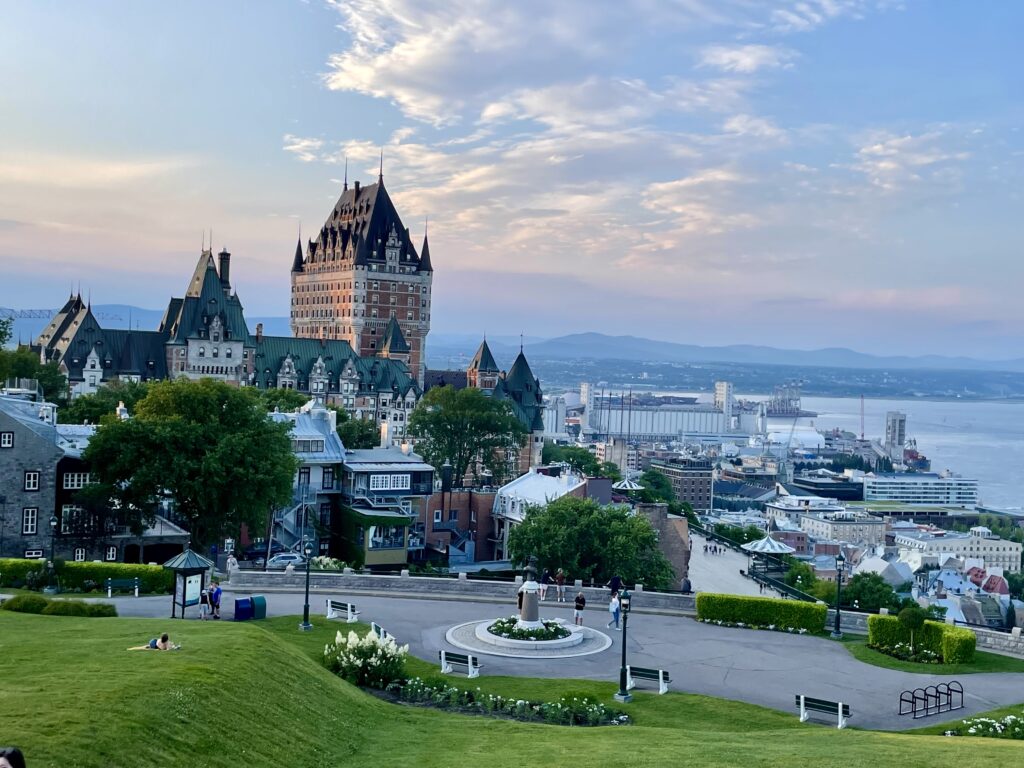
Santander - gateway to northern Spain
To be the first, a discoverer, a pioneer, a trailblazer: it has a proud ring to it. The first ever scheduled flight from Warsaw to Santander took off on 31 March 2017, and I was on board that Wizz Air Airbus. Greeted with a water salute and presented with goodie bags by local officials, we set foot on Cantabrian soil.

The plan for 7 days was, as usual, ambitious: a thorough exploration of northern Spain. Not just Cantabria, but also the Basque Country, Navarre, Asturias and Galicia. I had some unfinished business with Galicia, one of my so-called open regions. I had been there, in a way, but I had been left wanting much more. In this case, the gap was Santiago de Compostela, which I had not managed to visit. It happened like this. In June 2011 I was on holiday with friends in Portugal, north of Porto. I had planned several excursions, fairly intensive ones, just the way I like them. Unfortunately the group dug in its heels, refused to cooperate, and we never made it to Santiago, which remained a blank spot on the map of my European travels. But now the cards have been dealt again, and I am going back to northern Spain.
Santander - seafood and the El Pendo cave
Fate, our noses and a tip from the hotel receptionist steered us on the first evening to Bar Marucho on Calle Tetuán. We had our hearts set on seafood, which is at its very best in northern Spain. As an old Polish song has it, the best chestnuts in Paris are on Place Pigalle; younger readers can google what that line is about. What we experienced at Bar Marucho exceeded our expectations and set the bar very high for the rest of the trip. There is no point describing these culinary wonders; just look at the photos.


The morning in Santander was drizzly. We went to the Mercado market hall and had breakfast nearby. Personally, I am a firm believer in having breakfast at the hotel before heading out anywhere, but on this trip someone else was in charge of logistics for the first few days.
Cantabria is famous for its prehistoric human dwellings: caves where our ancestors lived, traded, held councils and prayed. The ones recommended for visiting are Chufín, El Pendo, El Castillo, Las Monedas, Hornos de la Peña, Covalanas and Cullalvera. We went to El Pendo. A small hut and a little car park reached by a dirt track hardly suggest a major tourist attraction. Coachloads of tourists will never find their way to this cave. The guide, who is also the site's caretaker, has a small office by the car park. Just for the four of us, he unlocks the barred entrance to the cave and begins his story. It is genuinely gripping. He tells us how the paintings were discovered by chance, when an inexperienced enthusiast decided to check the interior even though a leading rock-art expert had visited earlier and judged it not worth bothering with. We hear why the paintings are found in particular spots, how they were made, what they were for and how the layout of the cave changed over thousands of years. Archaeological work is still going on in the cave; in its cool, damp interior we felt like witnesses to history being uncovered. Although archaeology, ruins and prehistory do not really excite me, travelling 25,000 years back in time (yes, the paintings are around 25,000 years old!) was a fascinating experience.
The Basque Country: Bilbao, Lekeitio and San Sebastián
We are done with prehistory, and done for now with Cantabria, to which we will return, and we drive on to the Basque Country. The Basques are a proud people with their own language, culture and identity. They live along the northern Spanish-French border. To this day they do not have a state of their own, although they have won far-reaching autonomy from the authorities in Madrid.

History is not fair, and it does not draw borders according to what nations deserve. I wonder who deserves a state of their own more, our neighbours the Slovaks or the Basques…
Bilbao is an interesting example of a successful transformation from a city built on heavy industry, now a thing of the past in Europe, to one that draws its inspiration from culture, art and new technologies. One of the icons of the changing character of the Basque capital is the Guggenheim Museum.

Twenty years have passed since it opened in 1997, and it is both the proof and the driving force of the city's new face. Suffice it to say that of the millions of tourists who visit it, 80% came to the city specifically, or extended their stay there, in order to see the building and its collection. The museum has created around 9000 new jobs. Will Poland's Katowice follow the same path with similar success?
After leaving Bilbao we make a short stop for lunch and coffee in the seaside town of Lekeitio. The weather is not kind to us, but taking advantage of a “weather window” we walk along a slippery, algae-covered causeway to a small island in the bay.

You can only make it back to land with dry feet at low tide; when the waves start to raise the sea level again, the causeway disappears beneath the surface.
We are heading for San Sebastián. Had it not been for the rain, it would no doubt have proved to us that it is the summer capital of the Basque Country. We are staying in a little street full of tapas bars, which fill up in the evening and stay open late into the night. Tapas washed down with cava (not to be confused with kawa, which is Polish for coffee 😊) let you feel like a Spaniard, sorry, a Basque.

Pamplona, Bardenas Reales and the Vizcaya Bridge
The next day, continuing east with France already in sight, we take the last exit off the A8 motorway towards Pamplona. We pass five picturesque villages (Bera, Lesaca, Igantzi, Arantze and Echalar) as we enter Navarre. In one of them a local festival is under way, and we get a close look at the traditional costumes worn by the children and teenagers.

Pamplona does not seem exceptional architecturally, though there is no denying its charm. The city's magic is bound up with the annual running of the bulls, held in July. The 850-metre course runs through the streets of the city, and here and there its route is marked. Plugged holes in the pavements show where the wooden fence goes up to separate the bulls, and the daredevils running with them, from the spectators. A section of it has been left standing in one of the city's squares as a memorial to those who paid the ultimate price for wanting to compete with these mighty animals.

To reach Bardenas Reales from Santander you have to drive 3.5 hours south-east. We are already halfway there. Until recently the area was closed off because of a military firing range in the middle of it, and it is enchanting and mysterious. Heavily weathered rocks cover the desolate, sparsely vegetated land.

Over the ages nature has sculpted plateaus, gullies and rock spires here. The terrain is a little reminiscent of Cappadocia in Turkey. Bardenas Reales is a place that anyone who loves landscapes and nature really must visit.

We have just reached the south-easternmost point of our trip. From here we turn back towards the central part of the coast.
We call in at Portugalete, whose greatest attraction is the UNESCO-listed Vizcaya Bridge. When it was built, it was the first transporter bridge, with a gondola able to carry people and vehicles from a great height. It served as a model for other bridges in Europe, Africa and the Americas, of which only a few have survived to this day. It really is an unusual sight: a huge gondola, rather like a flat, wide metro carriage, full of people and vehicles, gliding across the water suspended on long steel cables. It looks like an overhead crane in a factory hall, only on a macro scale.

Galicia: hórreo granaries and the Way of St James
Ahead of us lies a long transfer to Galicia. Driving west towards Santiago, it is worth taking the shorter and toll-free N-634 rather than the AP9 motorway. The image that will forever be associated with Galicia is surely that of the stone granaries (hórreos) that have survived for centuries in the region's farmland. They are in varying states of repair, but stone, being a very durable material, has generally stood the test of time well.

Setting them on low stone pillars protected the stored harvest from rodents. The largest of these structures can be seen in the village of Carnota. It is 250 years old and almost 35 metres long. The second image that will stay in my memory is that of the Way of St James. It is an image of both places and emotions. I had not expected the spirit of pilgrimage to be so strong, and even undergoing a revival. Every so often we pass shops selling “everything for the pilgrim”.

They stock a whole range of essentials: a St James scallop shell to tie to your rucksack, a pilgrim's staff, a hat, a rain cape, a water bottle, and also socks and blister plasters. Metal studs set into the pavements of the towns point the way to the destination with the sign of the shell.

Along the routes, and there are several of them, there are refuges, hostels and guest houses catering for tourist-pilgrims.
The pilgrim's certificate and Cape Fisterra
Anyone who covers the last 100 km on foot or on horseback, and can prove it with stamps in a special passport, receives a certificate and can take pride in a remarkable achievement for the rest of their days. By the cathedral at the end of the route we met a Pole who had walked the French Way, and his euphoric mood said a lot about the emotions that go with the journey. As we passed pilgrims from every corner of the world, we wished them luck. Some, who spoke no English, had learnt just one sentence and answered every question with it. In a small village, by a fountain of drinking water, we met two Asian men. With smiles on their faces, they answered every question with “We are from Korea”.

The bridge at Puente la Reina and Cape Fisterra, the true end of the route, will always be associated with the Camino. On the cape stands the last waymark post, showing 0,00 km.

And it is there that, by tradition, some pilgrims burn the clothes that have accompanied them all the way. One of the sculptures gazing out over the boundless ocean is blackened with soot, and among the black ash you can spot buttons and zips that resisted the flames. There we also met a Dutch film crew trying to understand the magic of the Camino and the motivation of those who walk it. They were recording conversations about life with people who had made it to the windswept cape. Anyone who would like to take up the challenge and set off for Santiago can start the journey as far away as Gdańsk, Toruń, Wrocław or Kraków, as these are its easternmost starting points.

Combarro, Santiago de Compostela and Lugo
Driving along the Galician coast, it is worth stopping in the seaside village of Combarro, which, despite the crowds of tourists, has kept both its atmosphere and its centuries-old architecture.
It is not worth going out of your way to visit the overrated resort of A Toxa. Apart from the curious 12th-century church of San Sebastián, covered entirely, tower and crosses included, in white shells, there is nothing there to catch your attention.
We explore Santiago de Compostela twice, in the evening and early the next morning, following practically the same route.

Two different times of day reveal different faces of this important pilgrimage centre, comparable to Jerusalem and Rome. Unlike those two cities, Santiago does not have the same renown in Poland. The narrow streets and old squares are best explored on foot. The cathedral, austere monasteries, Baroque churches and pilgrims' hostels (from the 16th century) are all on the must-see list. It is worth wandering the picturesque lanes of the old town, where many old houses have arcaded ground floors. Perhaps it was a matter of being primed to be impressed, but Santiago did not disappoint us: imposing but not overbearing buildings, and a sense of communing with mystical history.

Heading back towards Santander, we stop in Lugo, a city where the Roman wall encircling the whole of today's old town has survived. A walk along the two-kilometre stone structure lets you see the old town from many different angles. Only Ávila can boast such a well-preserved city wall in Spain.

Asturias: Castro de Pendia, Cudillero and fabada
Crossing into Asturias, we come across one of the ancient Celtic settlements, Castro de Pendia. Discovered in 1941, it is open to visitors free of charge; besides the settlement itself, made up of round stone buildings, you can admire the beautiful landscape around it: a babbling brook, rolling hills and old trees.

Cudillero is one of the most picturesque villages on the Asturian coast. White and pastel houses with shutters painted in bolder colours rise in terraces around a narrow cove. The picture the little town creates is pure Disney.
Just as Galicia cannot do without its seafood, Asturias is famous for fabada. We came across this hearty one-pot dish especially in the mountainous parts of the region. White beans, spicy chorizo, black pudding and bacon make a filling combination. We bought a ready-made set of ingredients for cooking fabada at home as we passed through Oviedo.

On the hills around the city it is worth stopping at several pre-Romanesque buildings (9th century) located close to one another, such as Santa María del Naranco.
Picos de Europa and Bárcena Mayor
For many, the Picos de Europa are a destination in their own right: the largest national park in Europe and the oldest in Spain takes in green valleys, river-cut gorges, sheer drops and steep slopes. Of the many routes available, we chose the short (1 hour 15 minutes) “Los Lagos” trail. Interestingly, it crosses the site of an open-cast mine that closed many years ago, and the stone buildings, pillars and towers left in the landscape somewhat spoil the picture of untamed nature.

As we reach the end of the trail, a view of a mountain lake opens up before us.
Another good place to start walks among the deserted hills is Bárcena Mayor. This charming village, where you can eat and rest, closes off the Cabuérniga valley and is the starting point for trails heading upriver.

Santillana del Mar, Carmona and El Capricho de Gaudí
Two more typical Cantabrian villages lie on our route: Carmona and Santillana del Mar. Santillana is geared in every respect to serving crowds of tourists. Restaurants, souvenir shops, large paid car parks and historic sights.

Carmona is the very opposite of crowded Santillana. The tourists have not arrived here yet: laundry is hung out to dry, stacks of freshly cut wood lie about, there is no glitz and nothing is polished to a high shine. By the small car park just across the river, an elderly, rather deaf resident offers us carved wooden cutlery he has made himself. The one bar serves only locals.
50 km west of Santander lies the town of Comillas, whose greatest attraction, at least for me, is El Capricho de Gaudí. Antoni Gaudí was only 30 when he designed this three-storey building. Completed in 1885, it is one of only three works by the brilliant architect outside Catalonia. Touring both the interior and the garden transports you to the atmosphere of beautiful Barcelona, and Gaudí's style is something I can never resist.

2,500 kilometres in 7 days, 5 regions and a wealth of impressions. It is worth taking advantage of the direct flights from Warsaw to experience a great variety of places on a single trip, or to spread them out over several shorter breaks.