









Bosnia and Herzegovina
For many people Bosnia and Herzegovina remains off the beaten track, never seriously considered for a holiday and usually just passed through on the way to the Croatian coast.
Taking advantage of a business trip to Budapest, I decided to explore this small country. The Croatian motorway running south from Zagreb via Split towards Dubrovnik ends just a dozen or so kilometres from the border with BiH. Crossing the border presents no great difficulty, even though you are entering a country that is neither in the Schengen area nor in the European Union. Fortunately, the Balkan war, which ended well over a decade ago, has left no traces today, either in the infrastructure or in the historic centres of the towns and villages. Less than an hour's drive into the country lies the beautiful little town of Počitelj, which I had never heard of before and read about in Michelin's “Montenegro, Serbia, Bosnia and Herzegovina” guide. From several kilometres away, driving along the banks of the green Neretva, you can see the illuminated minaret towering over the houses. Destroyed in August 1993, it was rebuilt 12 years later and today bears no trace of those tragic days.
Počitelj on the Neretva

On a Saturday evening the little town is buzzing; the connected terraces of several restaurants are full of revellers reacting enthusiastically to the rhythm and lyrics of the songs being played on stage. Finding a bed for the night in this small settlement does not look easy; nevertheless, within moments the owner of the local private rooms is summoned from the merry crowd. He has no good news for me: festival-goers have booked all the rooms. But after a while we manage to find a house where a very kind landlady offers me a room for one night. The price of 10€ is not excessive. As soon as she has shown me where to sleep, the elderly lady goes back to the open-air festivities and I go to bed. The next day I get up early and explore the town in the morning. First you have to climb to the top of the hill and take in the surroundings from the tower of the old castle. From up here the minaret looks smaller and the Neretva even greener. Wandering the narrow lanes has to come to an end so that I can move on. It is hard to imagine a better time to visit Medjugorje than a festive Sunday morning. Passing vineyards and tempting signs advertising home-made wine and rakia, I reach this mystical place of pilgrimage.
Medjugorje and the Dervish Monastery in Blagaj

A climb up Apparition Hill, a visit to the town's main church and a brief moment of reflection by the statue of Christ, considered miraculous by many, will have to do; it is time to move on. Next up is Blagaj. I decide to take a short cut and, on a road barely marked in yellow on the map and too narrow for two cars to pass, try to get straight to my destination. I follow slowly behind an elderly BMW, which stops at the narrowest point for no apparent reason. When a broad-shouldered man gets out of the car, I feel uneasy. But the reason for this brief stop soon becomes clear: he has to rescue a little tortoise that was trying, also by a short cut, to get from the undergrowth on one side of the road to the other. I drive on and soon find signs pointing me to the attraction I am looking for. The panorama from the opposite bank of the river is breathtaking.

The Dervish Monastery, as if glued to a sheer rock face, seems to float above the surface of the river, which flows out of a cleft in the rock. It is impossible to resist one of the several restaurants spread out a little further on, between the rocks and the river's rushing current. The tables stand on little concrete-and-rock islands surrounded by flowing water. Besides its undeniable charm, the arrangement helps to cool the hot July air. You have to stop, at least for a coffee or a mid-morning snack.

Mostar and the Old Bridge divers
Now it is time for the greatest attraction of Bosnia and Herzegovina: Mostar. The city is much bigger than I imagined, but there is no problem finding its historic centre. Somewhat by chance, I park right next to a bridge with a magnificent view of the old town and the famous Old Bridge spanning the two banks of the Neretva.

The narrow lanes offer much-needed shade when the temperature climbs above 40 degrees. A dip in the Neretva is tempting, and I wait for a daredevil to leap from the bridge, plunging more than twenty metres straight into the river. Only members of a special divers' club are allowed to do it. Permission from the authorities is not enough: the diver expects donations, and only when 50€ has piled up in his purse will he thrill the crowd with a spine-chilling leap into the icy water. During the Balkan conflict, the people on the two banks of the river eyed each other with hostility, and the bridge was destroyed. It is heartening that now everyone can cross freely from one side to the other. The many mosques and their slender minarets, reportedly as many as 50 of them, define the city's skyline against the surrounding mountains. The merciless heat takes its toll; there is nothing better than a juicy piece of fruit to quench your thirst. Almost in the centre I find a market and enjoy the taste of peaches, probably straight from the local orchards.

A stay in Bosnia and Herzegovina is made easier by the fact that you can pay without any trouble in both euros and Croatian kuna.
Sarajevo - a melting pot of cultures and religions
Time for the last stop of the trip: the capital, Sarajevo. Tempted by the guidebook's description, saying that “you will not find another capital in Europe that is such a melting pot of religions and cultures”, I set off again. If you had one more day, you could easily devote it to an unhurried drive through the gorges along the Neretva. The views are stunning, with places for a picnic and a swim at every turn.

Sarajevo, whose name comes from the Turkish for “palace on the plain”, is striking for its setting and character. Hemmed in by mountains, the city has grown in only two directions.

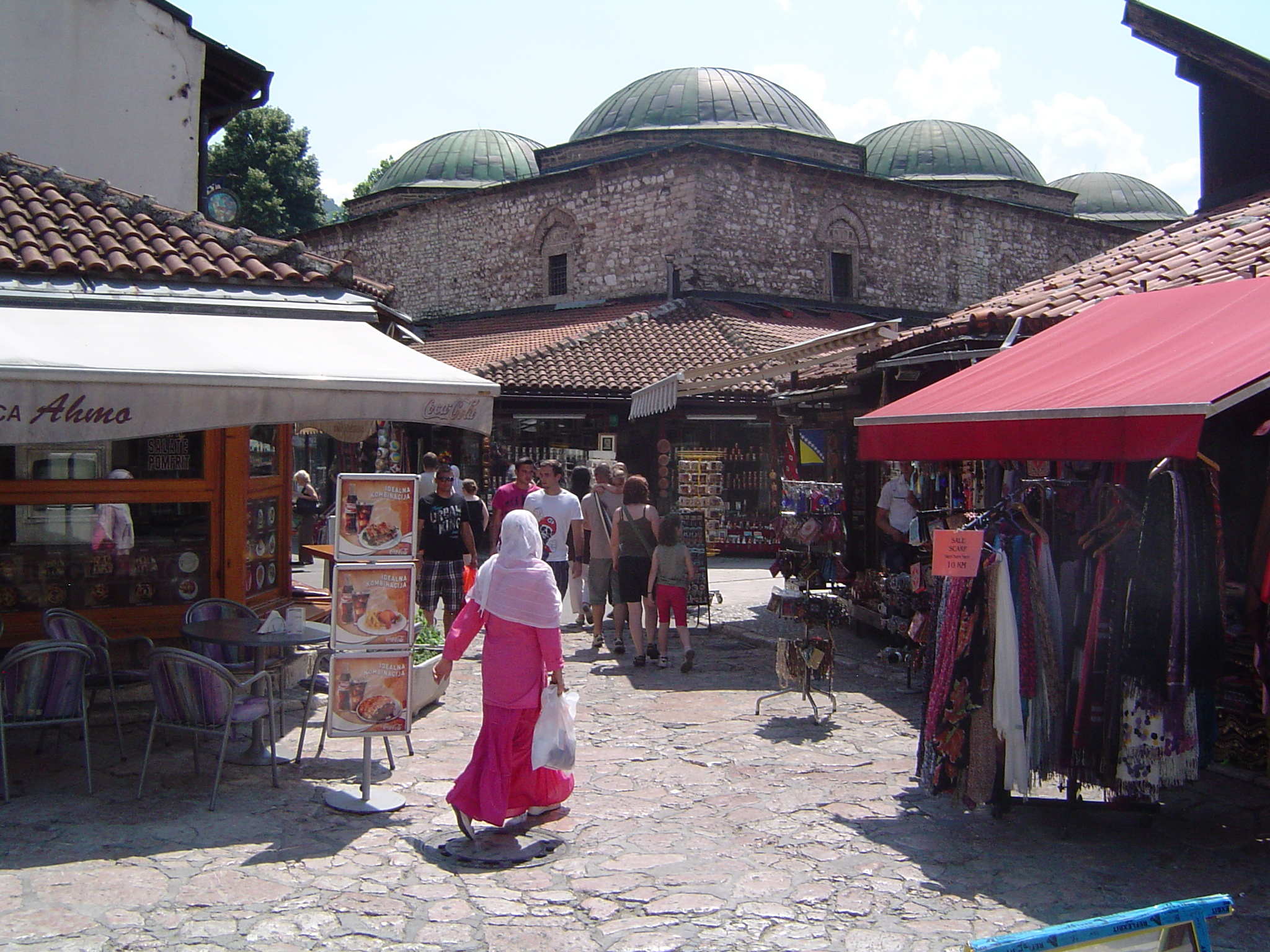
Following the signs to the historic centre, I pass the capital's old quarters and new developments. The centre, with its low wooden buildings, resembles an oriental bazaar.

Stalls selling brass jugs and ceramics stand next to cosy little cafés and places of worship. History has mixed the people of Sarajevo so thoroughly that today, within a small area, alongside the mosques you can see a synagogue, an Orthodox church and a Catholic church.

I say goodbye to Sarajevo in the early afternoon and head along winding, charming roads towards Serbia on my way to Budapest. Bosnia and Herzegovina is a beautiful, hospitable country, full of historic sights and wonderful nature. Its people know how to have a good time and are friendly towards tourists. It is a great place for a 2-3 day trip as well as for a month-long holiday on a modest budget. It is worth checking Wizz Air flights to Sarajevo (via Budapest) or Tuzla (via Bratislava).
If you are interested in the Balkans, read the stories in which I describe Kosovo and Slovenia.


