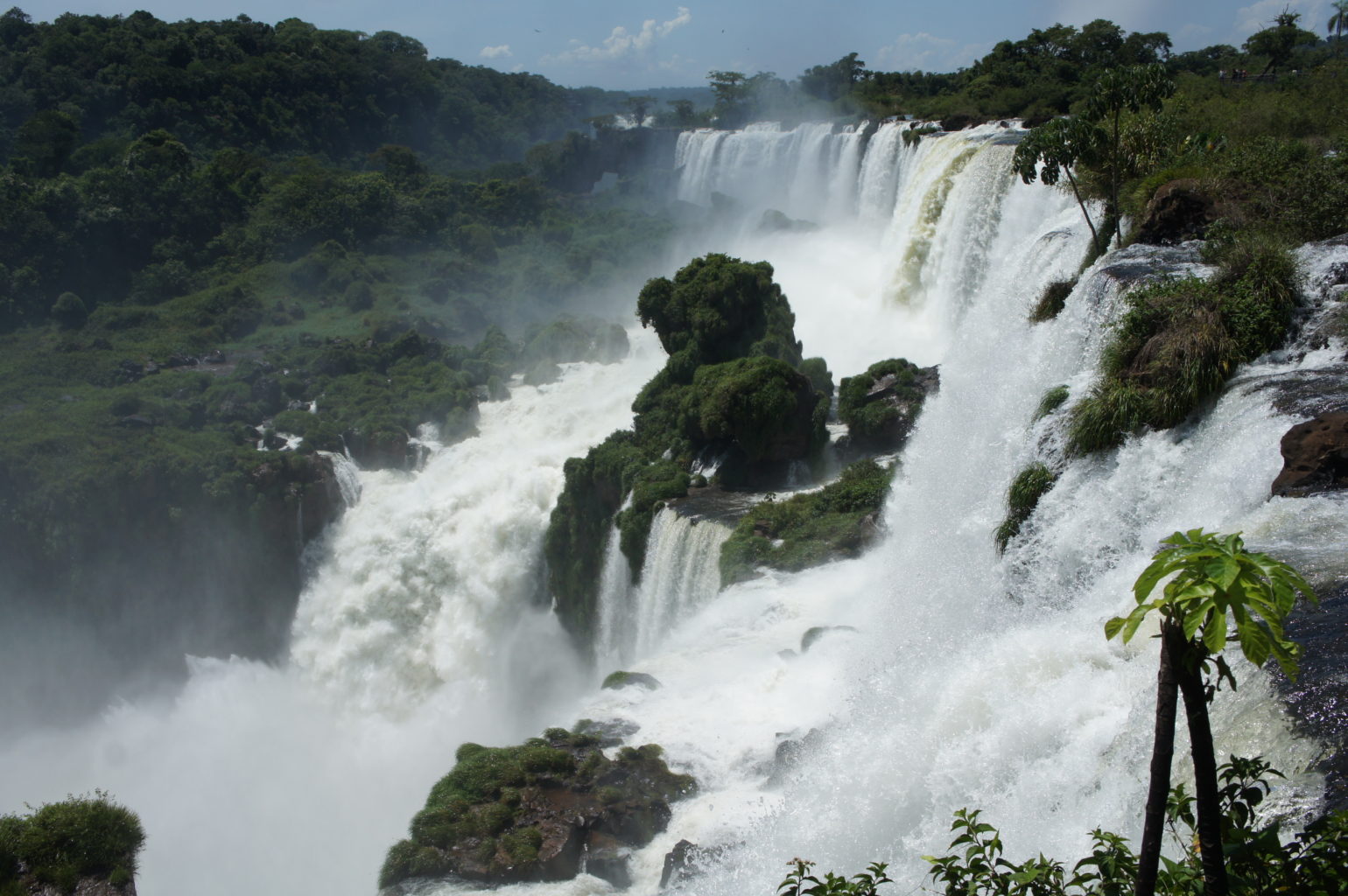
For many, the beautiful Iguazu Falls (the name Iguaçu, used on the Brazilian side, is less common) are the greatest attraction in South America. 250 wonderful cascades along a tectonic fault almost 3 kilometres long. They can be visited from both the Argentinian and the Brazilian side. I spent enough time on each side to be able to compare the two options.

It is estimated that 80% of the falls lie on Argentinian territory and the remaining 20% in Brazil. That does not, of course, mean that their appeal is divided in the same proportions. When you are on one side of the border, you are often looking at the other country without even realising it. The Argentina-Brazil border runs right through the Devil's Throat (Garganta del Diablo), the largest cascade of the Iguazu Falls, which tourists treat as a "mecca". A visit without it hardly counts. Here the water plunges as much as 82 m, a greater height than Niagara Falls. Many visitors who dash in and out rush straight to the Devil's Throat. Unfortunately, their tight schedule often doesn't let them see more, and it is definitely worth it! I think you need to set aside 1.5 days for all the attractions on both sides of the border: a day on the Argentinian side and half a day on the Brazilian side.

In both Argentina and Brazil the falls lie within national parks. In 1934 Iguazú National Park was established near the small town of Puerto Iguazú in Argentina. The Brazilian Iguaçu National Park, in turn, lies near the city of Foz do Iguaçu. Everything is incredibly green. The rocks and rock ledges are covered with dense clumps of trees and other plants. Some 400 species of birds live in the national parks, including various species of parrots and toucans. There are also monkeys, jaguars, tapirs and anteaters.

Unfortunately, wherever tourists gather you usually see pesky coatis. At first they are a curiosity, but later a nuisance. They steal food and make a mess. The young learn the thieving trade from the older ones. Large information boards showing bitten human hands dripping with blood are meant to discourage any contact with these seemingly cute animals. Attempts to scare them off don't seem to achieve much.

The Iguazu Falls were part of my plan for touring Brazil in January 2019, so it was natural to start exploring them from the Brazilian side. During my stay, 1 Brazilian real was equal to one Polish zloty (1 BRL = 1 PLN), and 1 Argentinian peso was the equivalent of 10 Polish groszy (1 ARS = 0.10 PLN)
Brazil
I stayed on the Brazilian side, in Foz do Iguaçu, which I flew into. From the city you can get to the falls by Uber in 20 minutes (20PLN). Admission to the national park costs 69 reais (children aged 2-11 pay 10 reais). The Visitor Centre is spacious and modern. Shops, cafés, toilets and a looooong row of ticket windows. Staff pick out families with children and tell them that only here, in Brazil, can children take a boat trip, while in Argentina it is forbidden. Of course, the boat trip is paid for separately.

The ticket price includes admission and a bus transfer. On the other side of the building you wait for a double-decker bus that takes you deep into the park. The stop near the pink "Belmond Hotel das Cataratas" (formerly the "Cataratas Hotel Iguazu Falls") is the right one to get off at. In a moment you will see a gorgeous panorama of the falls. You admire the falls from a terrace; they are quite far away, but the view is magnificent. You set off along the only concrete path running along the cliff. You can't get lost. With every step your cliff gets closer to the falls and you see them better and better, picking out details. A terrace appears, suspended over the abyss, and from there the view is even fuller. After a few hundred metres you can step onto a walkway that winds its way towards the thundering water. Remember that once you get close, you will inevitably get wet; the crashing water creates a mist that the wind carries, soaking everything around. After seeing this part of the falls, you return to the main path. You are approaching the Devil's Throat. The sturdy walkway is laid out in such a way that it seems you only have to stretch out your hand to touch the rushing water.

You are quite high up relative to where the falling water crashes onto the rocks, so despite being so close you don't get any wetter. This spot is not the actual throat; that lies beyond a bend in the rocks. You have reached the last point on the path; now you have to go back up to the level where the buses run, as you have been gradually descending the slope. You can take a lift or walk up the zigzag path. Once you have climbed up, you reach a food area: small restaurants, self-service bars and little shops let you grab a bite, have a drink, catch your breath and sort out your impressions. Right next to it is the stop for the buses that take you back to the start of the route, to the park exit. It is worth adding that the signage for each stage of the route is clear; you know where you are and where you are heading.

An added bonus on the Brazilian side of the Iguaçu Falls is the interesting Bird Park (Parque das Aves). Opposite the exit, about 200 metres away, you will see the entrance to this sort-of zoo. I say "sort-of zoo" because the birds, although not entirely free, are kept in large aviaries more than ten metres high, which you enter through special airlocks. These are home to very colourful flying representatives of South American wildlife.

You can look at colourful toucans to your heart's content, but the biggest attraction is meeting face to beak a large colony of beautiful macaws, perching on rails and trees or strolling on the ground. It is worth adding a visit to the Bird Park to your stay at Iguaçu. It is open 8.30-17.00, and a ticket costs 45 reais.

Argentina
From Foz do Iguaçu in Brazil you can get to the border crossing with Argentina by Uber in 10-20 minutes, paying about 10 PLN. Choose the address "Aduana Brasil Argentina"; the Uber won't go any further, because Uber is banned in Argentina. After getting your passport stamped at the border crossing on the Brazilian side (Poles need no visa for either Brazil or Argentina), you have to...............think about what to do next.

Right next to the crossing there is a bus stop, where a lone woman is sitting. She cannot explain when the bus she is waiting for will come or where it goes. I don't get the impression that this bus is a good option for getting to the falls. Most tourists probably cross the border on organised tours or with hired door-to-door transport. In the end we thumb a lift, which takes us to the park gates. It is not quite hitchhiking, as we come across someone who drives tourists around for a living. He charges us 27 US dollars for this transfer (4 adults and a child). On the way back, for the ride from the falls, across the border and right to our hotel on the Brazilian side, he will charge 47 dollars (10 USD per person). He insisted convincingly that he hadn't ripped us off. If you want to use his services, by all means: Hugo Morel of Remis is waiting by the phone on +549 3751 666 699.

Admission to the falls on the Argentinian side costs 700 pesos (the same as in Brazil, the equivalent of 70 PLN); children (6-12) pay 140 pesos. Remember the time difference: when it is already 9.00 in Brazil, it is still 8.00 in Argentina, and that is exactly when the park gates open.

Passing through the park gates is only the beginning. It took us 1.5 hours to reach the park's first and most important attraction, the Garganta del Diablo. You get there in several stages. First you have to walk to the first station of the little railway ("Central" station). There you collect a ticket for the train and wait until the train with your number pulls up at the two-track platform. Many people choose to cover the first stretch on foot rather than by rail; in that case you will have to walk about 600 metres. If you take the train, it goes to "Cataratas" station, where you meet those who came on foot and queue together for another ticket to take a different train to "Garganta del Diablo".

The Devil's Throat is impressive because you are very close. Although the walkway is very solid, the amount of water and the number of tourists can be frightening. The water thunders down from a U-shaped rock ledge, so that the edge of the cascade forms almost a circle. Here too you are exposed from time to time to the water mist that soaks everything.
Remember "Cataratas": this is not only where the trains leave from, but also where 2 circular walking routes begin: the "Lower Trail" (1400 m) and the "Upper Trail" (1750 m). In several places along the way there are clearings with bars and rest areas. Both routes are interesting; on the "Lower Trail" you see the falls from the front, while the "Upper Trail" takes you round to them from behind.

Although the routes in Argentina are more complicated, the signage is clear there too. Nevertheless, I was very irritated that all the maps and signposts still show the crossing to and the trail around San Martín Island, which has been closed to tourists for a good few months. The marking of the train routes and the system for issuing tickets for them also leave a lot to be desired.

Summary
The Brazilian side has the edge for panoramas, while on the Argentinian side you can get closer to the water. In Argentina children are not taken on boat trips, and the route signage is much worse than in Brazil. In Argentina there are considerably more paths - and therefore a greater variety of experiences - but on the Brazilian side the visit is more logical, and there is also the Bird Park. Adult admission costs about the same, 70 PLN. For me, the score is 4:3 to Argentina.