The incredible Amazon: caimans and piranhas, in the jungle and on the backwaters
The Amazon is oversized in every respect. It is 7000km long, more than ten kilometres wide in its main channel, and widens to about 130 km nearer its mouth. It is fed by some 1000 tributaries, no fewer than 17 of which are over 1600 km long. By comparison, Poland's Vistula is 1000 km long. The Amazon is 70 metres deep, so large ocean-going ships can sail as far as 3000 km inland. Besides the Amazon itself, piranhas, caimans, indigenous tribes and virgin jungle fire the imagination.
The gateway to the Amazon is the city of Manaus. It is a 4-hour flight from Rio de Janeiro, and on the way you cross 2 time zones. Manaus is a large metropolis of about 1.5 million people, the economic and administrative centre of the state of Amazonas. At the centre of the city is a small square with the only monument worth seeing, the Teatro Amazonas opera house. It is a real curiosity that takes you back to the boom years of the rubber trade. A suddenly created, fabulously wealthy class of rubber planters wanted to be able to show off its wealth and status, and to do so in the European manner. In 1881 it was decided to build an opera house that would rival those in Europe. And so today, in the middle of an unremarkable city, there stands a sumptuous building.

The building's interiors, the etiquette and the dress code in force in its heyday were all modelled on European standards. Local conditions, such as the temperatures and the truly incredible humidity, were completely ignored. The only references to the surroundings in which it was built are large paintings depicting idealised scenes from the life of the Amazonian Indians and.....the parquet floor, made of alternating dark and light boards, intended to evoke the place where the waters of two rivers - the Rio Negro and the Rio Solimões - mix to form the Amazon proper.

From Manaus into the jungle and the meeting of the waters
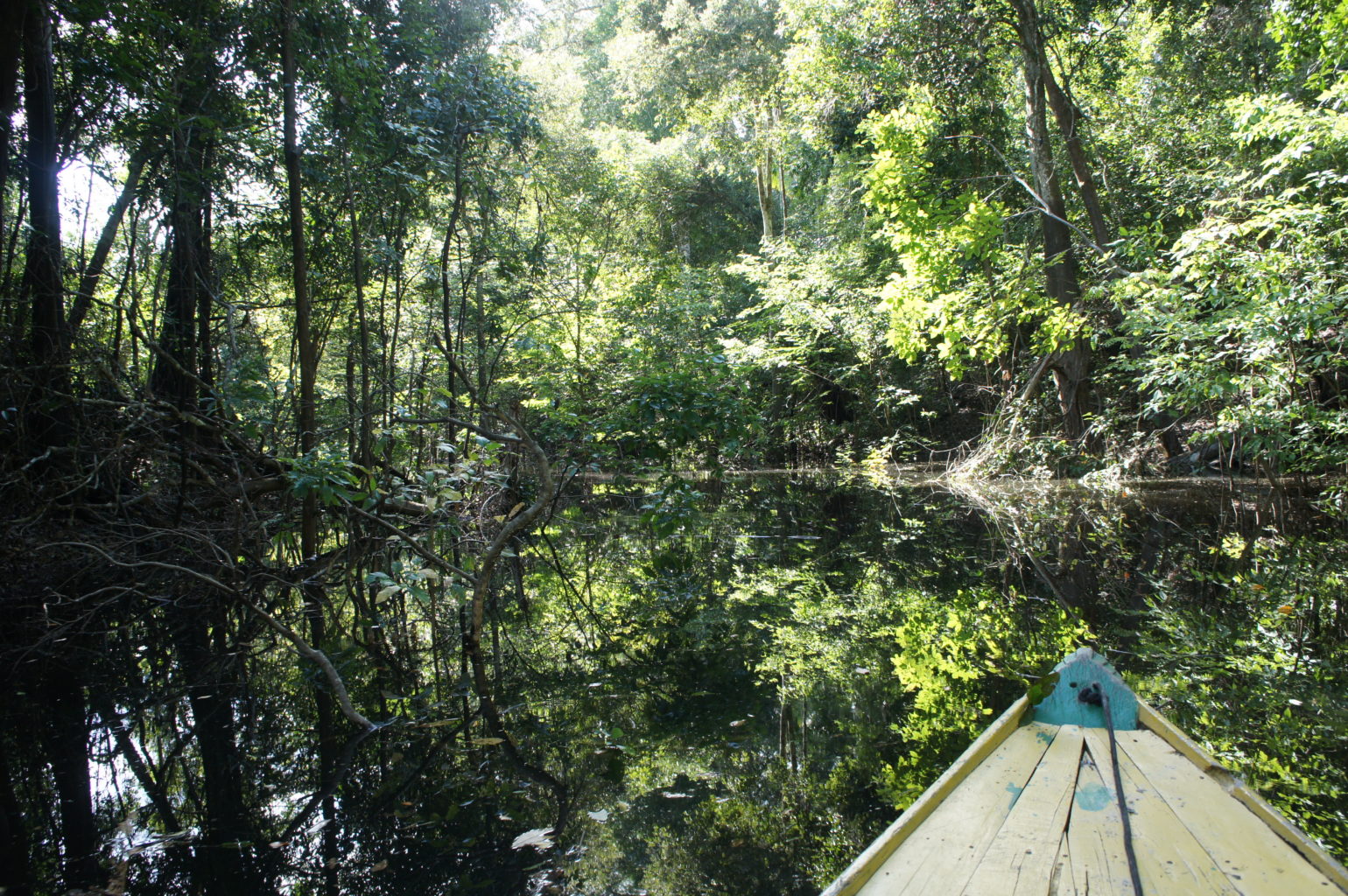
Manaus is also where organised expeditions to get to know the Amazon begin. On Rua 10 de Julho, a street leading off the main square, there are several agencies where you can arrange such a trip. I used Iguana Turismo (I include an extract from their January 2019 offer at the end of this article). It takes about 3 hours to get from the city into the wilderness. First you take a minibus to the port, then cross to the other bank of the Amazon in a speedboat, which slows down so you can savour the spectacle of the "meeting of the waters". The next stage is a ride in a cramped, old-fashioned minibus, first on tarmac and then on a dirt track, until the road runs out. From there you can only continue by small boat, meandering through the backwaters. Along the way, in the villages you pass, the driver does some shopping. Ours bought fresh vegetables and two enormous machetes....

Although I didn't expect much, the "meeting of the waters", the place where the currents of the Rio Negro and the Rio Solimões meet, made quite an impression on me. The first river is black, stained with tannin; the second is murky and caramel-coloured. It is not just about the colours, though they are what strikes you most. More interesting is that the two rivers have different temperatures, which is easy to check by dipping your hand in the water, as well as different acidity and current speeds. Even when a strong wind blows, large waves form on one while the other stays calmer.
A base on the Mamori river and swimming with piranhas

After 3 hours we reach the place that will be our base. The boat deftly pulls up at a jetty with a large wooden pavilion that will serve as our dining room. There are also drinking water dispensers that you can use as much as you like. A steep flight of steps leads up to a terrace, from which you can go right to a large wooden hut that serves as a dormitory for about 30 people. To the left is the washroom block, with 4 toilet-and-shower units. Walking a little further along a wooden boardwalk, you enter the zone of moderate luxury: here there is a row of about 10 cabins (max. 5 people in each), each with its own toilet and shower.

Knowing that the programme is 3 days and two nights, I immediately start comparing this experience with what I encountered in northern Thailand during a trek, which I described HERE ) In hindsight, it turns out that the programme in the Amazon is not as packed and does not include as many different attractions. Which does not make it any less appealing!

On the terrace above the Mamori river there are a few wooden sunloungers, and wooden steps lead down to the water. Can you swim? Your first thought is piranhas, your second caimans. It is the former you fear more. After all, in the port of Manaus, where we set off from, they had bared their sharp teeth at us from the stalls of the fish market. Remembering the blood-curdling adventure books of your youth makes your hair stand on end, but our local guide encourages us. The men, plunging into the dark, exceptionally warm water, tried to stay afloat by kicking their legs and paddling with one hand. The other hand discreetly protected what is most precious. The image of a hungry shoal of piranhas preparing to attack spoke to the imagination. In the end nothing happened, either then or during later swims.
Lake Juma: river dolphins and a caiman hunt

After a refreshing swim and a lunch at which we were served delicious pirarucu fish, we board a small motorboat and set off in search of wild animals. Interestingly, the pirarucu, also known as the arapaima, is a giant fish; specimens 4 metres long are not unusual. As everywhere, it is forbidden to catch fish that are too young and immature. In the case of the pirarucu, you have to leave alone the little ones measuring less than.....1.5 metres. From the Mamori river we sail out onto Lake Juma and quietly enter one inlet after another. We see monkeys, parrots and other colourful birds, and river dolphins, both grey and pink, often appear in the water. But let's be honest: this is not a zoo. The animals are not close and don't pose at all; they live their own lives hidden behind leaves or in the treetops, or, like the dolphins, surface only for a moment. I am glad I threw a pair of binoculars into my luggage at the last minute, but I regret taking out my telephoto lens.

After dinner, once it is dark, the guide announces a bloodless caiman hunt. Standing at the top of the boat, he lights up the overgrown bank with a powerful head torch. The caimans' eyes shine with reflected light and can be seen from a long way off; then you have to act fast so the reptile doesn't get away. After about half an hour on the water, the guide steers the boat towards the spot where loud croaking of frogs can be heard. Later he tells us that this is very likely where a mother caiman laid her eggs, so that the hatchlings would have food close at hand. And sure enough: a few light signals exchanged with the helmsman, the boat speeds up and glides into the reeds, and the guide grabs the animal with a practised movement. At first glance the caiman doesn't seem big, but taking the length of its tail into account, it is probably just under a metre. The braver among us can hold the animal for a moment. As when catching snakes, you have to squeeze firmly just behind the jaw to avoid getting hurt. A moment later the reptile is back in the water, safe again in its familiar environment.

A jungle walk and setting off for a night in the wild
The next day begins with an educational walk through the jungle. But is it really jungle? Our guide explains that it is so-called "secondary forest", which means more or less that, where the original vegetation was cleared, the wild jungle has been allowed for several decades to reclaim the ground it had lost. The whole area around Lake Juma has been bought up by foundations - mainly from Europe - and a painstaking natural process of reintroducing the original flora and fauna is under way. We stop at every step: here a liana, there a palm whose leaves are used to make roofs, here a termite mound, and somewhere else a plant that stores life-giving clean water in its trunk. This one has thorns, that one is poisonous. We hear birds in the treetops, and underfoot we sometimes see huge red ants. The machete bought along the way proves its worth. It is terribly humid and the temperature hovers around 35 degrees. Everyone dreams of a swim in the river, piranhas or not.

The next day, in the early afternoon, we set off by boat into the jungle again. This time it will be more serious, because we will be spending the night there. We took our head torches and settled trustingly into the boat. We sail slowly along the bank and again see lots of dolphins, monkeys and birds. Halfway there, the boat stops well away from the bank and the call goes out for a swim. It is easy to jump out of the boat, harder to climb back in, but everyone manages in the end. We reach a small inlet with swampy water. Our guide moors the boat and tells us to fish. Unfortunately, a caiman got wind of our plans, and not some tiddler but an animal of, at a guess, about 3 metres. It circled around us, so we send a messenger to the camp to ask the guide what to do.....Osmar is not too bothered by the situation. He has just one request: "Don't feed the reptile". Well, these instructions arrive a little too late, as we have already shared half of the bait intended for the fish with the beast. Fortunately, it all ended well. The reptile circled for a while, scared off the fish, which in the end we didn't catch, snapped its jaws once or twice and swam off disappointed.
Sleeping in hammocks and meeting the locals

Our shelter - a roof on stilts, with no walls - is our home. Despite earlier warnings that "if you don't catch any fish, there will be nothing to eat", a chicken and a huge piece of fish are cooking on the campfire. The plates are made of palm leaves, and the spork has been whittled from some kind of stalk. Before we start eating, we hang up our hammocks. Everyone has their own, surrounded by a mosquito net. The toilet...hmmm....anywhere, as long as it's not too close. Going out to answer the call of nature before dawn will require quite a balancing act. First you have to get out of the hammock, untangle the mosquito net, check that there are no spiders or other uninvited guests in your shoes, then walk into the darkness, listening and watching out for anything creeping along the ground or through the air.....

Wake-up is at 6.00 sharp, and at 6.10 our boat sets off. We want to reach a spot from which to admire the sunrise before dawn breaks. The sun rising over a body of water is always very impressive. The dolphins are waking up too, and in the distance we see the boats of locals heading to work.

We return for breakfast, after which we quickly set off to meet members of the local community. They are not Indians. They are rather people who have chosen a hard life on land where the jungle was cleared. Their homes are simple, and daily work is hard. In the garden by the house we see ripening fruit that we know from supermarket shelves labelled "exotic". We watch from a distance as the woman of the house - heavily pregnant - does her washing on a jetty in the river.

Despite the huge distances you have to cover from one of the big cities on Brazil's east coast, such an expedition is definitely worth it. The Amazon is not just a river; it is one of the most magnificent, mysterious and fascinating cultural and natural phenomena. Which of us doesn't remember adventure stories about explorers, Indians and headhunters?. Then there are the caimans, piranhas, giant arapaimas and the jungle. A 3-day expedition creates memories you will come back to for years.

Iguana Turismo tour programme and prices
Below is a description of our 3-day expedition as Iguana Tours describes it, in the original English version.
This Jungle trips will take part 130km south of Manaus at Juma lake Reserve. This place offers a dense and virgin forest to be explored as i's not a touristic area, so there you will have a fantastic jungle experience. Over there you will explore the jungle doing activities such as:
- Meeting of the waters, motorized canoe, piranha fishing, dolphin observation, sunset observation, alligator spotting, sunrise observation, bird watching, trekking in the jungle, overnight in the jungle, night walk, spear fishing, visit to a native people house, paddle canoeing, learn about the rubber process.(the activities will depend on the amount of days that you do)
Iguana Package (3 days and 2 nights)
1st day – Departure at 08h00 from the office and transfer to the CEASA harbor where you will take a speed boat to cross the river to Careiro village, passing by the meeting of the waters. Over there you will take a van for around 60 minutes until you reach a place called Paraná do Mamori where you will take the second speed boat to go to “JUMA LAKE CAMP HOUSE” which is the name of the lodge where you will be staying in. Arrival at 11h00, see the accommodations have lunch and after lunch you star the activities going for a canoe tour for piranha fishing, dolphin observation. Back to the lodge for dinner and after dinner, again by canoe you will go for the Cayman spotting where the guide will show you some big Caymans and after he will catch a smaller one to explain to you and if you want you can grab it to make some nice pictures. Back to the lodge and overnight.
2nd day – Early in the morning, before breakfast, you will see the sunrise and do a bird watch tour, back to the lodge for breakfast and after the breakfast you will do an ecological jungle trekking from 08h00 to 11h00 where the guide will explain all about medicinal plants, some techniques of survival in the jungle and animals that you can see during the trek like spiders, and different kind of monkeys, sloths etc.. (We can not promise that you will see wild animals but due to the Juma lake be a protect area the chances to see wild life are very good) After lunch at around 14h00 you will leave to overnight in the jungle where you will learn about the night life in the jungle, try to see the animal that come out by night, learn some more techniques of survival in the jungle and spear fishing.
3rd day – After breakfast that the guide will prepare for you in the jungle, you will visit a local people house (caboclos) to see and learn about their way of life, see how they do the manioc flour and interact with them, back to the lodge for lunch. After lunch you make the same way back to Manaus arriving around 17h00.
Price of the package: R$630,00 per person accommodation in private room with private bathroom when you sleep at the lodge or R$540,00 per person accommodation in dormitory (shared room&shared bathroom) when you sleep at the lodge. Children until 5 years free, from 6 to 12 50% discount.
Price includes: Pick up at the airport and transfer to your hotel, Transport Manaus – Juma lake inn – Manaus, Meals (breakfast, lunch and dinner), Mineral water, All the activities mentioned above, Bilingual guide;