German Alpine Road - Bavaria, mountains and history
The German Alpine Road has been voted the most romantic driving route in the world. Running along the northern foothills of the Alps, it scored 9.56 out of a possible 10 points and took first place in the ranking. Driving the 450 km from Lindau to Berchtesgaden, you pass 25 castles, monasteries and palaces. On top of that, there are some fascinating culinary attractions.
The German Alpine Road - history and the start in Lindau

The history of the route goes back to 1879, when the name still in use today was first coined, but it was not until 1960 that all the sections of the German Alpine Road were joined together. Since 2016, efforts have been made to build awareness of joint, coordinated action among the businesses and institutions located along the road linking Lake Constance and the Königssee.
The journey is best started in Munich, the gateway to the German part of the Alps. From the Bavarian capital, head towards Lindau, where the Alpine adventure really begins. The direction of travel matters - it is best to drive from west to east. We start in the lower parts of the mountains and finish in Berchtesgaden National Park, full of rocky cliffs and steep slopes.

Lindau is a charming old town set on an island surrounded by the crystal-clear waters of Lake Constance. It is full of exotic vegetation, and from its busy harbour excursion boats sail in every direction, including to the Austrian and Swiss shores.
The next stop could be the municipality of Scheidegg, a popular holiday destination. Around the little town there are three beautiful waterfalls and a newly built skywalk, a wooden walkway above the treetops. These are attractions for children and adults alike.

It is worth noting that along the German Alpine Road there are plenty of interesting places to visit when the weather turns bad. There are castles, palaces and museums. One of the most intriguing is the Hat Museum in Lindenberg, which shows the many fashions in headwear, both past and present.
Füssen, Linderhof and the Wendelstein cable car
Following the Deutsche Alpenstrasse, as the road is marked on brown signs, we reach Füssen. This is where Germany's most beautiful scenic routes cross: the Alpine Road (east - west) and the Romantic Road (north - south). The town is always full of tourists because of its location and historic sights, and because the famous Bavarian castles, such as fairy-tale Neuschwanstein and Hohenschwangau, stand on its outskirts. It has to be said, however, that neither was ever fully completed, and the only residence Ludwig II managed to finish was Linderhof Palace. To get there, you need to turn off the main route for a while and drive about 10 km along an ever narrower valley with beautiful views.

Bad Tölz gives us several reasons to visit. Marktstrasse is a row of houses with beautifully painted façades. It is always bustling here, with tourists mingling with farmers from the surrounding villages who come to sell their produce. Before you arrive, it is worth checking whether one of the town's regular festivals is taking place.
When you are in the Alps, you cannot pass up the chance to "conquer" one of the peaks. The Wendelstein cable car was built 52 years ago and still draws tourists who want to see Bavaria and the Alps "from above". When visibility is good, from the top station of the cable car you can make out Germany's highest peak - the Zugspitze, all of 2,962 metres high.

Chiemsee, Traumwerk and Lake Königssee
Chiemsee is the largest lake in Bavaria. In summer it is a real paradise for water sports enthusiasts, while in autumn the lake takes on a more nostalgic character, as the overgrown islands teeming with birdlife and the mist-shrouded wetlands come to the fore. We pass it on the north side of our route - it is worth stopping, if only for a boat trip.
An interesting stop on the route is the Hans-Peter Porsche Traumwerk museum, which attracts lovers of meticulously crafted miniatures in various scales. The most impressive sight is a huge model layout with a network of miniature tracks as long as 2.7 km, on which 180 trains run, served by 80 tiny cars. The layout is designed to stage a "day and night" show.
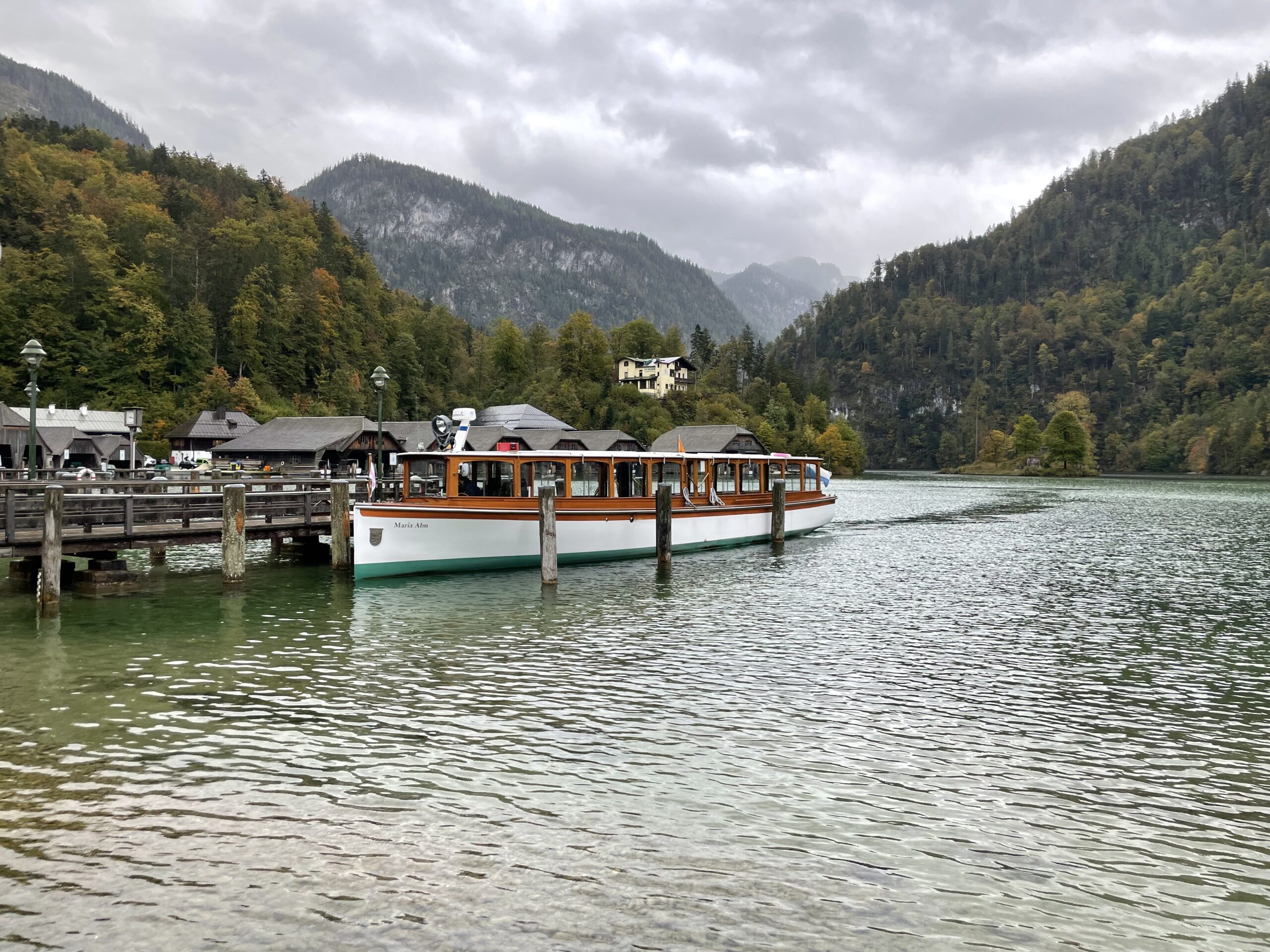
We end our journey along the scenic route at Lake Königssee. This is where the mountains are at their highest and where you will find the only national park in the German Alps: Nationalpark Berchtesgaden. A boat trip on the lake is a must, as it lets us appreciate the beauty of the mountain scenery, see several waterfalls and stop at the St Bartholomew peninsula, where a church was built in this picturesque setting in 1134. If we sail on further, we can get off at a landing stage where trails begin, revealing the wild and beautiful face of the Alps.

Bavarian cuisine: Käsespätzle, Kaiserschmarren and weisswurst
The drive from Lindau to Berchtesgaden is a great opportunity to get to know Bavarian dishes which, despite the passing of centuries, remain popular and bear witness to the region's culinary identity.

Käsespätzle, or spätzle with cheese and onions, is an almost obligatory item on restaurant menus in Alpine Bavaria. Once a meatless dish served on Fridays, it is tasty and filling. The noodles are baked with yellow mountain cheese and topped with fried onions. The most discerning diners expect three different kinds of cheese to go into it. Käsespätzle goes perfectly with local beer, ideally a wheat or dark one. Bavaria is the kingdom of the golden brew, and the few vineyards you will come across are found only around Lindau, on Lake Constance.
Travelling between Alpine lakes, past villages and valleys, we are bound to come across Kaiserschmarren on our culinary journey. It is a very sweet pancake, torn into pieces as it fries. On the plate you will also find raisins and ground almonds.

Because the portions are huge - and very high in calories - it is often ordered not as a dessert but as a sweet main course. When it is meant to round off dinner on a sweet note, often just one plate is served - to share - between several diners.
Every day should start with breakfast. It is a good moment to try white sausage (weisswurst), which is scalded and served hot. It tastes best with a dollop of sweet mustard. Some Bavarians follow the custom of not eating it once the clock has struck noon. On the side, go for pretzels or tasty dark bread. At breakfast there is usually a separate table with bread, which you put into small wicker baskets.

A good opportunity to sample Bavarian cuisine is the Oktoberfest beer festival, held in Munich every autumn (in 2022 it ran from 17 September to 3 October). In the huge halls belonging to Bavarian breweries, beer flows into large steins and big portions of Bavarian delicacies are served. Outside the halls there are many stalls offering smaller portions and snacks, which you can eat at bar tables or take away.
(if food is close to your heart, see what culinary attractions are offered by Malta)
Practical tips: when to go and how many days to plan
The best time to drive the German Alpine Road is from May to October. The route can be covered in four to seven days, depending on the pace we choose and how many stops and excursions we plan. Although we will be in the mountains, in summer there are several chances to spend time on the beach by the lakes, so packing a swimsuit is highly recommended. The gateway to the Deutsche Alpenstrasse is Munich, the route starts in Lindau and ends in Berchtesgaden. Driving the route is not only a sightseeing adventure and a chance for an active mountain holiday, but also an opportunity to try local Bavarian cuisine.
I drove the German Alpine Road in a Nissan LEAF - you can find my test of the car here