








Lviv and the castles of the Golden Horseshoe
Official figures show that Lviv has been under many different influences. For 406 years it belonged to the Polish-Lithuanian Commonwealth (Poland), for 155 years it was Hungarian or Austro-Hungarian, for 50 years it was ruled by the Russian Empire and the USSR, and since 1991 (30 years) it has belonged to independent Ukraine. Even a passing knowledge of these periods suggests that there should be plenty of traces of the city's Polish past. And indeed there are. Despite the passage of time and the horrors of communism, churches, inscriptions on walls and a national necropolis, Lychakiv Cemetery, have survived. We recognise familiar-sounding street names, and Polish is still widely spoken - in some places you can still communicate in it with ease. Still, few visitors to Lviv decide to see the three surviving castles of the so-called Golden Horseshoe.

Lviv - street life, the Market Square and the Opera
Lviv has a rich street life. One of the squares has been taken over by sellers of paintings and handicrafts. Another is home to second-hand booksellers. By the monument to King Danylo, grandmothers and grandfathers line up to sell passers-by the fruit and vegetables they picked in their gardens at dawn. A little further on you can buy cut flowers. In some parts of the city, elderly people invite you to a game of chess. Svobody Avenue is full of people out for a stroll: young Lvivians meet up for dates, while older ones meet for games of chess. In the evenings, the Market Square and the surrounding bars - and there are loads of them - are packed with young people. I had the impression that the average age then drops to 25. During the day you see more people who are a bit, and quite a lot, older.

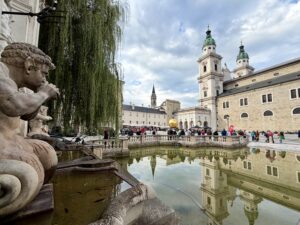
Lviv's Market Square is surrounded by 44 historic town houses, with the Town Hall standing in the middle. Add to that 4 seventeenth-century fountains - wells - and plenty of greenery, and you have a postcard image of a noble European city. When I was in Lviv in 2017, it reminded me of a "little Kraków", and this time I was only confirmed in that view. Many famous figures from Polish history are linked to Lviv's town houses: Jagiełło, Piłsudski, Lubomirski, Baczewski, Sobieski. The last of these bought several houses and rebuilt them to create picturesque, romantic arcades, which Lvivians call either the "Little Wawel" or the "Italian Courtyard". On one corner of the Market Square, in an old town house, there is a pharmacy with its historic interior preserved. On another there is a coffee roastery. It is worth stepping through one of the gateways to relax in a café in the Andreolli Passage.

The Lviv Opera House is a beautiful building that closes off the pedestrian boulevard - Svobody Avenue - that runs along the oldest part of the city. In front of the building there are fountains, or rather water jets that spurt water up from the level of the pavement. Children love playing in them. The Opera House is very visible and can be seen well from every side, which is why it was decided that each of its façades should be richly decorated. The interior (ticket 100 UAH) is beautiful too. The building was designed by Zygmunt Gorgolewski and opened on 4 October 1900. More than 30 artists were involved in decorating the interiors. Interestingly, to the right of the entrance there is a plaque commemorating John Paul II. The Polish Pope, often called "Ivan Pavlo 2" here, financed - from Vatican funds - the Ukrainian opera "Moses". In memory of the Pope's gesture, a commemorative plaque was unveiled in 2011, on the 10th anniversary of his pilgrimage to Ukraine.

Lychakiv Cemetery and the Cemetery of the Eaglets
Set on a hill in the shade of old trees, on the edge of the city, Lychakiv Cemetery is one of the most distinguished national necropolises. The cemetery is full of sculptures, chapels and mausoleums, some of which have recently been painstakingly restored. At the southern end of the necropolis lies the Cemetery of the Defenders of Lwów, known as the Cemetery of the Eaglets, because 20% of the 2,859 soldiers buried here were under 18. Under communism, the chapel, graves, sculptures and catacombs were systematically destroyed. This was even done with tanks, which used cables to pull down solid, carved stone elements. Today it looks beautiful and is a dignified memorial to that heroism. Nevertheless, the Ukrainian authorities have still not agreed to unveil the sculptures of two great lions bearing shields with the inscriptions: "Ever Faithful" and "To You, Poland". The best way to get to the cemetery is by tram no. 2 or by Uber; admission costs 50 UAH, and you can buy a map in Polish on site.

Open-air museum of wooden architecture in Lviv
On the outskirts of Lviv (tram no. 2 from the centre) there is an open-air museum called Shevchenko Park. The park covers 50 hectares and has more than 100 wooden cottages, Orthodox and Catholic churches, mills and windmills. In some of these buildings you can meet folk artists making, for example, beautiful painted Easter eggs (prices from 150 UAH upwards). The site is divided into ethnographic areas: Boykivshchyna, Hutsulshchyna, Lemkivshchyna, Volhynia, Transcarpathia, Podolia, Bukovina, etc. Several buildings have strong associations with Poland, for example a replica of an old Orthodox church from Krosno. In Poland, the original building has lost its original function, has been rebuilt and now serves the Catholic Church. A new entrance to the open-air museum is currently being built; once it opens, visitors will be able to use a spacious visitor centre, and the first exhibit they come across will be a former Polish church saved from destruction (in the museum's current layout, it is well off the beaten track)

What to eat and drink in Lviv
What and where to eat in Lviv? There are a few dishes you really must try... I love soups, so first on my list is "borscht" (in Poland it would be called "Ukrainian borscht"), then "solyanka" (let's say, as a huge simplification, that it is a "goulash soup that tastes like żurek"). Then pierogi, with meat or with cheese.

You will come across pierogi that are... black. Buns, like the ones used for burgers, can be black too. Why black? A little ink produced by cuttlefish and squid is added to the flour. On the whole it does not change the taste, although discerning gourmets will detect a hint of "the sea". It is a good idea to order "kvass" with it. In Ukraine it is a popular drink. I love it and always order it. "Kvass" tastes like something halfway between Coca-Cola and beer. For dessert, try "Galician cheesecake". To finish, an excellent coffee - some places have a long list of "Turkish" and "espresso" coffees. A popular place to eat well, locally, always fresh and cheaply is the "Puzata Khata" chain of canteens - there are two of them in Lviv.

It is worth trying the local beer: the city even has a Beer Museum, and on the Market Square there is the multi-level "Pravda" bar, where you can savour the golden brew while listening to live music. Lviv is also famous for Baczewski vodkas and fruit liqueurs. On the Market Square you will find bars serving cherry, apple and raspberry liqueurs...
If you would like to read about another Ukrainian city, here is my post about Odesa.
The castles of the Golden Horseshoe
If you have an extra day in Lviv (2 full days are enough for the city), it is worth taking a day trip to the so-called Golden Horseshoe. The coach tour costs 400 UAH, starts at the monument to King Danylo, and a guide accompanies the group the whole time. He talks a lot and interestingly, but only in Ukrainian. It is quite possible that, as tourist traffic from Poland grows, Polish-speaking guides will appear. About 70 km east of Lviv there are 3 castles: Olesko, Pidhirtsi and Zolochiv. Admission to each of them costs 90 UAH.

Olesko Castle
Let us start with Olesko, which is associated with King John III Sobieski, who was born here. Legend has it that the birth of the future king was accompanied by mysterious signs: a great storm, a stone table cracking and the midwife going deaf... The castle stands on a high hill surrounded by marshland, and what we see today is the result of a reconstruction carried out in 1975. The building is surrounded by a park, where you can see the remains of flowerbeds and paths. On the other side of the village road stands the Carmelite Monastery, closed to visitors.

A large sign announces ongoing renovation work, but this is more of a marketing ploy, because - as a security guard who spoke excellent Polish let slip - there had not been a living soul on the "building site" for a long time. Still, you can see a new roof and gutters. Today the former monastery buildings serve as storerooms for works of art saved during the war and under communism. Next to the monastery there are several stalls with souvenirs and fast food. Mr Yuriy has a good selection and gives everyone a warm welcome (he also speaks good Polish).

Pidhirtsi Castle
Pidhirtsi Castle is completely different from the one in Olesko. It looks more like a palace, because it was built according to the Italian "palazzo in fortezza" concept. It stands prominently on raised ground surrounded by a high wall with four bastions at the corners. The flat area behind the walls was used to position defensive cannons. The castle stands on the edge of a hill, where the ground drops steeply, allowing views for many kilometres. After the war, the building was turned into a hospital for tuberculosis patients. Despite its new function, it was chosen in 1973-74 as a location for scenes from the film "The Deluge". In 2008 it was placed on the list of the 100 most valuable world monuments at risk of destruction.

Opposite the castle stands a beautiful historic church with very strange proportions. Its massive, monumental front hides an almost microscopic interior.

Zolochiv Castle
Time for the third of the "Golden Horseshoe" castles: Zolochiv. Once again it is different from the others, mainly because it is not one building but two completely different ones. The eye is drawn to the whimsical Chinese Palace, which stands directly opposite the stone gate guarding the grounds. But the building on the right is the older and more important part of the complex. The rescue of the castle is linked to Borys Voznytskyi - according to the descriptions and photographs on display at the castle, he managed to save many of the furnishings and works of art. Thanks to his efforts, the castle was secured and rebuilt. Unfortunately, he was a highly controversial figure - during the Second World War he was an active member of the UPA, the Ukrainian Insurgent Army, which is hated in Poland.

The castle grounds also hold a mysterious boulder engraved with an inscription in an unknown language. It has a hole bored into it: put your finger in and turn it, and your dreams will come true - by magic, of course. Unlike the other two castles, which stand off the beaten track, this one is part of a small town, so it has the best facilities: not stands, stalls or fast-food kiosks, but - right by the entrance - a proper restaurant.
How to get to Lviv
Lviv lies close to Poland's south-eastern border (85 km). In 2017 I travelled to Lviv by coach from Przemyśl and made the return journey on a very comfortable train. This time I opted for a Wizz Air flight, which took off from Warsaw Chopin Airport and took just 45 minutes. When flying to Ukraine (the situation keeps changing), as well as "Covid certificates" you must have medical insurance for the duration of your stay. From the modern airport, trolleybus no. 29 - less modern, as it has no air conditioning - takes you to the city centre in 20 minutes. A ticket costs 10 hryvnias, or 1.40 PLN (1 PLN = 7.00 UAH)
If you are interested in travelling to Ukraine, I recommend my article about Odesa and Bessarabia


