





Central Portugal
Central Portugal is ready to welcome tourists.
Many attractions can now be visited without the crowds, while following the national health guidelines.
Pandemic safety measures, in Fátima as throughout Portugal, are at the highest level. Under the "Clean&Safe" programme, regarded by many European countries as a model, numerous rules have been introduced that help minimise the spread of Covid-19. Temperatures are taken with contactless thermometers before boarding coaches and often in restaurants too. Cutlery comes in hygienic wrappers, and breakfasts are pre-portioned or served by staff. In restaurants you often sit "diagonally", leaving the seat opposite you empty. There are hand sanitisers at building entrances, and masks are compulsory. All these inconveniences are more than made up for by the fact that you are never in a crush, never wait in queues, and are guaranteed that your travel photos will show only you, not dozens of strangers.
Caldas da Rainha
Caldas da Rainha, where a spa makes use of the healing waters. You can admire its historic buildings and, inside, the bathing pools and special basins for inhalations. The town's main square is filled with stalls; it is the only place in the country where a fruit and vegetable market is held every day. At the Bordallo Pinheiro factory shop you can buy the famous ceramics. Rafael Bordallo Pinheiro was not only a ceramicist but also a renowned caricaturist. References to the cult character he created almost 150 years ago, "Zé Povinho", a canny country bumpkin, can still be found in Portuguese culture today. His distinctive mug looks out at you from many spots around the town.
Caldas da Rainha, for sure, where a spa makes use of the healing waters. You can admire its historic buildings and, inside, the bathing pools and special basins for inhalations. The town's main square is filled with stalls; it is the only place in the country where a fruit and vegetable market is held every day. At the Bordallo Pinheiro factory shop you can buy the famous ceramics. Rafael Bordallo Pinheiro was not only a ceramicist but also a renowned caricaturist. References to the cult character he created almost 150 years ago, "Zé Povinho", a canny country bumpkin, can still be found in Portuguese culture today. His distinctive mug looks out at you from many spots around the town.
"The Canny Peasant"
Giant replica of model from around 1895 - Rafael Bordalo Pinheiro
Zé Povinho is a brilliant creation of Rafael Bordalo Pinheiro.
It was born on the humoristic journal “A Lanterna Mágica”, in 1875, to report injustices and caricaturize the Portuguese people. Passive victim of all his powers, but able to laugh about that fact, he does the manguito in a sort of vengeful note, which is his emblematic refusal gesture when he feels like he has been deceived.
Bordalo Pinheiro Factory 2014/2015
Weight: 58,32Kg
Height: 1830 mm
Tomar
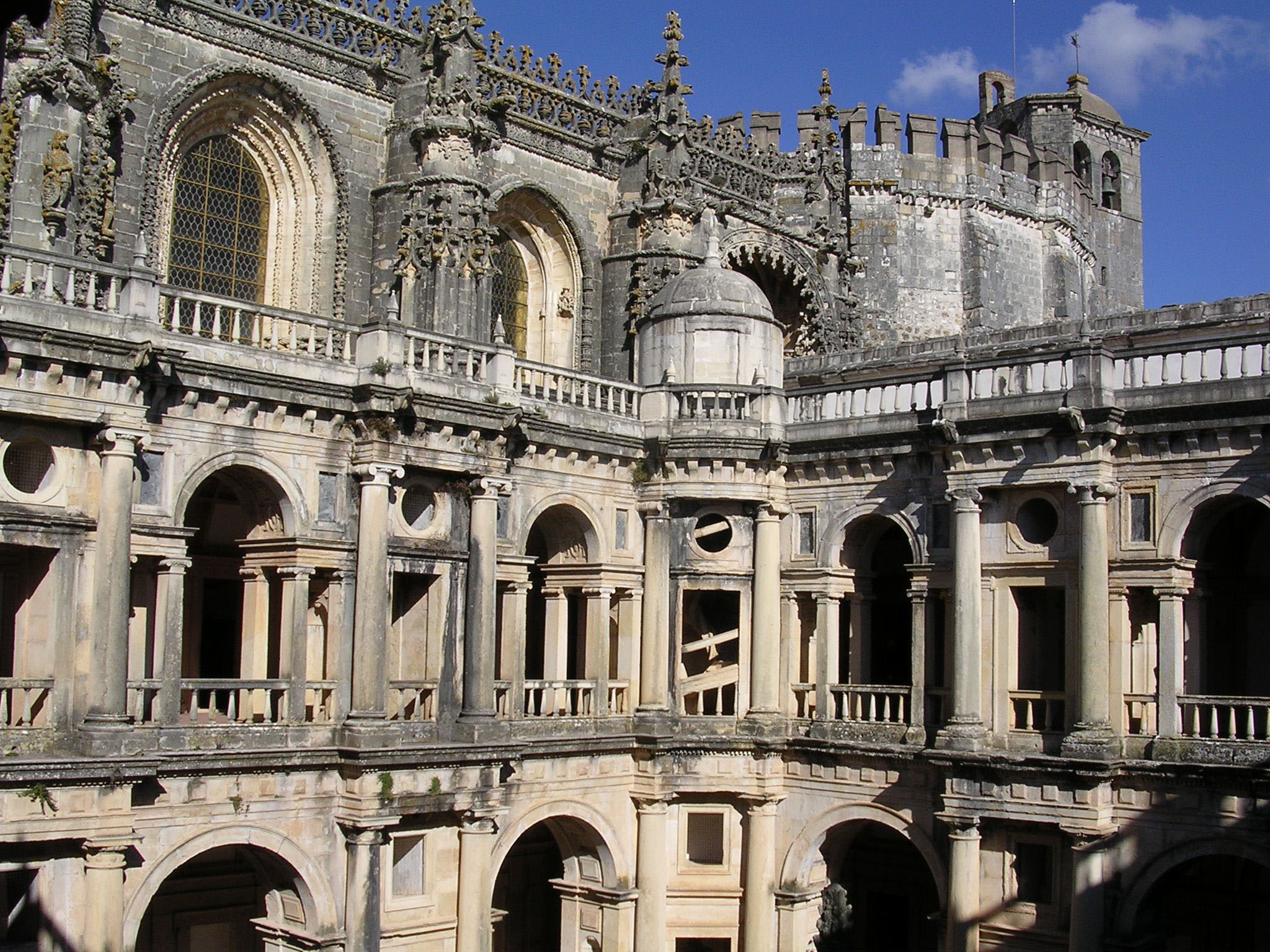
Another place worth visiting is Tomar, where crowds flock every 4 years to take part in the "tabuleiros" festival. Young women carry wicker baskets on their heads, built to hold as many "loaves" of bread as possible, separated by flowers. This is meant to symbolise a willingness to share food and drink with others. Although the "bread" looks more like a Kaiser roll, keeping the huge structure balanced on your head (the basket should be as tall as the girl carrying it) takes considerable concentration. As you stroll around the charming old town, have a coffee at the Café Paraíso, where Umberto Eco worked on "The Name of the Rose". The writer was inspired by his visits to the Templar castle towering over the town. Walking through its cloisters, you will discover exceptional Manueline decoration. The sea-gazing Portuguese combined ship's ropes, corals, furled sails, anchors, knots and figures of sailors in their stone ornamentation.
Another place worth visiting is Tomar, where crowds flock every 4 years to take part in the "tabuleiros" festival. Young women carry wicker baskets on their heads, built to hold as many "loaves" of bread as possible, separated by flowers. This is meant to symbolise a willingness to share food and drink with others. Although the "bread" looks more like a Kaiser roll, keeping the huge structure balanced on your head (the basket should be as tall as the girl carrying it) takes considerable concentration. As you stroll around the charming old town, have a coffee at the Café Paraíso, where Umberto Eco worked on "The Name of the Rose". The writer was inspired by his visits to the Templar castle towering over the town. Walking through its cloisters, you will discover exceptional Manueline decoration. The sea-gazing Portuguese combined ship's ropes, corals, furled sails, anchors, knots and figures of sailors in their stone ornamentation.
Belmonte
Little Belmonte boasts as many as six museums. One of them, the Museum of Discoveries, is devoted to Pedro Álvares Cabral, the discoverer of Brazil, who was born here. You can see the special status of the former overseas province for yourself at the historic castle standing on the highest point of the town, where Brazilian flags fly alongside Portuguese ones. Another interesting museum is the Jewish Museum of Belmonte. The story of the town's Jews is almost unbelievable. Can a community of 200 people survive in Europe for centuries while hiding its faith and customs? It turns out that more than 400 years passed between the banning of Judaism in 1496 and the discovery of this Jewish community in what was then a poor, pastoral region. Only in 1917 did Samuel Schwarz, born in Zgierz in Poland, make contact with them and convince them that they could safely reveal themselves. The "Crypto-Judaism of Belmonte" has been named one of the "7 intangible wonders of Portugal".
Little Belmonte boasts as many as six museums. One of them, the Museum of Discoveries, is devoted to Pedro Álvares Cabral, the discoverer of Brazil, who was born here. You can see the special status of the former overseas province for yourself at the historic castle standing on the highest point of the town, where Brazilian flags fly alongside Portuguese ones. Another interesting museum is the Jewish Museum of Belmonte. The story of the town's Jews is almost unbelievable. Can a community of 200 people survive in Europe for centuries while hiding its faith and customs? It turns out that more than 400 years passed between the banning of Judaism in 1496 and the discovery of this Jewish community in what was then a poor, pastoral region. Only in 1917 did Samuel Schwarz, born in Zgierz in Poland, make contact with them and convince them that they could safely reveal themselves. The "Crypto-Judaism of Belmonte" has been named one of the "7 intangible wonders of Portugal".
The Age of Discovery
The main source of knowledge about Gaspar and the circumstances of his meeting with the Portuguese in India is the account of Álvaro Velho, one of the members of the expedition which set out under the command of Vasco da Gama on 8 July 1497 to discover the sea route to India. Álvaro's account was edited by Damião de Goes, who was extremely well informed about Vasco da Gama's first voyage, head of the Portuguese archives in the 16th century and previously a diplomat, sent among other places to Poland. In his account we read that "...under torture he confessed that he was a Jew from the Kingdom of Poland, from the city of Poznań, the capital of Greater Poland and seat of a bishop, a considerable and strongly fortified city".
Gaspar left Poland with his parents at the age of about 10. He spent some time in Venice, Jerusalem and Alexandria. From there he made his way to India, probably for trade, already a young merchant experienced in travel. There he married a Jewish woman who was to "play a major role in the life of the Jewish community in Cochin". In the administration of Yusuf Adil Shah, Gaspar held the post of shahbandar, the official responsible for negotiating with foreign merchants and managing customs duties. In May 1498, when the Portuguese led by Vasco da Gama arrived in India, he already had a nineteen-year-old son and, besides Italian, knew Hebrew, Arabic, Chaldean and several Indian languages. A month after leaving Calicut, when the Portuguese ships anchored off the island of Anjediva (about 20 miles from Goa), a mysterious man appeared on Vasco da Gama's ship: about forty, perhaps fifty years old, with a white beard, dressed in linen robes, with a fine turban on his head and a short sword at his belt. He greeted the Portuguese and asked in Italian for permission to come aboard. Suspecting a trick, Vasco da Gama had him tortured, and under torture he admitted to his spying mission and also revealed his origins. The Portuguese were going to kill him, but Vasco da Gama quickly realised that the newcomer knew India, the local language, customs and the surrounding waters extremely well. He therefore decided to make use of his services and offered him a place in the service of Portugal. He set one condition, however: he had to be baptised and embrace the Christian faith. The stranger accepted the condition and, on the return voyage, knowing the local waters, put the lost Portuguese back on the right course. In Lisbon the stranger was baptised Gaspar, because he reminded the Portuguese of the venerable Wise Man from the East, Caspar. His godfather was Vasco da Gama himself, who also gave him his surname. He also presented him to King Manuel I the Fortunate as the saviour of the whole expedition and a man of immense knowledge. Gaspar became a courtier of the king, receiving the title "knight of my household", which gave him unlimited access to Portuguese libraries and archives, of which he made diligent use. The King of Portugal boasted about him in a letter to Pope Alexander VI.
In 1500 Pedro Álvarez Cabral, on his expedition to India, reached the shores of Brazil. Gaspar da Gama was the navigator on one of Cabral's ships. It was reportedly he who, fleeing a raging storm, advised Cabral to set a course even further west, thanks to which they reached the shores of America. Gaspar and Nicolau Coelho were the first people to set foot in the New World.
Gaspar da Gama
In 1502-03 Gaspar again sailed to India with Vasco da Gama. During his stay in India he brought about the establishment of trade relations between the ruler of Cochin and Portugal and the opening of further Portuguese trading posts on the Indian peninsula. In 1505 he also found his son in Cochin and persuaded him to be baptised (he was given the name Balthazar, like the third of the Wise Men).
He then prepared Balthazar to take up the post of interpreter at the local trading post. Gaspar da Gama disappears from the Portuguese chronicles in 1510, when he took part in the siege of Calicut, where he is said to have lost his life. Another version gives Lisbon as the place of Gaspar's death, to which he supposedly returned because he had reportedly married a Portuguese woman from high society there and had a son with her. There are also hypotheses that he never returned to Portugal and died around 1520 at the age of nearly 80. Nobody knows the truth, but there is no doubt that this descendant of the Jews of Poznań rendered the Portuguese invaluable navigational, geographical and administrative services. The impossibility of verifying the information stems mainly from the loss of the Portuguese archives (including the logs of Vasco da Gama's voyages) in the Lisbon earthquake of 1 November 1755
Schwarz
In the first decades of the 20th century Judaism was revived in Beira at the hands of Samuel Schwarz. In 1917, in the municipality of Belmonte, he was directing the exploration of the Gaia-Belmonte mining area, considered one of the richest cassiterite deposits in Europe. A dredger began working the Ribeira da Vela, a tributary of the Zêzere, along a 10 km stretch; a blessing for some, a curse for others. The mining operation paid rent for the land it dredged, but it impoverished the soil and impoverished farming. Even so, it brought in money, providing the relief longed for by a people attached to a land that did not always guarantee them their daily bread. Samuel Schwarz, the mining engineer, was made welcome. Later, other matters of interest awaited him in Beira. In his preface "Pro Israel" to the book Os Cristãos-Novos em Portugal no Século XX1, Ricardo Jorge writes: Samuel Schwarz (…) a Polish Israelite, is "a strong Hebraist, following in the footsteps of the Hebrew master who is his father; as such he was able to bring to light the past of his brethren in Portuguese Jewry, the noblest and restored cradle of their race". In Belmonte, Covilhã and Fundão, among other places, the mining engineer discovered families who had preserved Jewish practices. Although the holy books had been banned, the Law of Moses was still handed down from generation to generation. Following the ideological pulse of the country, however, secrecy mainly governed the religious life of these Jews. They alternated periods of secrecy with others of greater openness.
As soon as he arrived in Belmonte, Samuel Schwarz heard about the Jews. He says that a Belmonte merchant advised him not to do business with a competitor, because... "suffice it to say that he is a Jew". That was enough. Samuel Schwarz tried to get to know him and to make contact with the community, but, as he admits: "Only after many months of constant effort, and thanks to a concurrence of very curious circumstances, were we able to be admitted into their midst and take part in their Jewish prayers and ceremonies".
Schwarz aroused the suspicion of the people of Belmonte because of the boldness with which he declared his Jewish faith. Some time later he met Baltazar Pereira de Sousa, a Jewish merchant, in Lisbon. He took him to the synagogue. The doors of the Belmonte community opened. Even so, they asked him to pray. Among the words he spoke in Hebrew, they heard and recognised the word "Adonai". They accepted him: he is one of ours!
1 Samuel Schwarz, The New Christians in Portugal in the 20th Century, Lisbon, Empresa Portuguesa de Livros, Lda, 1925
Samuel Schwarz (1880-1953) was born in Zgierz (Poland - Russia. At 16 he left for Paris, where he studied at the National School of Decorative Arts. He graduated in mining engineering at
24, at the Escola Superior de Minas. His professional career developed in oil exploration and in coal, tin and gold mines. In April 1914, in Ukraine, he married Agatha (1884-1950), daughter of the banker Samuel Barbash.
In the summer of 1914 Samuel and Agatha were on their honeymoon in Portugal; the outbreak of the First World War made it advisable to stay in Lisbon.
In 1915 Samuel Schwarz began working as an engineer at the tungsten mine in Vilar Formoso and the tin mine in Belmonte, both owned by the Tin and Tungsten Mining and Metallurgical Company.
In Portugal he was president of the National Chamber of Commerce, a member of the Order of Engineers and of the Association of Portuguese Archaeologists, and chairman of the General Assembly of the Israelite Community of Lisbon. He knew Russian, English, Polish, German, French, Italian, Spanish, Portuguese, Hebrew and "Yiddish".
In 1923 he acquired the old 15th-century synagogue building in Tomar; he carried out excavations and clearance work, and in 1939 he donated the property to the Portuguese state on condition that a museum be installed there. A ministerial decree of 27 July 1939 established the "Museu Luso Hebraico Abraão Zacuto". In the same year (1939) Samuel Schwarz obtained Portuguese citizenship.
During the Second World War he lost family members who had stayed in Poland. Samuel Schwarz's brother Aleksander came to Portugal in 1940 with his family, saved by visas issued by the consul Aristides de Sousa Mendes.
In 1949 Samuel published an article in the newspaper "Diário de Lisboa" calling on the Portuguese government to recognise the newly created State of Israel.
Sortelha
Sortelha is one of the oldest and best-preserved small towns in Portugal, with a 13th-century castle towering over it. For almost 600 years it defended the border with Spain. In 1855 its stone defences were deemed inadequate for modern times, and the town was downgraded administratively. Thanks to this it preserved its atmosphere and today, after restoration carried out in 1990, it invites visitors on an unhurried journey into the past.
Sortelha is one of the oldest and best-preserved small towns in Portugal, with a 13th-century castle towering over it. For almost 600 years it defended the border with Spain. In 1855 its stone defences were deemed inadequate for modern times, and the town was downgraded administratively. Thanks to this it preserved its atmosphere and today, after restoration carried out in 1990, it invites visitors on an unhurried journey into the past.
Almeida
Almeida is a small town near the Spanish border, surrounded by mighty fortifications laid out as a twelve-pointed star. The walls, built in 1641, were meant to prevent further invasions by the neighbours to the east, as well as by the armies of Napoleon and the English sweeping through. The town is a paradise for lovers of fortifications and military history. The casemates have been opened to visitors, with weapons, uniforms and ammunition from various periods on display.
Almeida is a small town near the Spanish border, surrounded by mighty fortifications laid out as a twelve-pointed star. The walls, built in 1641, were meant to prevent further invasions by the neighbours to the east, as well as by the armies of Napoleon and the English sweeping through. The town is a paradise for lovers of fortifications and military history. The casemates have been opened to visitors, with weapons, uniforms and ammunition from various periods on display.
Covilhã
Since 2011 Covilhã, at the foot of the Serra da Estrela mountain range, has invited street artists every June to use the town's walls for murals. Among the artists who accepted the invitation of the organisers, a Catalan-Portuguese couple, Elisabet and Pedro, was the Polish artist "Nespoon", who created a small porcelain piece set into one of the town's squares. The festival is called "Wool", and the organisers encourage people to play with words and call it "Wall". Both names work perfectly, because Covilhã is the national centre of wool production.
Fátima
Since 1917 Fátima has been a place of pilgrimage for Catholics from all over the world. Every year, on the anniversary of the apparitions in mid-October, it drew crowds of up to 200,000 people. This year there were only 4,500 pilgrims.