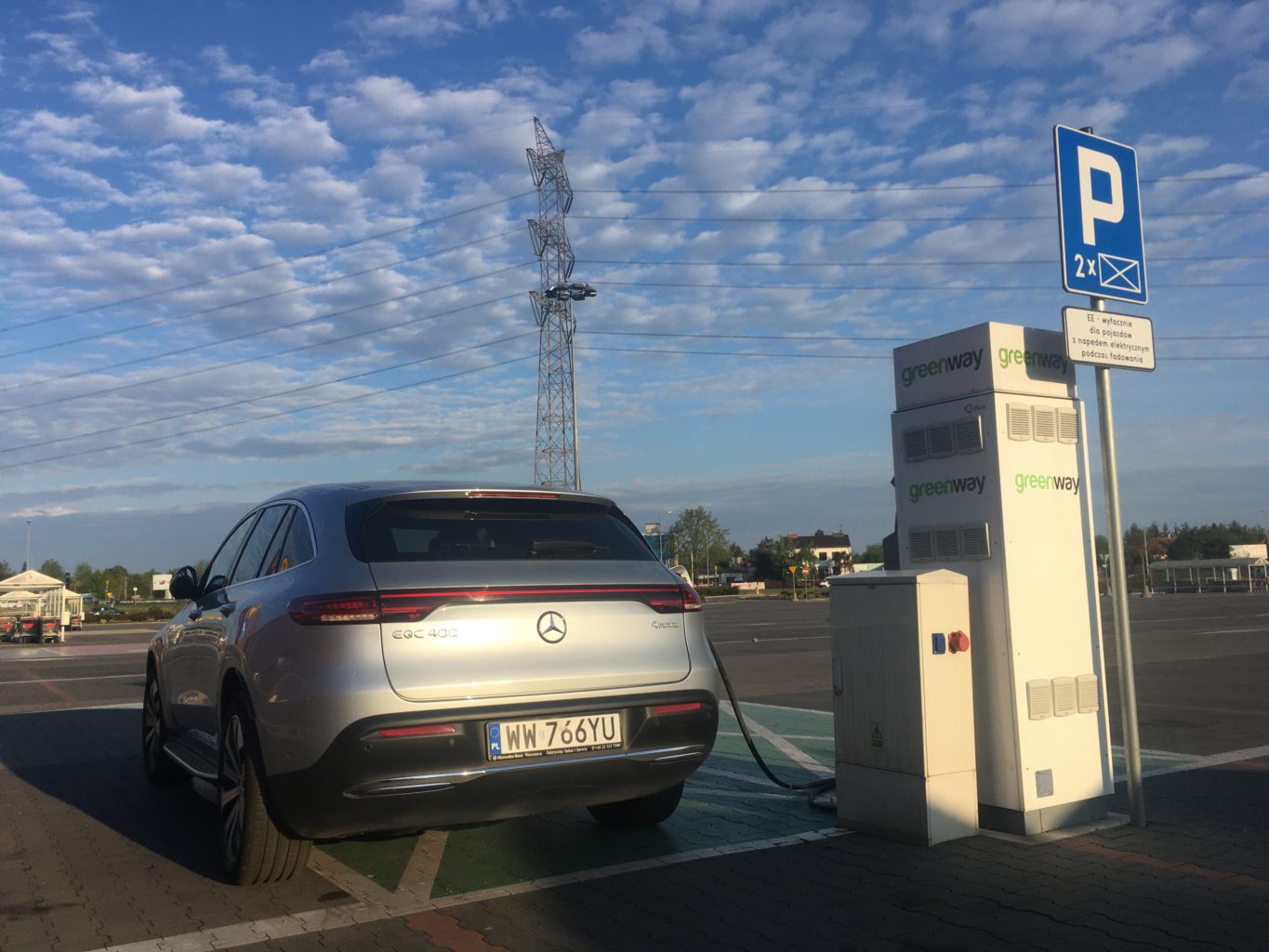
EQC400 4MATIC - Mercedes joins the EVs
I really liked the first fully electric Mercedes. This car competes at the very top end of the electric car market. In Poland only the zero-emission Audi and Jaguar can try to compete with it.

The EQC is a true Mercedes with a superbly made, stylish interior; it means quality and comfort. Another sign that it belongs to the family with the star is that you select the automatic gearbox modes with a stalk on the steering column. The EQC is based on the GLC floorpan, yet only about 15 per cent of the parts are shared. Like its main rivals (the Audi e-tron and Jaguar I-Pace), the Mercedes has 2 electric motors, each driving a different axle. The 80 kWh battery is supposed to provide a range of up to 417 km according to the WLTP test cycle. It is a pity the capacity was not increased by another 20 kWh; the car would then have beaten both the Audi (95 kWh) and the Jaguar (90kWh) in this category and drawn level with the Tesla S (100kWh). The drivetrain is completed by a standard on-board charger rated at 7.4 kW AC and 110 kW DC.
Body, interior and the Edition 1886 version

This will sound sacrilegious, but every time I looked at the Mercedes its body lines reminded me a little of the somewhat forgotten....... Fiat Croma. When the Croma appeared, it looked like no other vehicle, with its elongated body and high roofline. Looking at the EQC, some will see a "stretched SUV", others a "raised estate". The exterior design will certainly appeal. Light strips run across the front and rear of the modern body, and the absence of roof rails emphasises the flowing lines. When you open the doors, a beautifully made interior is revealed. Unfortunately, to get in you have to step over a 25 cm sill integrated with the side step. At the rear, the door opening is also fairly small.
The car I was given was the special "Edition 1886" version, recognisable by its unique combination of a black front end and 20-inch light-alloy wheels. The "1886" badge could not be missing. There is also a Black-Panel radiator grille with black slats and surround, hightech silver metallic paint and aluminium-look running boards with rubber studs.
Under an elegant glass panel, the widescreen cockpit combines a digital instrument cluster and a multimedia display. The layout of the screens' content can be customised; the screens are operated by touch or by voice commands.

Driving modes, regenerative braking and range assistance
The car has several drivetrain operating modes. What may be a little disappointing is that when you change the driving mode (each will have different energy consumption), the range reading is not updated. The paddles adjust the level of regenerative braking: from D+, which means "coasting" with no energy recovery, through D, to D--, which means sharp deceleration. Sometimes the level of regeneration is set by default for a given driving programme, and there are several such programmes. In ECO the priority is high efficiency and low energy consumption. In the COMFORT programme the car has standard settings. In SPORT mode the driving programme aims for the sharpest responses and the highest dynamic performance.
As you would expect, ECO mode is the most economical. In this driving algorithm the car analyses whether there is a slower vehicle ahead, a speed limit or a downhill stretch (navigation must be switched on). Depending on the situation, the car advises the driver to take their foot off the accelerator and also manages the level of regeneration. The system determines whether, once the accelerator is released, the vehicle should ideally keep rolling with as little resistance as possible or slow down while recovering energy into the battery.

The car is fitted with several useful, advanced functions. Active range monitoring constantly checks whether it is possible to reach your destination with the current battery charge. If the charge is too low and the system cannot find an alternative route, in the MAX RANGE driving programme the accelerator pedal shows a pressure point. If you continue driving at reduced speed, you will reach your destination. The electronics use, among other things, navigation data, taking into account the topography, speed limits and driving mode. The car slows smoothly before roundabouts and brakes intelligently with the electric motors on descents, recharging the battery, leaving the driver only gentle steering to do. Some of these functions can be used by the cruise control; if you set it to expressway speed, it will still slow down as it approaches junctions (I tested this on the Warsaw - Modlin route).

Performance and 4MATIC drive
The EQC catapults itself to 100 km/h in 5.1 s. That is thanks to two motors with a combined output of 408 hp (300 kW). Both units have an identical maximum output of 150 kW each. Their characteristics differ, however. The motor driving the front wheels is designed for efficient, relaxed driving. Only when you press the accelerator harder does the rear unit also come into play. 4MATIC distributes drive smoothly between the front and rear axles, from 0 to 100 per cent, because the two electric motors can be controlled independently of each other. If one axle loses grip, more torque is available on the other. Bear in mind that this SUV weighs 2.5 tonnes, of which 652 kg is the batteries.

Test summary
This first electric Mercedes is a very successful vehicle. The EQC is superbly built and modern. Travel comfort is very high, and the range allows you to plan intercity trips with short top-up charges. The multitude of synchronised systems can optimise electricity consumption and adapt the car's parameters to the driver's expectations.