San Marino - a tiny country full of surprises
Europe's oldest republic, tiny San Marino, was founded by Marinus, who fled from what is now Croatia in the 4th century. He is said to have been persecuted by the Emperor Diocletian, whose palace ruins can be found in Split. San Marino lies 12 km from the Adriatic coast, yet in good weather you can make out Marinus's former homeland on the other side of the sea from the summit of Monte Titano. On his deathbed the founder of the republic whispered words that remain the inhabitants' motto to this day: "keep your independence from both the Emperor and the Pope". Today that means keeping a distance from its big neighbour, Italy, and separating state and church. San Marino is a modern state but also a true relic of the past, cherishing its traditions and curious customs.

Monte Titano and independence from Italy
Most of San Marino's territory is taken up by Monte Titano. Geologists speculate about the origin of this rock formation. After research many lean towards the theory that the rock "wandered" here all the way from the western side of the Apennine Peninsula, from the Mediterranean. It took millions of years for the monstrous slab of rock, driven by tectonic movements, to travel from west to east, "shedding" fragments that broke away along the route.
How is it that San Marino is not part of Italy? Garibaldi, who was responsible for unifying the peninsula, tried to persuade the Sammarinese to join the newly created state. He came here in 1849, but his efforts came to nothing. Yet he bore the inhabitants no grudge. Not only did they host him with dignity, they also led him out of the town at night so that he would not fall into the hands of his enemies. The next person who could have changed the geopolitics of the region was Napoleon. He offered to enlarge San Marino's territory, but the inhabitants wisely declined, even though adding the port of Rimini might have meant a chance of huge economic growth. A practised eye will notice that the oldest buildings have roof ridges finished in different ways: in the old days they were a kind of code signalling a town's allegiance, whether it sided with the Empire or the Pope. The Sammarinese showed great prudence; the roofs facing Rome signal ties with the papacy, and those facing Rimini with the Emperor....

Two heads of state and the swearing-in at the cathedral
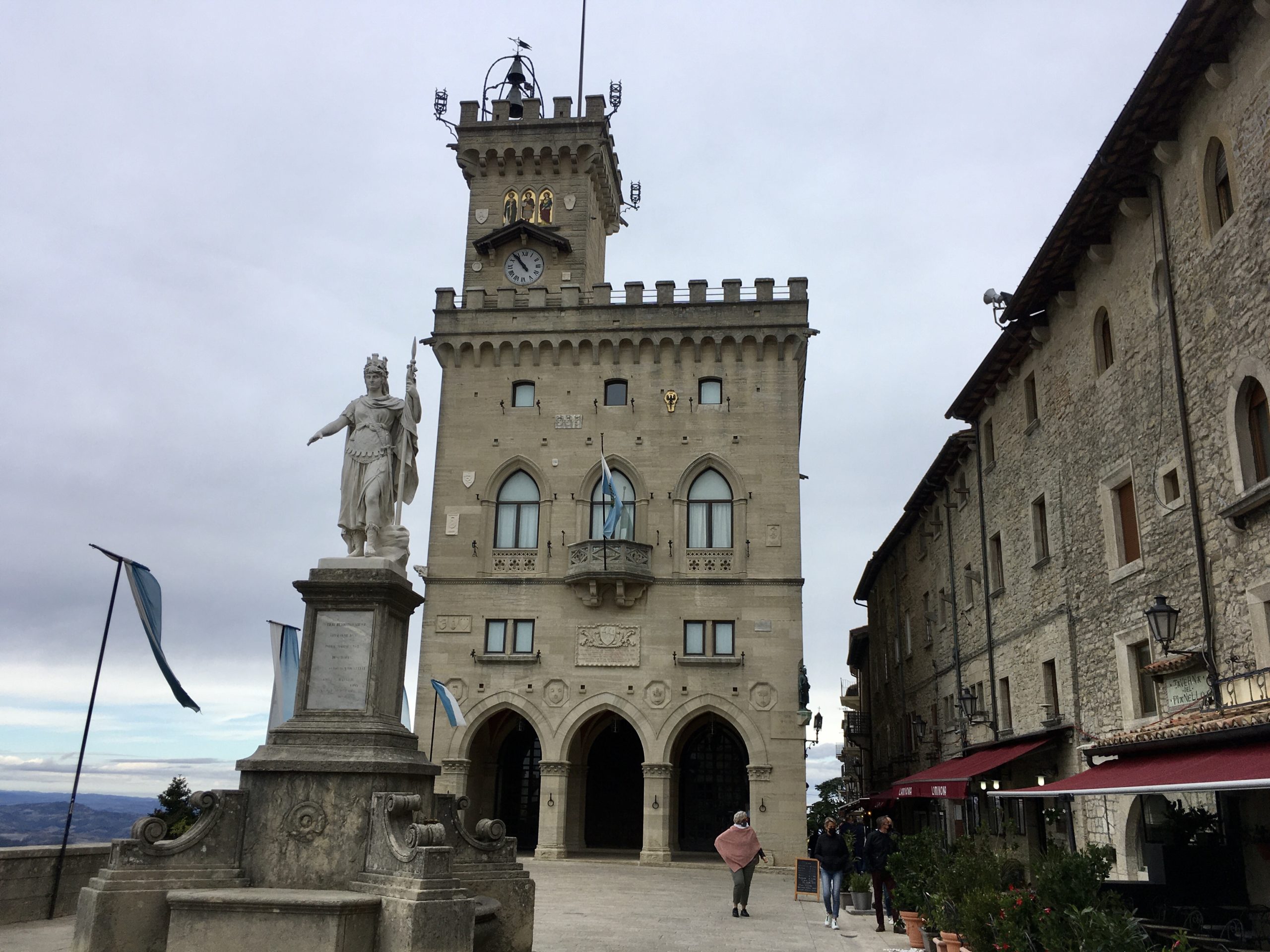
The tiny country (12 km across at its widest point) is ruled jointly by two Captains Regent. Their term lasts 6 months and they are elected by the 60-member Parliament. No other country in the world has such a system. What criteria must the heads of state meet and what privileges do they enjoy? You must be at least 25 and a native-born Sammarinese. Once elected, you get a car with a driver and the honour of being addressed by the inhabitants as "Excellency". The latter is taken quite seriously. Overnight, parents, grandparents and friends have to address the new head of state that way. Breaking this law is punishable by 3 months in prison, and the republic has 6 solitary confinement cells in one of its historic towers. It has happened in San Marino's history that one of the Captains Regent was just over 25 and counted among the youngest leaders in the world. On another occasion both were women.

The Captains Regent are sworn in at the cathedral, but the Sammarinese, mindful of their founder's words about the need to separate state and church, resort to a little trick. For the 2 days needed to hold the ceremony, the cathedral ceases to be a sacred place. This peculiar deconsecration and reconsecration therefore takes place regularly every 6 months.
Shopping and San Marino euro coins
San Marino once made a fortune selling goods that were not subject to customs duty. Today trade is no longer so lucrative, because an agreement with Italy obliges the republic to keep the difference in VAT to no more than 5% (VAT is currently 17% in San Marino and 22% in Italy). That does not mean the local shops are not worth a look. Alcohol and perfume are said to be still slightly cheaper, and the sale of "perfume samples", banned in Italy, is permitted. Many visitors buy local postage stamps here. I was amazed by shops specialising in a single product line; there was a shop selling nothing but model cars, and another with a full range of air guns.

Some people want to take euro coins home as a souvenir. The best way is to change a banknote in one of the...... parking meters. You can be almost certain that the coins you get back will have a reverse showing San Marino. Although the euro is used, the country also has its own independent, historic currency. Because its coins are solid gold, they do not circulate, but every family tries to keep a few put away "for a rainy day".

Getting there from Rimini, the cable car and the three towers
Although San Marino is not a member of the EU, you can enter the republic, home to 34,000 people, without any formalities. The country is surrounded on all sides by Italy. To the frequently asked question "why is it an enclave inside Italy?" the locals reply with a smile that one should rather ask "why does Italy surround them on every side?". The Italian city of Rimini is the "gateway" to San Marino. On the Rimini ring road you turn off towards San Marino, or you can take the bus from the local station. The most interesting way to reach the top of the hill is by cable car. It sets off from a large car park at the foot of the hill and arrives right in the centre of the capital. Italians feel at home in San Marino, Italian is spoken here, and the memory is still alive of how, during the Second World War, 15,000 inhabitants of San Marino took in 100,000 refugees from the neighbouring country.

San Marino has a national football team, which from time to time shocks the football world.... by drawing with another side. A win for this hastily assembled group of amateurs is out of the question. The republic's national sport, however, is a peculiar variety of archery. In the centre of the capital there is a small meadow where competitions are held. The people of San Marino are pleased that in this sport they are always world champions, because nobody else practises it.
Three watchtowers, built for observation and defence, survive on the highest points of the hill. They are named unpretentiously: the first, the second and the third. As we look out over the country from them, we will not see a single river, because San Marino has none. Centuries ago people relied on rainwater, which was collected in huge cisterns under the republic's main square. Today water is imported by pipeline from Italy.

San Marino is a tiny country with plenty of surprises. Its inhabitants take pride in their history, cultivate their customs and take seriously the traditions that have shaped the republic since the 4th century. Given that San Marino is surrounded by the beautiful Italian region of Emilia-Romagna and lies just a few kilometres from Rimini and the Adriatic beaches, a visit here is a must.