Autoworld - Brussels' showcase of vintage cars
Autoworld is a vintage car museum in Brussels, Belgium. It presents a large and varied collection of more than 250 European and American cars, from the end of the 19th century to the 1990s. The collections of early vehicles and of cars built in Belgium are particularly noteworthy. Several limousines that belonged to the Belgian royal family are also on display.

Many people come to Brussels' "Autoworld" to see examples of Belgium's own national motor industry - which no longer exists. Two marques catch the eye: Minerva and Imperia.
Minerva KK (1914)
3.3-litre four-cylinder engine, 18 hp, three-speed gearbox, 70 km/h.
The car could take two types of body on a single chassis. Swapping the 'summer' body for the 'winter' one was very simple.

Minerva SP fire engine (1934)
6.2-litre engine, 70 hp, four-speed gearbox, 65 km/h
The adapted body was built by Plas & Mestagh of Brussels. For many years this fire engine served with the fire brigade of Schaerbeek, one of the 19 municipalities of Brussels.
Minerva 8 HP (1908)
Motorcycle, 0.9-litre engine, 8 hp, 65 km/h.
Minerva's motorcycles were such a success that in the early 20th century car production was suspended for several years. Not only the motorcycles but also their engines were highly regarded abroad.

Imperia TA-8 (1949)
1.3-litre four-cylinder engine, 45 hp, 125 km/h.
Imperia existed from 1906 to 1948, and its first cars were built in Liège. Between 1934 and 1940 Imperia produced German Adlers with Belgian bodies, including a version with drive to both axles. Probably 1,000 examples of the TA-8 were built. Production was halted at the beginning of 1949 so that the company could build cars under licence from Britain's Standard - first the Vanguard and soon afterwards the smaller Standard 8 and 14 - as well as Triumph cars, including the TR2 and TR3.

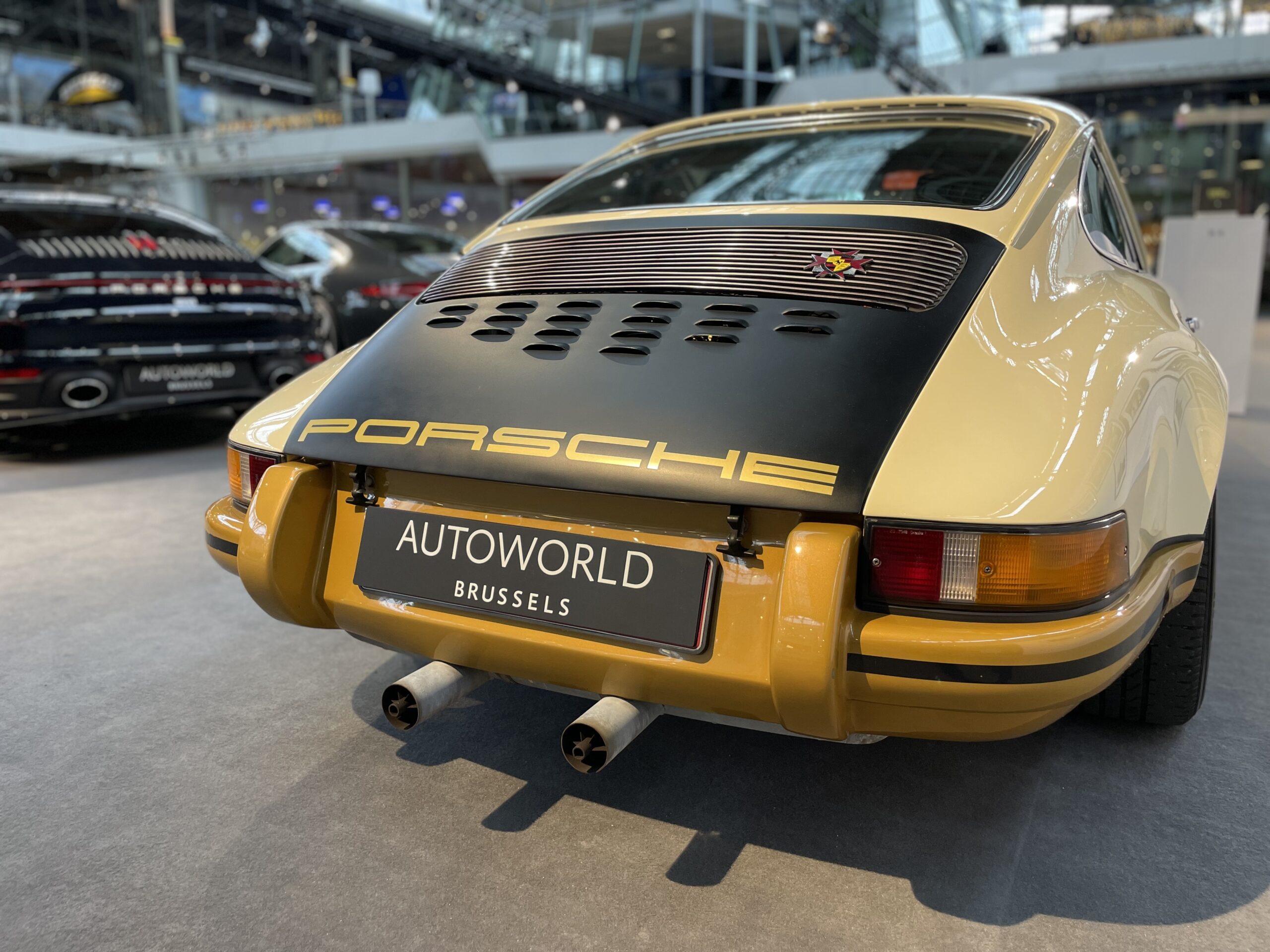
Autoworld also stages interesting temporary exhibitions. One example was the Porsche exhibition hosted by the museum from 8/12/2023 to 25/02/2024. The show, entitled 'Porsche. Driven by Dreams', brought together 50 models, among them eight generations of the 911 and several remarkable prototypes.
On display was the Porsche 911 SC Safari, which in 1978 was one of the two cars entered by the works team in the Safari Rally in East Africa. The cars were fitted with 3-litre engines producing 250 horsepower and driving the rear wheels. The rally was extraordinarily gruelling. Suffice it to say that of the 72 cars that started, only 13 made it to the finish. Martini Racing Porsche System Engineering hired two outstanding drivers: the Swede Björn Waldegård and the Kenyan Vic Preston Jr. Their cars had 28 centimetres of ground clearance, suspension travel suited to desert conditions, an underbody guard, a strengthened body and a 110-litre fuel tank. Additional tanks carried 16 litres of water and 20 litres of oil. Waldegård was leading at first but eventually dropped to fourth place. Preston Jr took second.
Even before the first 959s reached customers, the Porsche 959 scored its first international victory in the Paris-Dakar Rally (the 1986 edition), taking 1st, 2nd and 6th places. The output of the twin-turbo six-cylinder unit was set at 400 hp (reduced because of the poor quality of the fuel along the route). An electro-hydraulically controlled centre differential split the torque between the front and rear axles. The suspension was strengthened with twin shock absorbers at the front. The body was made of plastic reinforced with carbon fibre and glass fibre, which brought the weight down to 1,260 kg.
The Porsche 911 Vision Safari was conceived as a tribute to the successful 911 SC Safari of 1978. The brand designed it in 2012. The result was a vision of an off-road sports car with a raised body, a fixed rear spoiler, reinforced wheel arches and massive bumpers. This prototype was rarely shown in public, yet it was this very concept that paved the way for the special 911 Dakar model unveiled in 2023, which is also on show at the exhibition.

Among the concept cars, the Porsche Cayenne Cabriolet Concept (2003) was worth a closer look. Porsche was weighing up how to develop the Cayenne. A study version with an open roof was built so that the overall look of the car could be judged in two body lengths. The project was eventually dropped, but the two-piece roof concept tested on the Cayenne prototype was adopted for a generation of the 911 Targa.

Another astonishing exhibit was the Porsche 924 Turbo DP in a... cargo version. Only nine were built, by the German firm 'GP-Design und Plastic Motorsports'. The extended roof and near-vertical tailgate prove that in this form the 924 could offer a generous load space.

Autoworld Museum Brussels is located at Parc du Cinquantenaire 11. On weekdays it is open from 10:00 to 17:00, and at weekends from 10:00 to 18:00.