Piešťany - Slovakia's largest spa town
Slovakia's Piešťany is built on mud - literally and figuratively. Patients come from every corner of the world for treatments using the local mud. The country's finest spa lies on an island in the River Váh, where no fewer than seven hotels of varying standards have been built.

Thermia Palace - an Art Nouveau hotel from 1912
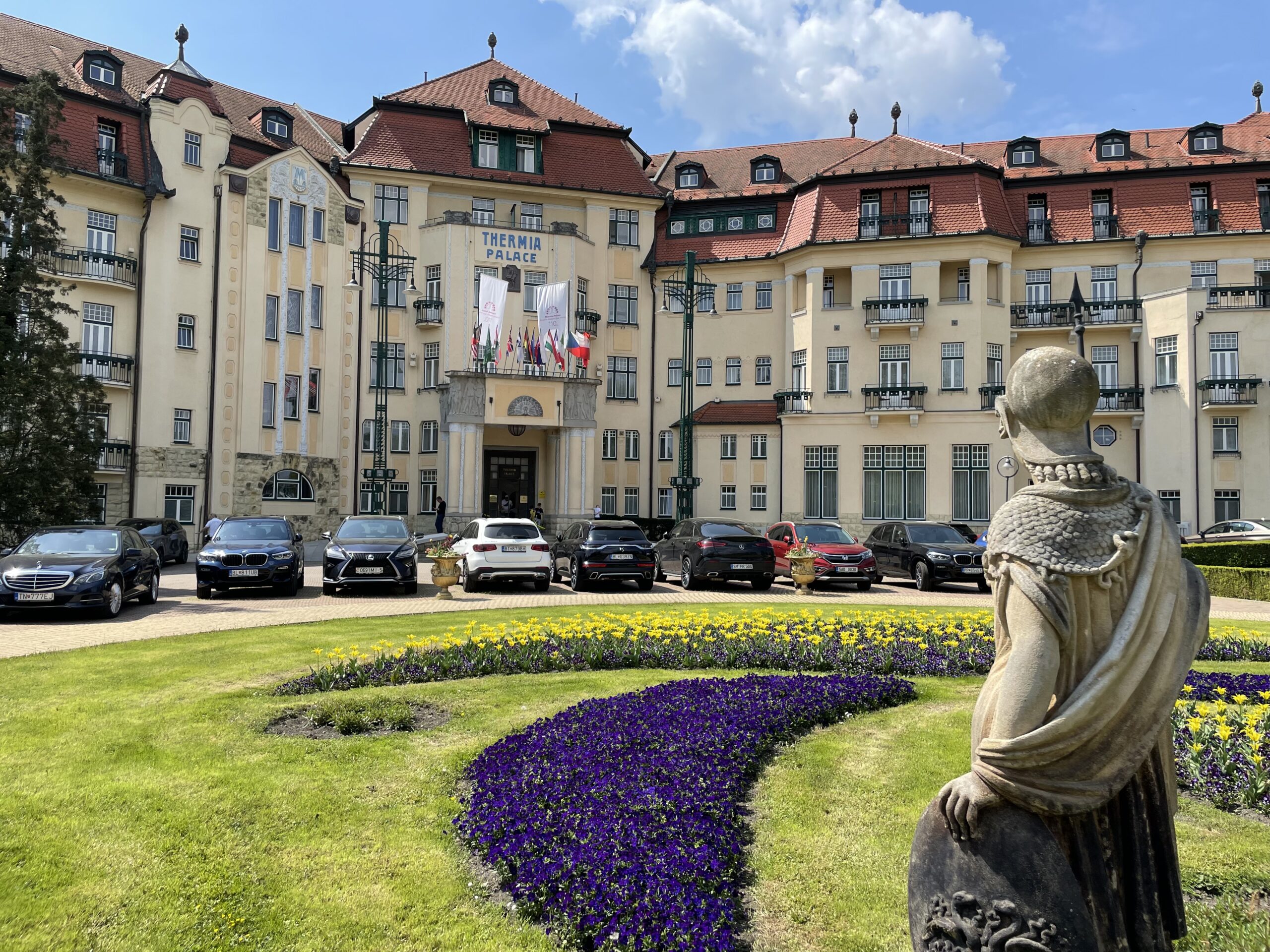
The Thermia Palace Ensana Health Spa Hotel is the most luxurious of them. Here a musical duo plays during evening meals, while a priceless work by the Art Nouveau master Alfons Mucha looks down on the guests. Opened in 1912, the hotel fully deserves its five stars. The sculptures, ornamentation, staircases, floors and stained glass all bear witness to the era in which it was built. The building has 118 rooms, each of them one of a kind, with its own shape, size, window layout, balcony and view. Most impressive of all is suite '420', whose decoration and choice of furniture pay direct homage to the Czech artist.

The hotel is conveniently linked by a covered walkway to the Irma Spa House, where the medical treatments take place. Both the hotel and the spa house stand directly above large natural reservoirs of healing water, which rises from deep underground through stabilised tectonic fissures. So as not to disturb the underground flows, the buildings were given no traditional foundations; instead they rest on piles driven into the ground.

Mud packs, treatments and the wellness zone
Guests can choose from more than 60 different treatments, such as peat packs, thermal baths, bubble baths and underwater massage. The hotel's representatives stress that they specialise in looking after foreign guests - traditionally most come from Arab countries, Israel, Germany and the Czech Republic. Service is provided in Slovak, English, German and Russian. Visitors from Poland are starting to discover Piešťany - a few years ago President Lech Kaczyński and his wife stayed here, and more recently the former first lady Jolanta Kwaśniewska came to 'take the waters'. Poles will feel at home here, because the Slovak-speaking staff understand Polish with ease.

One of the more interesting therapies is the mud pack. The mud is extracted once a year and then matures for 365 days in special 'maturing' pools, during which time it is saturated with naturally sourced minerals and colonies of microflora are cultivated in it. Once matured, the mud is piped to the so-called mud kitchens in the individual spa houses. During the treatment the body is 'wrapped' in a layer of mud about 5 cm thick, and the brown mass has a temperature of 45°C. Between 40 and 60 kg of mud are used for a single person! Many say that after such a treatment you feel like a new person!

Directly adjoining the medical section is the relaxation area, in other words the 'wellness' zone. This part of the complex was thoroughly renovated in 2019. The suite of saunas and pools (two indoors and one outdoors), connected to relaxation annexes and a bar, is open to hotel guests without restriction.

The peacock-man, Mucha's painting and Ľudovít Winter
The hotel and the spa have given rise to plenty of curious anecdotes, legends and intriguing stories. The best known of the legends says that the healing springs of Piešťany were not discovered by chance, and that behind it all was... a peacock-man. An evil spell had turned a young man into a beautiful peacock with a screeching voice. Trapped in the bird's body, he moved clumsily and sprained his leg while trying to fly. He was the first to think of soaking the injured limb in the natural pools of healing water, and thanks to that he recovered completely. Whether it really happened, no one will ever know, but the peacock motif recurs in many of the spa's decorative details. It is also a fact that the symbol of the town of Piešťany is a sculpture of a muscular young man holding broken crutches - no longer needed for support after a cure at the local spa.
Another story is linked to the famous painting by Alfons Mucha, which was given to the spa in gratitude for the treatment of his daughter. Its unusual pentagonal shape did not prevent it from being cut out of its frame and stolen on the night of 19 October 2000, in circumstances that remain unexplained to this day. It was not until December 2004 that two men were arrested while trying to sell it for 95,000 euros to a buyer from Austria.

Although over the last century many famous people from all over the world have passed through Piešťany - emperors, Indian princesses, presidents and actors among them - the most important figure remains Ľudovít Winter. This visionary of Hungarian origin devoted almost his entire life to building the spa. He pioneered many solutions that were innovative for their time, such as combining the hotel with the spa facilities, or designing the surroundings so that before or after treatments guests could take a walk in beautiful scenery. He also thought about how to pipe the healing water directly into the rooms.

Piešťany has ambitions - following the example of the Tatras or the Jasná-Chopok ski resort - to join the most visited places in Slovakia. More than a hundred years of history and a combined therapeutic and leisure offer give the spa serious assets that could draw visitors from Poland.