Emilia-Romagna - fast cars and superb food
Italy is not uniform: every region, even every town, has its own character, something that sets it apart. Often it is distinctive products, dishes, customs or the local dialect. Emilia-Romagna marks the border between the cold Alpine north and the warm Mediterranean south. It is a land of historic cities, industry and exceptional food. Whole books have been written about the monuments of Bologna, Ravenna and Modena, so I will focus on the beautiful cars of Emilia-Romagna and its remarkable culinary tradition.

CARS
The Italian region of Emilia-Romagna is a mecca for lovers of the most beautiful and fastest cars in the world. Ferrari and Lamborghini are built in and around Modena, and this is also where the Maserati brand comes from.
(if you would rather travel by bike, read this piece about the Italian Bike Festival)
Maserati
Ten kilometres outside Modena, between the villages of Baggiovara and Cognento, a priceless collection of historic Maseratis lies hidden. It holds almost 40 cars and several prototypes bearing the trident on the bonnet.
The closer we get to the museum, the more puzzled we become. After turning off the main road you have to pass several huge cowsheds full of dairy cows, squeeze past working tractors and great heaps of manure. Do not let that put you off, because the last building of the "Hombre" farm is the Panini Motor Museum, also known as CUP - "Collezione Umberto Panini".

Why such an odd location and such surprising surroundings? For that we need to go back in time.
Umberto Panini, the man behind the collection, was born in Pozza di Maranello in Emilia-Romagna in 1930, the seventh of eight children. As a young man he worked as a blacksmith, welder and mechanic in various workshops in Modena. At 27 he set off to seek his fortune in Venezuela. He returned to Italy in 1964 and, together with his brothers, founded a company producing... stickers. Italians had gone mad for collecting stickers of footballers; everyone wanted to fill the special albums. In 1972 he bought the farm he had always dreamed of. He started with 30 cows and 30 hectares of land, and named it "Hombre" after his Venezuelan nickname. On the farm Umberto produces "Parmesan" in its finest and most authentic form, Parmigiano Reggiano, and since 1996 he has also displayed a collection of classic cars and motorcycles.
How did a collection of historic Maserati cars end up in the hands of Umberto Panini?
Maserati was founded in Bologna in 1914 by Alfieri Maserati as a car repair workshop. Then, in 1926, the six Maserati brothers took over Diatto, a small Turin company that built racing cars. Drawing on their mechanical experience, that same year they built their first car, the "Tipo 26".
The company began building vehicles, and in 1965 the first Maserati museum opened at the factory on Viale Ciro Menotti in Modena. In May 1993 FIAT bought Maserati from the De Tomaso Group. The Turin company took over the brand and the rights to build the cars, but the status of the collection of historic cars and engines remained unclear. In December 1994, on Maserati's 80th anniversary, an exhibition was staged at the Bologna Motor Show and a new museum opened at the factory headquarters. In July 1996 the De Tomaso Group claimed the car collection and the court ruled in its favour. Almost immediately after the ruling the company decided to sell 19 valuable cars at auction in London. Brooks auction house set the sale for 2 December 1996.

As soon as news of the planned sale of the precious trident-badged classics reached Modena, it sparked fury among devotees of Emilia-Romagna's motoring heritage. When Umberto Panini learned that the collection was at risk of being lost and scattered, he bought every car on the strength of photographs and descriptions alone, and Brooks announced that the Maserati collection had been withdrawn from the auction. And so money earned in Venezuela, then multiplied by producing stickers and Parmigiano Reggiano cheese, saved the heritage of the Maserati brand.
The Maserati museum today
The Panini Motor Museum collection of historic cars, the "Collezione Umberto Panini", is displayed in a large two-storey hall, with the cars on the ground floor and motorcycles and engines upstairs. Maseratis form the core of the collection, but there are also vehicles of other makes as well as motorbikes.
The collection opens with a 1953 A6GCS Berlinetta Pininfarina. It is one of only two cars that survive in original condition today, and just four were ever built. Its 2.0-litre straight-six engine gave a top speed of 235 km/h with a weight of 740 kg. The red example on display in the museum was badly damaged in a crash during a rally in Sicily. The co-driver was killed in that tragic accident and the car was severely damaged. Back in Modena it was supposed to be scrapped, but factory workers who refused to accept that decision hid it in the plant's warehouses. Covered with tarpaulins, it waited 27 years to be rediscovered and for its undeniable value to be recognised. Rebuilding the car only began in 1981.

Among the cars is also the legendary 1956 420M 58 "Eldorado" racer. The famous Stirling Moss raced in it. Its 4.2-litre V8 allowed it to reach a sky-high 350 km/h. It is probably the first car in history whose bodywork was covered in advertising. The "Eldorado" slogans and logo promote an ice cream maker.
The Maserati 250F is another legendary car. The car itself is fascinating, but so is its driver. In 1958 Maria Teresa de Filippis raced it in Formula 1, the first woman ever to do so. The car's V12 engine produces 310 hp, enough for a top speed of 303 km/h. The famous racer signed the car in her own hand.
Upstairs is the futuristic Chubasco prototype, a car ahead of its time. Only one was ever built, in 1990. It was meant to be fitted with a 3.2-litre V8 producing 430 hp.
On the outskirts of Modena lies one of the most valuable collections of historic cars, created thanks to the legendary Umberto Panini. Today the gathered "treasures" are personally looked after by Giovanni Panini, the founder's son. He works from a small office that also serves as a shop selling souvenirs and publications about the brand.
The Maserati museum is open from March to October and admission is free, and you can find more information about the car brands that come from Emilia-Romagna here.
Ferrari
Near Modena there are also the Ferrari museums, better known than the Maserati one. One is at the factory in Maranello, the other in the city of Modena itself. The latter consists of two buildings. The old brick building displays engines and a recreation of the car maker's study, while the large futuristic hall with a yellow roof (yellow is the colour of Modena) hosts themed exhibitions. Until February 2021 visitors can see exhibits brought together under the motto "Grand Tour".

My eye was caught by a car beneath a sign reading "Paris". It is the Ferrari 212 Inter in which the actress Ingrid Bergman made her journey from Rome to Paris in 1953, watched by crowds. Another interesting car is the LaFerrari 612 Scaglietti 2+2, which covered 15,000 miles across China as part of a promotional campaign, so it is accompanied by a "Beijing" graphic. The 2020 Ferrari Roma prototype, its city naturally being "Rome", points to the direction in which the Ferrari brand and its styling are "travelling".
A ticket to the museum costs 17 EUR per person, and if you combine it with entry to the museum in Maranello, be prepared to spend 24 EUR.

FOOD
Italians love food, and in this respect every one of them is both an expert and a local patriot. Parma, Reggio Emilia, Modena, Bologna and Rimini are the main culinary centres whose products and dishes have made not only the region but the whole of Italy famous around the world. In telling the story of the Maserati collection I mentioned the Panini family, who came back from Venezuela in 1989 and expanded the "Hombre" farm near Modena, devoting themselves to producing genuine Parmigiano Reggiano. "Parmigiano Reggiano" combines the names of two places, and it is also the full name of the most famous cheese of all, oversimplified as "Parmesan". Only 300 farms in Emilia-Romagna have the right to produce it. Everything else is essentially an imitation. Some of the huge wheels, coated in salt, mature for more than 30 months, losing as much as 10 kg of water, hardening and darkening. The "Hombre" farm produces 16 wheels of Parmesan a day.

Traditional "balsamic vinegar" is produced near Modena; the best is at least 12 years old. Every year it is poured from larger casks into smaller ones, and each should be made of a different wood. It gains flavour and thickens. Centuries ago the ageing and maturing of the vinegar began when a daughter was born into the family. After 12 years the vinegar was ready to use and the girl was ready to marry.
And Parma ham? You will not find anything like it anywhere else, because the pigs have to drink the whey left over from making Parmigiano Reggiano.
"Piadina" is a thin flatbread, similar to the Polish podpłomyk. An Italian can often tell where it comes from, almost down to the district, just by the thickness of the dough.
Interestingly, rice is also grown in Emilia-Romagna. Growing rice near Ferrara is something of a side effect, because the plants were originally intended only to desalinate the flood-prone land.

Emilia-Romagna is a region that not only produces the finest ingredients of Italian cuisine but is also home to some of the best restaurants in the world. The chef of Modena's "Osteria Francescana", which boasts three Michelin stars and has twice been named the best restaurant in the world, is Massimo Bottura. For years he has been one of the hottest names in world gastronomy. To many he is an outstanding chef, to others an iconoclastic reformer of the Italian way of thinking about food. He is also a social activist, a speaker and a visionary. He has something of the charismatic celebrity about him, able to stir emotions in his audience. He works closely with the UN, and his organisation "Food for Soul" tries to tackle the challenge of widespread food waste, enlisting artists and spectacular events to achieve its goals. In its first year it managed to use 25 tonnes of food, from which more than 48,000 meals were prepared. In 2012, after the earthquake near Modena, he supported local producers of Parmigiano Reggiano. At the time 360,000 damaged wheels of cheese were sold, which may have saved local businesses from bankruptcy.

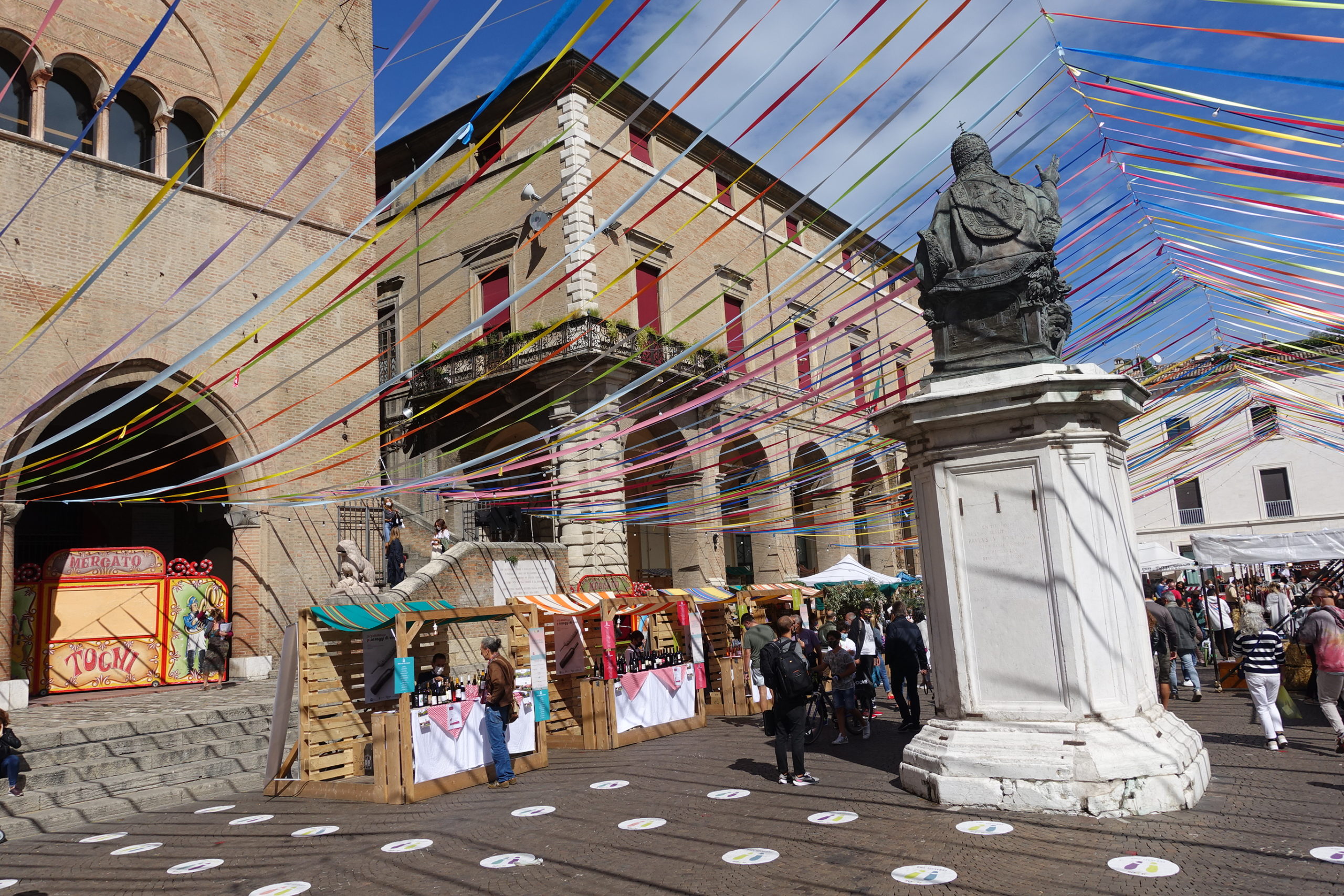
Every year Rimini hosts the "Al Meni" Food Festival. The September edition was already the seventh and coincided with the centenary of Federico Fellini's birth. "Al Meni", meaning "by hand" in the local dialect, is a celebration for food lovers, a chance to taste the best dishes prepared by the chefs of the finest restaurants and an opportunity to buy produce directly from the makers. The area around the circus big top, a nod to Fellini's films, was the centre of the action, although the old fish market also drew crowds.
The big top in the gardens behind the town's main square was the stage for the festival's opening ceremony. Several speeches were preceded by circus acts, during which Bottura was carried shoulder-high, both literally and figuratively. Then the tastings began. Leading the way were Osteria Francescana's closest collaborators. At the old fish market (Antica Pescheria) the first dish was served by Takahiko "Taka" Kondo. As befits a Japanese chef, he added a sauce inspired by miso soup to a pasta-based dish. Jessica Rosval, a Canadian who runs Casa Maria Luigia, a luxury hotel complex linked to Bottura, served roasted mussels with surprising accompaniments.

Do not despair if you find yourself in Rimini when the "Al Meni" festival is not on, because there are several restaurants worth recommending. The Italian-Argentinian restaurant "Abocar" offers a remarkably interesting menu, and excellent fish and seafood is served at "Il Canevone"
The Emilia-Romagna region offers attractions for all kinds of visitors. There are factories and museums devoted to beautiful, fast cars. There are also plenty of places where you can eat superbly, and Rimini has proved that it is becoming one of the most dynamic centres of ambitious tourism on the Adriatic coast.