








Kežmarok and Dunajec rafting - two highlights of the "Tatry Spiš Pieniny" region
Kežmarok means historic churches, a lyceum with centuries of tradition, a town hall, a castle and a charming town centre. Less than 40 kilometres north of Kežmarok flows the Dunajec, the river that marks the border. Rafting down its fast current is an almost obligatory part of any stay in the Pieniny. If you decide to do it from the Slovak side, you can expect some extra attractions! Both lie in the "Tatry Spiš Pieniny" region.

For centuries Kežmarok was associated with the Lutheran community of Spiš. The town is believed to have grown out of the merging of Slovak villages with others dominated by German settlers. This mix, and the fact that Kežmarok enjoyed many privileges as a "royal town", meant that it developed very dynamically. Today we can enjoy exceptional historic buildings that have survived the centuries. Sightseeing is best started at the library of the Evangelical Lyceum, the largest historical school library in Central Europe.
The Lutheran lyceum and churches of Kežmarok

The first written record of the library dates from 1600, and today its collection, built up over the centuries, numbers 150,000 books. When a wealthy pupil arrived to study, it was considered good form to donate useful books, which could then serve everyone. The lyceum was also open to poor but exceptionally gifted pupils - a special certificate issued in their home town entitled them to study. Besides the books, the school rules have survived to this day, forbidding, among other things, damaging nature and... bathing in the river, which was considered too dangerous. Breaking the rules could bring drastic punishments, such as many hours locked up in the lock-up "on bread and water". The lyceum attached great importance to languages - the pupils' surviving school reports show grades in Latin, Greek, Hungarian, German and Slovak.

Right next to the lyceum stands a remarkable church. It is an entirely wooden Lutheran church, built according to the strict rules imposed on followers of this faith in the 17th century. At that time, the so-called articular churches could only be built outside the town, using the cheapest materials, with no towers or bells, and the entrance could not face the town. In Kežmarok, the site allocated was a patch of marshland right next to an inn that did not enjoy a good reputation. The church, completed in 1717, was built only of wood of various species and stands on yew piles, without a single nail. Legend has it that Swedish sailors helped with the construction, which is why the building's architecture features maritime elements, such as round windows and distinctive lettering. The church is a UNESCO World Heritage Site.

Right next to it stands the so-called new Lutheran church. Although it dates from the 19th century, it is also worth a visit. The local community could not afford to commission a design for a new church, so they used a ready-made design prepared for a country in the Orient, which was meant to include decorative elements emphasising the openness and ecumenism of the faith. Architecturally it is an eclectic building, drawing on Romanesque, Byzantine, Gothic and Renaissance architecture, and some even see Turkish mosques as its inspiration.

Kežmarok Castle and the legend of Beata Łaska
Walking through the old part of Kežmarok, past the town hall and the charming buildings of the old town, you reach the castle. Kežmarok Castle hides many secrets. There is a tale of a woman steward who wanted to steal her lord's treasure, and there is also the legend of a wealthy co-owner of the surrounding estates who was walled up in one of the towers. She suffered this draconian punishment for going on an unauthorised... trip to the Tatras. This happened in 1565, when such an idea was regarded as proof of "losing one's mind", and travelling without her husband's knowledge or company was also treated as a deeply indecent offence. Nevertheless, despite this tragedy, it is Beata Łaska - Polish by birth - who is now regarded as "the first female tourist in the history of the Tatras".

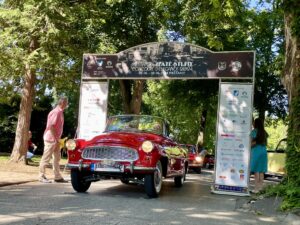
Kežmarok Castle is open to visitors and offers interesting exhibitions. There is a display of period costumes and weapons, a recreated centuries-old pharmacy and the surgery of one of the first Slovak radiologists. There is also a small museum of vintage cars.
Dunajec rafting from the Slovak side

Anyone who has been to the Pieniny has surely planned a rafting trip down the Dunajec. It is the "must-do" attraction of this mountain range. Polish raftsmen have 250 rafts at their disposal, while on the Slovak side there are only 50. Do our southern neighbours have any arguments to compete with the Polish rafting operators? It turns out they do.

On the Slovak side, the rafting trip is best started at the "Pltník" guesthouse, whose name means "raftsman". Penzión Pltník is not only the starting point for the trip, located about 3 km downstream from the Polish landing. It is also a café, restaurant, hotel and campsite. Once enough people have gathered - a raft holds 12 passengers and 2 raftsmen - the adventure on the fast-flowing river begins. The rafts are identical to the Polish ones, and the raftsmen wear the same costumes. They steer the rafts skilfully and tell interesting stories, which usually end with a spicy punchline. There is no shortage of jokes either, keeping a smile on your face during the trip, which lasts 1 hour 40 minutes. Asked "What's the difference between you?", they answer: "None, highlanders live on both sides of the Dunajec, after all." A keen eye will, however, spot the Slovak flag painted on the side of the raft. Although the Slovak trip is a little shorter, it also covers the most beautiful stretch of the Dunajec gorge, where the river winds through a ravine, often passing sheer, bare rock cliffs. At the end, the raft moors at a spot marked by the state border. From here it is just 800 metres to the bike rental at "Chata Pieniny" (towards the village of Lesnica), and you can start the return journey on two wheels, which can be just as charming.
By bike to Červený Kláštor

A wide path runs along the Dunajec, and as you ride you can wave to those floating by on the rafts. The views are often breathtaking, and the advantage is that you can stop the bike and take your time looking at both the river and the nature around you. After about 10 km you reach Červený Kláštor, the Red Monastery. It is a unique place, and you will look in vain for anything similar on the Polish side of the Pieniny. The history of these buildings goes back to the 14th century, and their importance reaches far beyond being a religious centre. Today you could say that for years it was a centre of research and science. An extraordinary figure associated with Červený Kláštor was the semi-legendary Brother Cyprian. He practised medicine, herbalism and pharmacy. According to legend, he was also the "Icarus of the Carpathians", who built a flying machine that carried him all the way to the area of Morskie Oko in the Tatras. There, an angry God caused the daring monk to fall, and to this day one of the peaks is called Mnich, "the Monk". So much for legend - the facts show that Cyprian was a truly brilliant expert on plants. In the 18th century he created a herbarium describing 282 plants in five languages. Scientists are still amazed that, classifying the flora at that time, he was wrong in only 14 cases. Visiting the monastery is a journey into the past: you will see the monastery halls, a beautifully restored chapel, stone alleys and... flowerbeds full of herbs.

Leaving Červený Kláštor, you are less than 2 km from where the trip began, the Pltník guesthouse. There we return the bikes and have lunch. Being able to combine Dunajec rafting, a bike ride and a visit to a historic monastery is an attractive option available on the Slovak side of the Pieniny.

The "Tatry Spiš Pieniny" region is certainly worth a visit for its wealth of historic sights packed into a small area, set amid beautiful nature. Among its interesting towns, Kežmarok and Levoča are the ones to mention. The region is very well connected with Poland, and you can cross the border in several places, not only by car but also on foot and by bike. There is an extensive network of cycle paths on both sides of the border, and riding along them often opens up beautiful views of the mountain landscape, including the highest parts of the Tatras. Rafting down the Dunajec from the Slovak side offers extra attractions. "Tatry Spiš Pieniny" is well worth considering as a destination for your next trip!


