Skoda Enyaq - a Czech EV from the Volkswagen Group
The Skoda Enyaq is the Czech brand's second electric car, after the small Citigo-e city car. Unlike its smaller sibling, it is not an adaptation of an existing model but was designed from the very first sketch as an electric car. Technically it is a twin of the Volkswagen ID.4 and, like it, is built on the MEB platform.

The MEB platform is intended to be the basis for the electric cars of the entire VW Group and is, and will be, used by Volkswagen, Seat, Audi and Skoda. Using the defined layout of components on the MEB platform, the Skoda Enyaq shares many features with other VW Group models.
Styling, space and boot
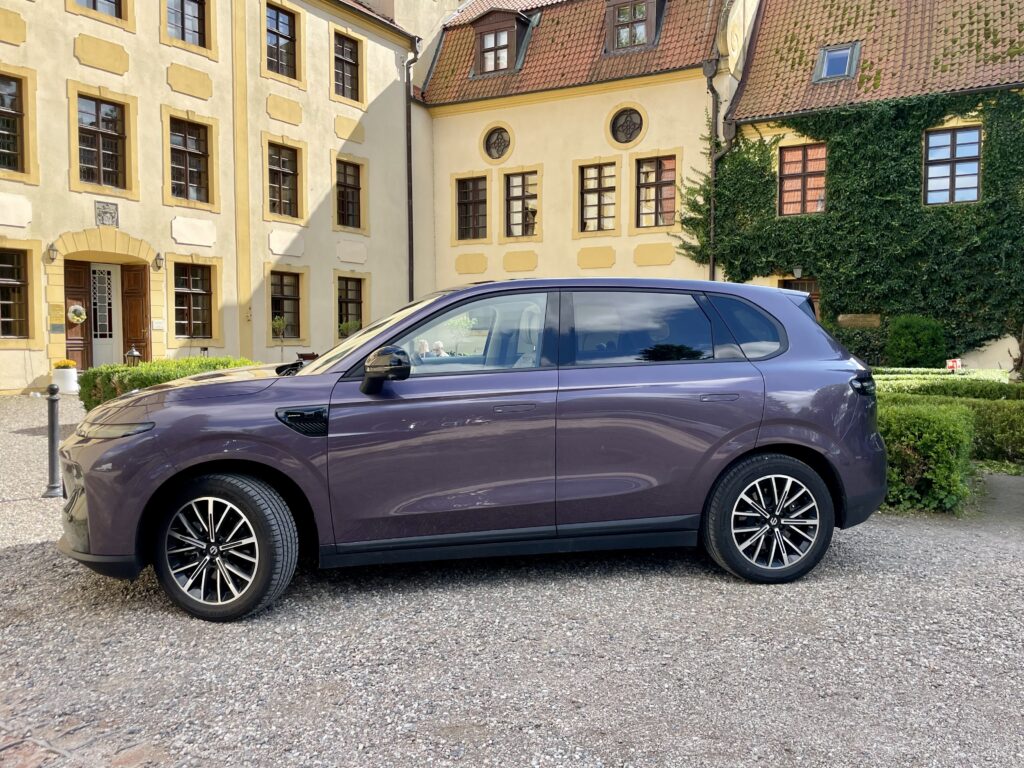
The Enyaq has been styled so that at times it looks like a raised estate and at others like a chunky SUV. Its dimensions, however, are compact - 465 cm long and 188 cm wide - yet it is not short of interior space. There is a great deal of room in the rear seats, and those travelling in the front row have no reason to complain either. The backs of the front seats have fold-down tables, and the floor is flat. Despite the motor being placed right above the rear axle, the boot holds 585 litres. It is a pity that Skoda, which proudly presents various "smart" solutions, did not provide storage for the charging cables in the front of the car, as some competitors do. They live under the floor of the main boot, which is not ideal, especially when the cables are dirty or you are carrying a lot of luggage.

Interior: seats, storage and screens
The seats are comfortable, adjustable in many directions and offer good lateral support. They are upholstered in a neutral grey fabric that should simply appeal to everyone. The seats form a coherent whole with the minimalist cockpit, where a small (5-inch) screen in front of the driver stands out. It is so small that most current smartphones seem bigger. The interior offers a high quality of finish, and the number of shelves and storage compartments is impressive. The centre console is on two levels: the upper part houses a small "cube" for selecting the drive mode, the parking brake switch, storage compartments and cup holders. The lower part offers several cavernous spaces where you can carry the things that matter to you. It is a pity the upper compartments cannot be covered with a roller blind. A folding umbrella is hidden in the driver's door.

Heated seats are almost standard in electric cars. Skoda has gone a long way with this feature. Not only can the front seats be heated at 3 levels, but the rear seats and even the steering wheel can be heated too, again at three levels of intensity.
The centre of the dashboard is taken up by a large screen, which controls most functions. Unfortunately, the number of physical buttons has been kept to a minimum, and the touchscreen, to which control of the on-board systems has been moved, does not always work as you would expect. Perhaps operating it becomes more intuitive with longer use. An interesting feature is a touch slider - a groove in the plastic panel - used to adjust the media volume. The "slider" is built into a small ledge, which is very handy, as you can rest your hand on it to steady it while using the screen. Another interesting styling touch is the touch-sensitive interior lights: when they are "off", all you see are slightly milky rings. Brush them lightly and the lights come on.

The test Enyaq coped well with uneven city streets, and the interior is well insulated from noise. The tight turning circle is impressive, making manoeuvring in narrow streets easy.
Powertrain, range and CCS charging

The car I tested was the Enyaq iV 60, with a 179 hp motor above the rear axle producing a maximum torque of 310 Nm. These figures translate into 0-100 km/h acceleration in 8.8 s and a top speed of 160 km/h. There are 4 driving modes to choose from: Eco, Normal, Sport and Individual, which lets you create your "ideal car". With the standard driving settings, regenerative braking is automatic, while in the other modes you can change its level with paddles on the steering wheel. The 58 kWh battery gives a real-world range of around 300 km. The maximum supported charging power is 125 kW, using the most popular DC connector, CCS / Combo.