Toyota Prius - an icon of hybrid drive
When I stood in front of the Toyota Prius I was about to test, I was reminded of an old joke. A wife comes home after doing the shopping and running errands and says to her husband: "Tell me, why do you go around telling everyone that you married me for money? I was as poor as a church mouse." The husband looked her up and down and replied without enthusiasm: "Well, what else am I supposed to say?"

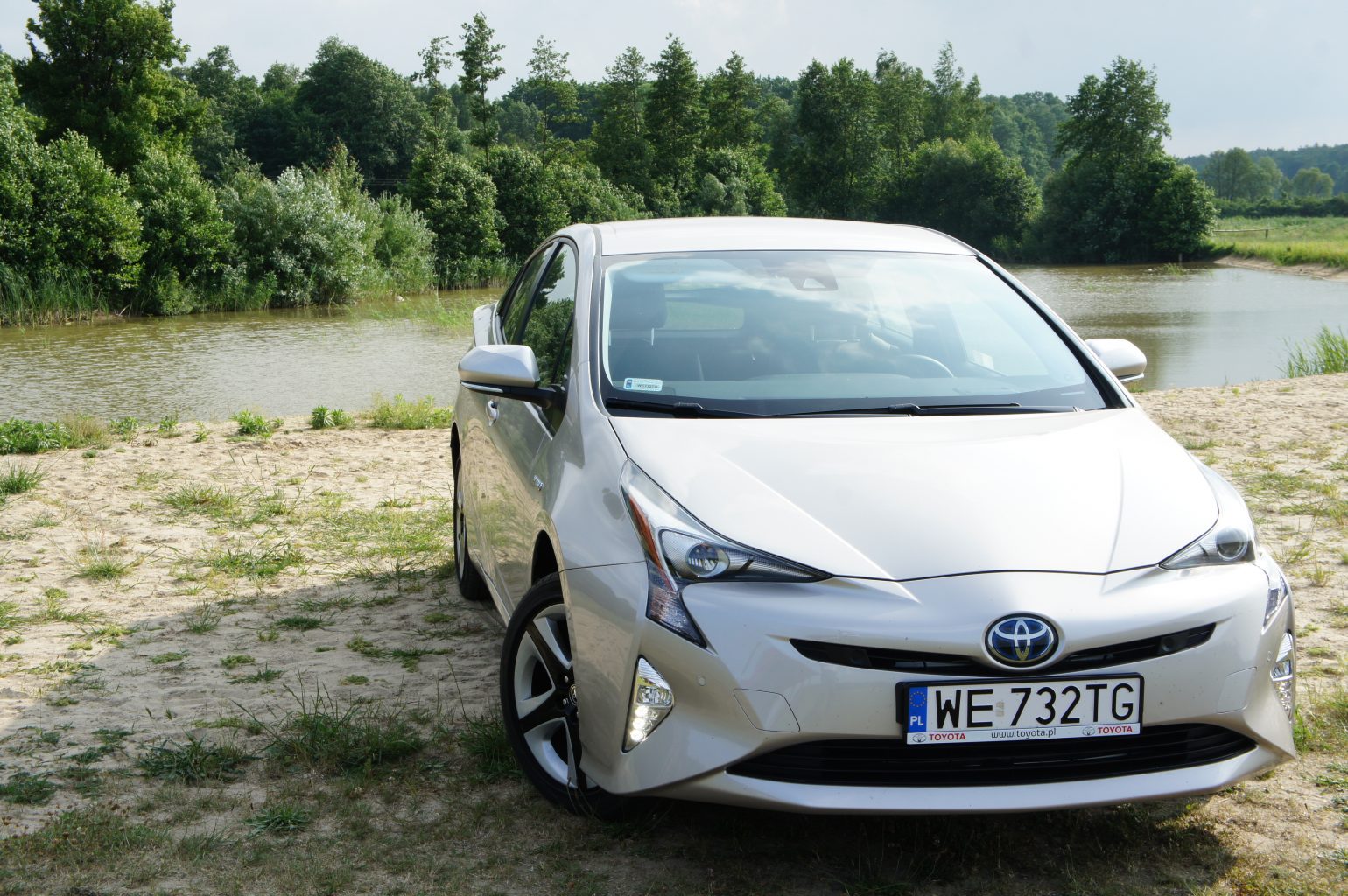
It is a bit like that with the Toyota Prius. You certainly won't buy one for its looks. You have to look for its strengths elsewhere. You will find them under the bonnet. Being the world's first production hybrid car, built since 1997, comes with obligations. Indeed, the persistence with which Toyota has promoted each new version of the Prius deserves respect and has certainly helped to popularise this type of drive. The current, fourth-generation Prius boasts an improved hybrid system and promises to offer more benefits than its predecessors.
How Toyota's hybrid drive works

So how does Toyota's hybrid drive work? It consists of three interconnected devices: a petrol engine, an electric motor and a battery. The key to their cooperation is an optimised flow of energy between these three components. The electric motor recovers energy from braking, and when driving at a constant speed it sends surplus energy to the battery so that it can be used again, for example when crawling along in heavy traffic. Some versions of the Toyota Prius can have their battery charged from an external source, and then they can add the term "plug-in" to their name. Being able to charge the battery from outside moves these versions of the Prius into the electric car category, which in many countries can mean certain privileges.

Driving impressions and fuel consumption
My few days with a Prius fitted with a 1.8 petrol engine and a continuously variable transmission left me with mixed feelings. On the one hand, I was dealing with a legend, an automotive icon that will forever be mentioned as the car that blazed a trail. On the other hand, its American-Japanese styling could not escape attention, and you could also feel the suspension tuning typical of those markets: by European standards the car rolls too much and the braking is spongy. The messages the driver sees are too often descriptive and don't use icons, again something characteristic of the communication culture in Japan and the USA. Then again, you have to take your hat off to the remarkably smooth switching between the power sources. Only a very skilled driver who listens closely to their car can detect the tiny reactions of the car when it switches from petrol to electric mode and back.

Thanks to its electric drive, the Prius is an economical car, but few will manage to achieve the manufacturer's stated fuel consumption of 4 litres, whichever of the three driving modes they use. For driving on a shoestring, the electric mode will be the most useful, but in my case it switched off when I went above 60 km/h and when I wanted to accelerate a little more briskly. The Prius is a spacious family car (or taxi...), with a large boot and plenty of room in the front and back. One interesting feature I noticed was a dedicated button for setting the priority of the ventilation system: it can focus on the driver, or the airflow can be distributed more evenly around the whole car.

Test summary
The Toyota Prius is certainly an icon of hybrid drive. Its spacious, comfortably sprung interior will work well on longer journeys or when the car is a money-earning tool as a taxi. The car switches between driving modes very smoothly, moving from petrol to electric power and back again. Another plus is the Prius's reputation for reliability, strongly emphasised in Toyota's marketing.