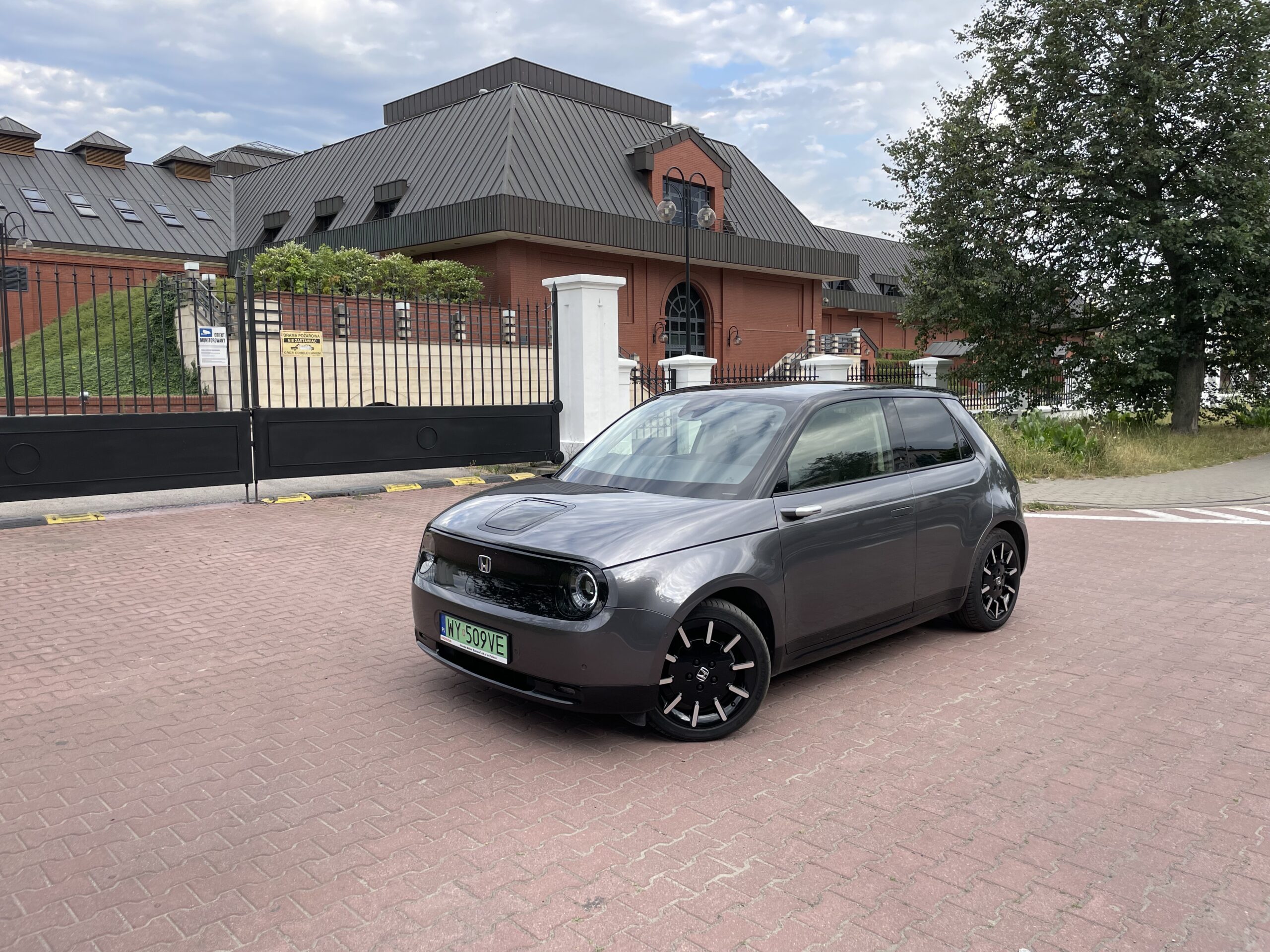
Honda e - a clever car full of unusual ideas
Designed from the ground up, the Honda e has a rear-wheel-drive floor platform and plenty of solutions you will not find anywhere else. On its list of bold moves, doing away with side mirrors is just one of many surprises.
The Honda e first appeared as the 'Urban EV' concept car in 2017, and the car had its global premiere at the Frankfurt Motor Show in September 2019.
Cameras instead of mirrors and hidden door handles
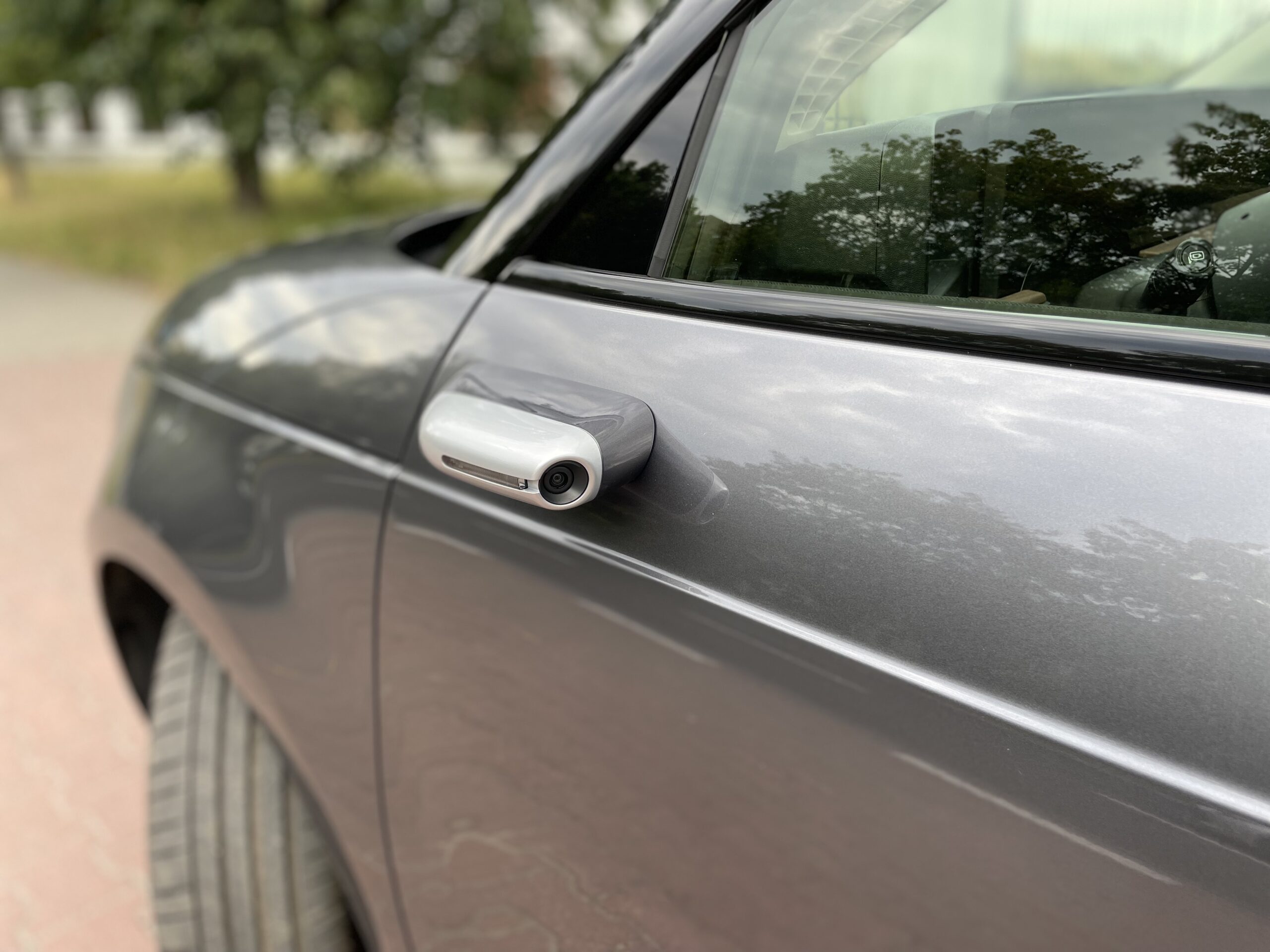
The Japanese company chose to introduce an exceptionally bold concept and step off the beaten track. The Side Camera Mirror System (SCMS) replaced conventional door mirrors with small devices that send images to two six-inch screens inside the car. This solution, a first in the small car segment, brought the expected freshness to the car's design and made it safer to use, reducing blind spots by around 10% in normal view and by around 50% in wide-angle view. Nor do you have to bother folding the mirrors in tight parking spaces.
Also worth noting are the exterior door handles hidden in the bodywork - another first in this class of car. The 'paddles' of the rear door handles are integrated into the C-pillar, which has kept the side surface smooth.
Interior, screens and driving modes
The horizontally arranged LCD touchscreens take up the entire width of the dashboard, adding to the sense of space. The car can display a calming animation on the screens. Elements of synthetic wood have been worked into the front panel (interestingly, the seat belts are also 'wood'-coloured).
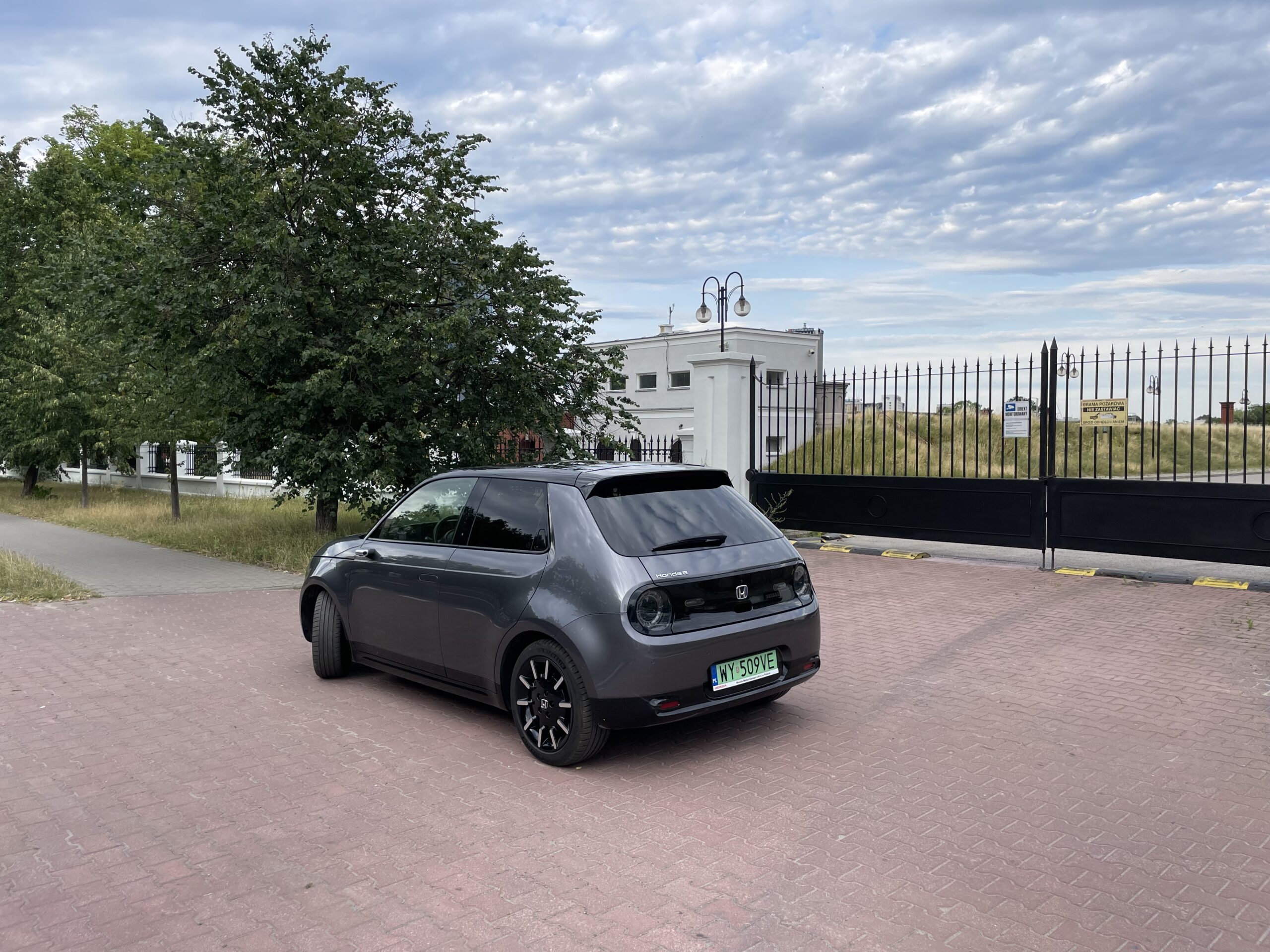
The long wheelbase has made it possible to create an interior the size of cars one segment up, and the flat floor throughout and the absence of raised door sills reinforce this effect further. With an overall length of 3895 mm, the car is relatively wide at 1750 mm. Independent rear suspension and 50:50 weight distribution give it the right credentials for dynamic driving. With no drive components at the front wheels, it was possible to use a mechanism that significantly reduces the turning circle. The boot holds 171 litres.
The designers set out to use subtle, modern materials in the cabin to create the relaxing atmosphere of a lounge. It has to be said that this blend of modernity and Japanese minimalism is appealing.
The interior lighting is cleverly designed and is switched on with a button on the pillar between the doors. Small LED spotlights sit above the passengers' heads. Plenty of light can stream in through the glass roof once you open its blind. From the outside, however, the roof is completely black.
Wide-opening doors give access to the cabin, but once you settle into the driver's seat you will not find a lever for adjusting the lumbar support.
The Honda e has two driving modes: Normal, intended for relaxed driving around town, and Sport, in which the car responds more dynamically to the driver's inputs. The absence of an 'eco' mode is surprising. There is also a system that lets you speed up and slow down using only the accelerator pedal.
Passengers have not been forgotten when it comes to using their own smartphones, tablets or other electronic devices. The cabin has an HDMI connector, a 12 V socket and a 230 V AC socket (max. 1500 W). Two USB ports have also been fitted for the front passengers, plus two more USB ports in the back.
Range, charging and the Advance version
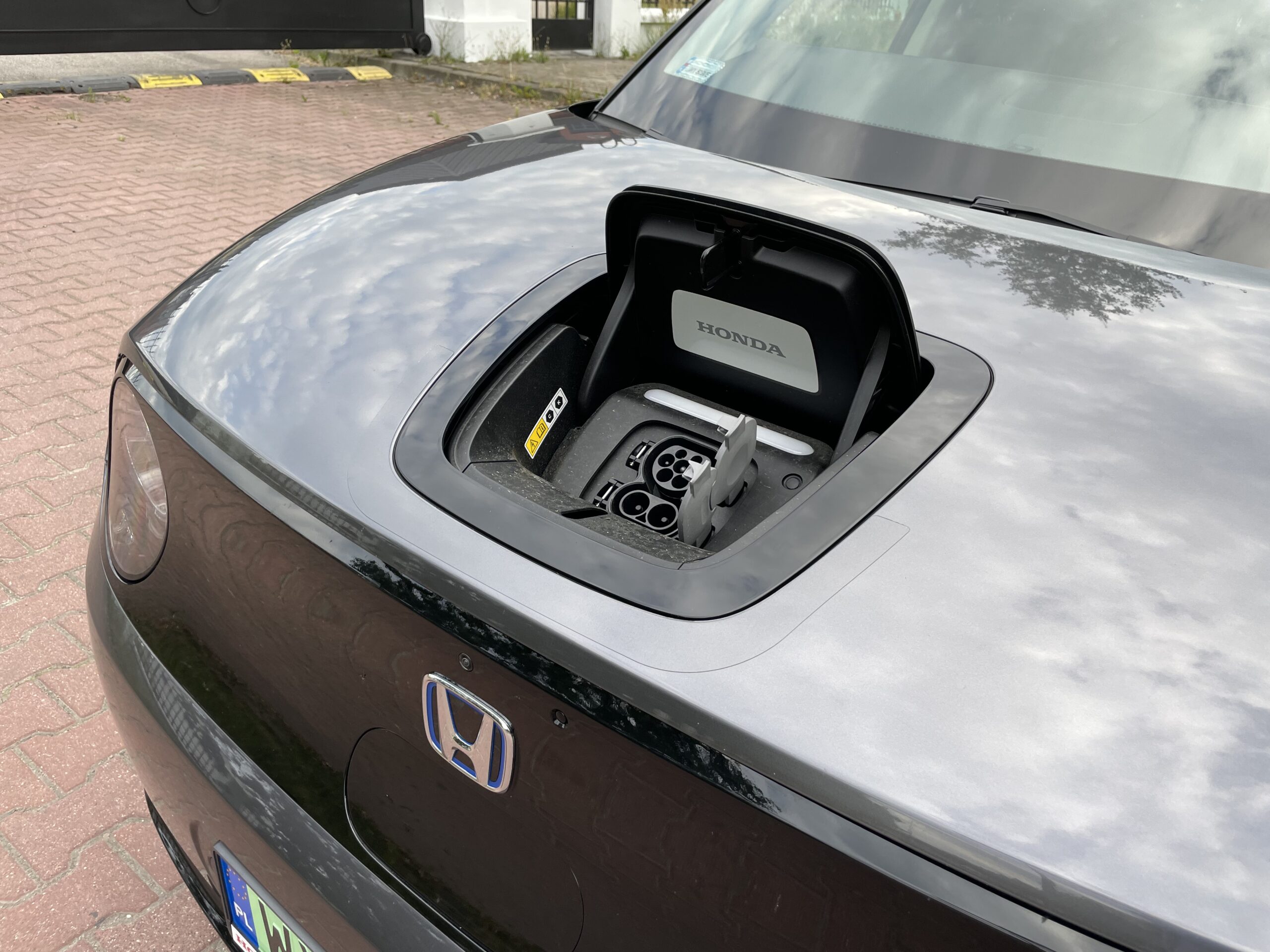
The Honda e is available in two trim levels, and its range on a single charge is 222 km (WLTP), thanks to a 35.5 kWh battery. The battery can be charged via a CCS DC connector or a Type 2 AC connector at 7.4 kW. The Honda's charging port is built into the bonnet. It is worth adding that the battery is liquid-cooled and liquid-heated.
Alongside the base version there is also the Advance. The Honda e Advance's motor delivers a maximum output of 154 hp (113 kW) and an impressive 315 Nm of torque, enough to take the car from standstill to 100 km/h in 8.3 seconds. The base Honda e, with a motor producing a maximum of 136 hp (100 kW), has the same torque and reaches 100 km/h in 9.0 seconds.
Buyers of the Honda e Advance also get a choice of 16-inch or 17-inch alloy wheels and a camera system with a display in the central mirror, which can be switched between the image from the central rear camera and a conventional rear-view mirror image. Other upgrades include a more powerful audio system, a heated windscreen and steering wheel, and Honda Parking Pilot intelligent parking assistance.