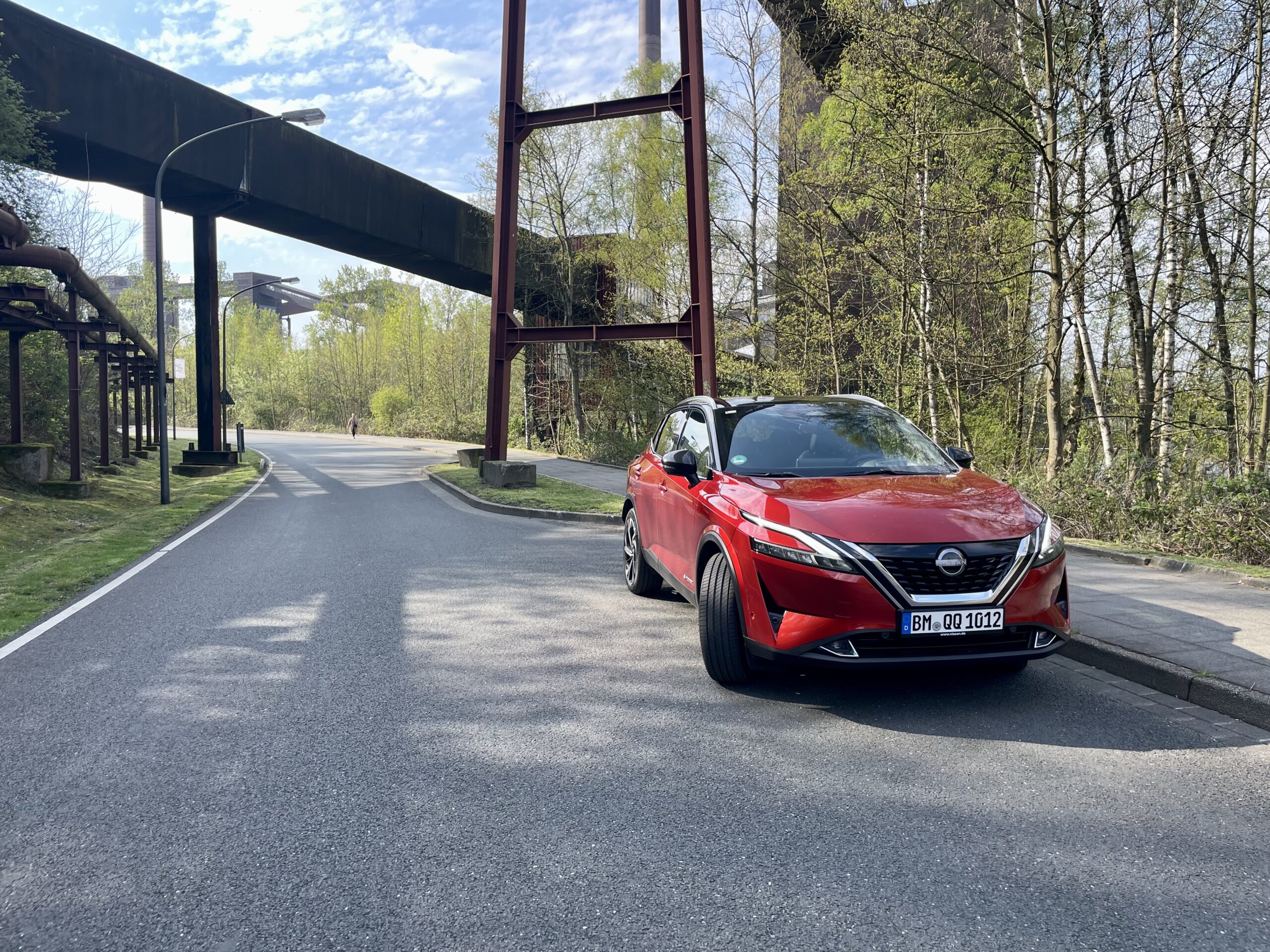
Nissan Qashqai e-Power: the petrol-powered electric
Nissan is pressing home its advantage: after the success of the Note on the Japanese market, it has brought an unusual powertrain to the familiar Qashqai. As a result, this urban crossover has become the first European model to be fitted with the innovative e‑POWER system. We drove one for 450 km on German roads.

How the e-POWER drive works
The e-POWER system consists of a battery supplemented by a three-cylinder, turbocharged 1.5-litre petrol engine with a variable compression ratio, producing 158 hp. The powertrain also includes a generator, an inverter and a 190 hp electric motor. The petrol engine generates electricity, which can be sent via the inverter to the battery, the electric motor or both at once, depending on demand. Naturally, kinetic energy is also recovered when slowing down and braking and used to charge the battery. Configured this way, the car has a top speed of 170 km/h and accelerates to 100 km/h in 7.9 seconds. In introducing such a complex powertrain, the company is harking back to the attempts made some time ago by General Motors with the Opel Ampera and the Chevrolet Volt.

Nissan claims that this configuration makes for a more responsive, quieter and more efficient drive. On those three counts the company has certainly succeeded, although you may have reservations about the level of fuel consumption.

One might ask: 'Why complicate the powertrain like this?' Here it is worth going back to the figures that illustrate the efficiency of combustion engines. Unfortunately, in everyday use it is very low. As a rough simplification, at most 40% of the energy contained in the fuel is used to move the vehicle; the rest is lost. A combustion engine reaches its optimum in a very narrow rev range and under light load. Nissan followed this line of thinking and, by combining two drive systems, set out to give the petrol engine operating conditions close to the optimum. In the end, the only thing driving the wheels is the electric motor. This translates into a quieter ride, and the acceleration is worthy of an EV. You feel it especially when pulling away from the lights, overtaking and accelerating hard, when the electric motor proves its superiority (around 90% efficiency).
During the development of the Qashqai e-POWER, a great deal of time went into matching the pace of the petrol engine to the speed of the car. The 'Linear tune' function controls the combustion engine, gradually raising its revs to meet the demand for power as the car accelerates, while eliminating the mismatch between performance, engine sound and road speed that occupants would otherwise feel. This avoids the unpleasant sensations that often accompanied cars with CVT systems, where engine revs rose disproportionately without adequate acceleration to match.
e-Pedal, EV mode and equipment

The car uses the e-Pedal system familiar from the Japanese company's electric cars. It allows you to accelerate and brake using the accelerator pedal alone. When you lift your foot off the accelerator, the car slows down to a 'creep' speed but does not come to a complete stop. e-Pedal slows the car slightly more strongly than the 'B' function. Because of the greater deceleration, the brake lights come on automatically. A braking signal every time you lift off the accelerator may irritate the drivers behind you. In this 'semi-electric' car you can force zero-emission driving. Press the 'EV' button and no exhaust gases come out of the tailpipe. Don't expect too much, though, as the battery has only 2.1 kWh, so the car soon switches back to the standard combustion mode. Nevertheless, there is a certain benefit, especially when you drive like this in the very centre of town.
The third-generation Nissan Qashqai (the first model appeared in 2007) stays true to its original concept: it still offers attractive styling and a comfortable, spacious interior wrapped in a compact body (4425 mm x 1835 mm). The car remains very easy to manoeuvre, with good all-round visibility supported by the fitted cameras. The Japanese company is very skilled at creating successive attractive generations without breaking with a certain stylistic heritage of their predecessors.

The car we tested was very well equipped. Not only were the steering wheel and front seats heated (three settings), but even the windscreen was heated. Electric motors were used to close the tailgate. When a longer drive started to tire us, a 'massage' function was on hand. The left-hand dial in front of the driver looked deceptively like a rev counter, but its readings were scaled in per cent, and the label left no doubt that it showed % of power.
Fuel consumption and test summary
And what about fuel consumption? Average consumption over the entire 455 km route, made up of motorways and town roads, was 6.2 l/100 km. The lowest consumption recorded was 5.6 litres and the highest 7.1 l/100 km. Unlike a fully electric car, the Qashqai e-POWER burned relatively more fuel than expected in town and less on the motorway. These fuel consumption figures are good, but they are not the 'revolution' some had been expecting. (The test author's own second-generation Qashqai uses 4.9 l/100 km in relaxed motorway driving)

Is the Qashqai e-POWER the ideal car for people who would like to switch to fully electric drive in the future, but currently have no way of charging a battery or are not yet ready to change to a fully electric car? Will this petrol-electric hybrid appeal to a wider group of customers? The Qashqai is a proven car, so this version too can be expected to succeed. As usual, however, the market will decide, with customers voting with their wallets.