Mitsubishi Outlander PHEV - CHAdeMO makes the difference
The Mitsubishi Outlander PHEV is astonishing. Despite visible signs of..... maturity, the car still sells exceptionally well. For 7 years now this plug-in SUV has been very popular, and 2020 will be another successful year for it. It is the 4th best-selling plug-in model in Europe, and in some key markets it does even better. Take the United Kingdom, where it stands on the 2nd step of the podium among PHEVs. Technically, the Mitsubishi also has surprises in store, especially when you want to charge it. Unusually for a hybrid, it can be rapid-charged via CHAdeMO.

What does the Mitsubishi owe its popularity to? The manufacturer lists in one breath: the practicality of an SUV, a well-insulated and well-equipped cabin, the dynamism of electric four-wheel drive, a long range and easy battery charging.
Mitsubishi in Poland decided to relaunch the car on the market. This so-called relaunch was driven by a desire to lower the average CO2 emissions of the brand's line-up and by the fact that excise duty on plug-in cars had been cut significantly. Their prices could fall by anything from a thousand to more than 80 thousand zlotys. In the latter case, the buyer of a Porsche Cayenne, which I described here , could enjoy such a reduction.

PHEV drivetrain and the new 2.4-litre engine
The Mitsubishi Outlander PHEV is driven mainly by two electric motors working in a permanent 4WD system. The combustion engine plays a supporting role, either driving a generator that feeds the traction battery or driving the front wheels directly, but always with the front and rear electric motors running. The manufacturer says the drive control system will strive to return to fully electric drive as quickly and as often as possible. The drivetrain components are arranged unusually, with no propeller shaft, which has reduced mechanical losses.

The PHEV powertrain in the 2020 model year has undergone a comprehensive update. The most important change is a new 2.4-litre petrol engine (displacement up from 2.0 l to 2.4 l). Before the excise duty rate was cut in Poland, moving into the bracket of cars with engines over 2.0 l (taxed at a much higher rate) would have been the final nail in the coffin. Now the car can be successfully relaunched. Mitsubishi says the larger displacement of the 2.4 petrol engine brings higher torque (especially at low revs), lower vibration and noise, better acceleration (especially at low and medium speeds) and generally lower fuel consumption and CO2 emissions. New features have also been added: a battery heating system that keeps the traction battery working in low temperatures when the vehicle is plugged into a charging point. The top speed in EV mode has also been raised to 135 km/h (by 10 km/h).
Driving modes, SAVE and regenerative braking

The Outlander PHEV offers three driving modes:
1. EV - fully electric mode (up to 135 km/h) - the car is then driven by the front and rear electric motors.
2. Hybrid mode I - the car is still driven by the front and rear electric motors, while the combustion engine charges the battery.
3. Hybrid mode II - in this mode the engine drives the front wheels, the front electric motor assists the combustion engine and the rear electric motor drives the rear wheels.
You can also activate SAVE mode. The system then keeps some of the battery's energy in reserve for later (e.g. for driving in a zero-emission zone). It can be combined with CHARGE mode, which forces charging. This feature could be crucial if regulations are introduced that allow only zero-emission vehicles into Clean Transport Zones. An Outlander PHEV driver will be able to travel in from the suburbs using the hybrid modes and then switch to zero-emission electric mode on entering the city. The question remains how anyone will know that a car in the zone is running on its electric motor rather than its combustion engine. The legislator has an idea here: when driving on electricity, a green LED under the rear-view mirror is supposed to light up on the windscreen.
Well done to Mitsubishi for its 5 levels of regenerative braking, selected with paddles behind the steering wheel. Unfortunately, although there are as many as 5 levels, the difference in energy recovery is very small. Even at the most effective braking setting it falls far short of the solutions known from the Nissan Leaf (e-Pedal) or the latest-generation Renault Zoe, which I described here
It is worth adding that EV mode is the default mode as soon as you start the car, and it gives a zero-emission range of up to 57 km (according to the WLTP City cycle).
CHAdeMO charging and the Type 1 socket

When it comes to charging, the Mitsubishi almost sent me into euphoria. Open the charging flaps and you see a CHAdeMO connector, which lets you charge the battery at express speed with DC current. In the 2020 catalogue of electric cars published by the Polish Alternative Fuels Association you will not find any other hybrid that can be charged this way. Sadly, the euphoria soon turned into disappointment, because the car's second socket is the archaic Type 1. If you wanted to use the most popular charging network in Poland, run by GreenWay, you would not be able to "serve" a car with that connector. GreenWay's 200 chargers are fitted with CHAdeMO, CCS and Type 2 connectors.

Most petrol-electric SUVs proclaim a combination of ecology and sportiness. Yes, electric drive can deliver stunning performance! With the Outlander, especially looking at the shape of the vehicle, you think rather of ecology combined with off-roading. Mitsubishi muddies the waters, though, by comparing the Outlander with the Lancer Evolution and its Super-All Wheel Control (S-AWC) four-wheel-drive system, which has not only a SNOW mode but also a SPORT mode that sharpens throttle response and improves traction when cornering hard.
Design and interior after the update

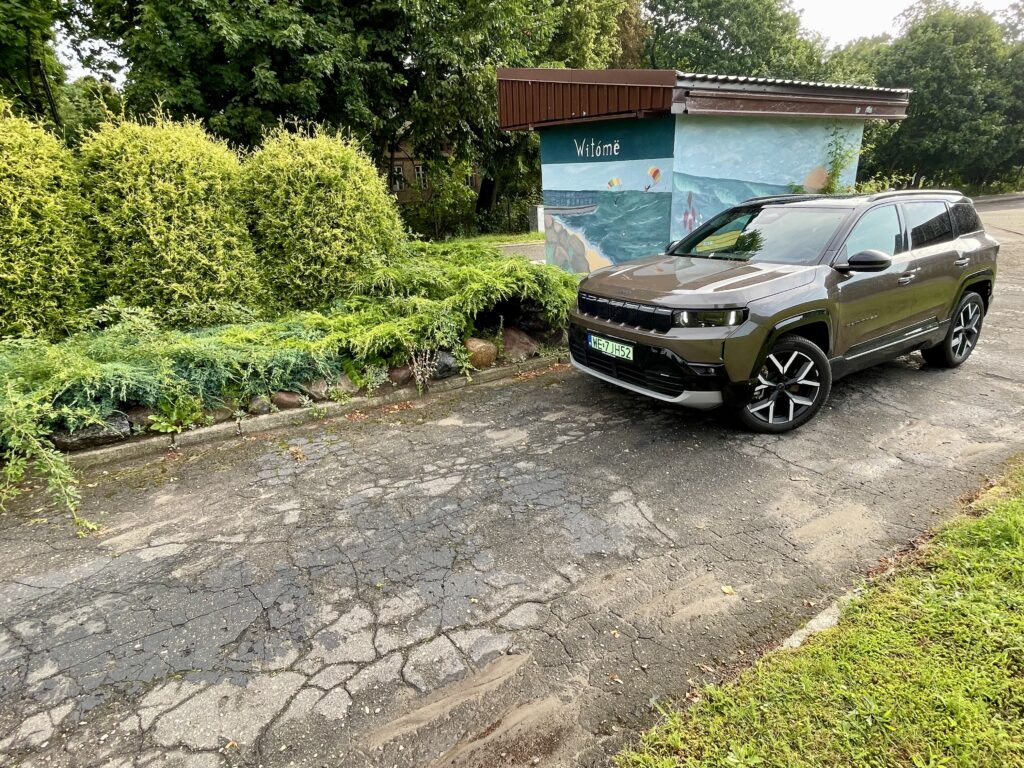
In the new 2020 Mitsubishi Outlander PHEV the grille and bumper have been redesigned, and the fog light surrounds and LED main beams have taken on a "technical" style. At the back, the rear bumper has been extended and the roof spoiler enlarged. Further changes include new 18-inch wheels with a contrasting pattern. That does not change the fact that the car has a strongly off-road look, not very polished, which harks back to classic off-road design of years gone by. As for the interior, the strong influence of the Japanese school of car design is evident. Everything is functional and perfectly put together, but a little uninspired. It is a pity that the "revitalisation" did not include a new drive selector: the one used in the car is made of cheap plastic and its design recalls the 1980s and the first computer game "pads".

Warranty and test summary
The Mitsubishi Outlander PHEV comes with an 8-year or 160,000 km warranty on the batteries and electrical components. Add the 5-year warranty on all components that Mitsubishi Motors gives on its cars, plus the 5-year, unlimited-mileage Mitsubishi Assistance Package, and you get a very solid package that guarantees peace of mind for the first years of ownership.