"Stop smog go hybrid": the Corolla saloon as an example
Toyota has now unveiled the twelfth generation of the Corolla. It is one of the most popular and recognisable cars in the world. What the Golf is to fans of German cars, the Corolla is to lovers of Japanese ones. It comes as a hatchback, an estate and a saloon. What does the hybrid three-box version with the 1.8 engine offer, and what are its limitations?

Under the bonnet of the saloon you will find either a 1.6/132 hp petrol engine or the hybrid 1.8/122 hp tested here. This is not a plug-in hybrid charged from a socket, but one in which the electric drive increases the efficiency of the combustion system without the car qualifying as "electric". Admittedly, this kind of drive increases the car's efficiency considerably. At moments when the combustion engine would reach for extra fuel (pulling away from traffic lights, accelerating), the electric motor kicks in, which results in much lower average fuel consumption. During the test the car made do with just 5 l/100 km.
The saloon body and 471-litre boot

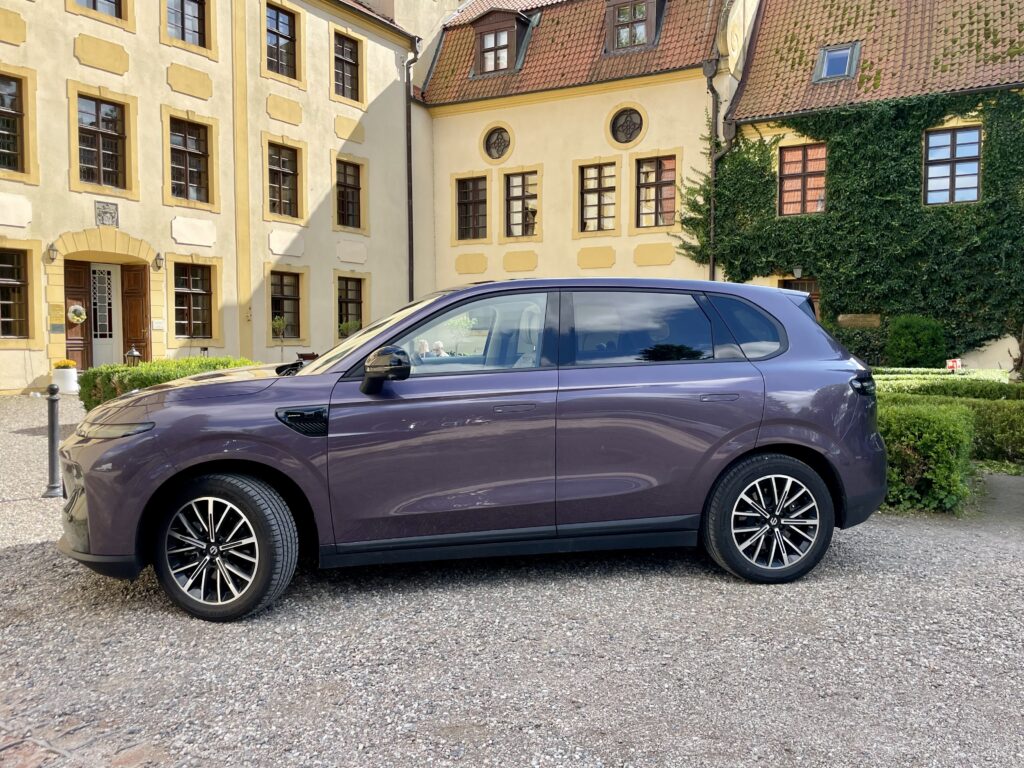
The Corolla's body is one of the more attractive among three-box compacts. I say "compacts", although not long ago a body of this size would have placed the car in the D segment. The saloon measures 463/178/143.5 cm (length/width/height), and the wheelbase is 270 cm. The car looks dynamic and smart, and its design is sure to "speak" to those who believe that even the most beautiful hatchback cannot match the beauty of a saloon's lines. The proportions are well judged, the front is striking and the rear is neat.

Inside there is more than enough room for four adults. The rear bench has a practical fold-out armrest. The 471-litre boot means you can plan long holiday trips. Unusually, the tailgate release button is placed at the side. I was probably not the only one to struggle to open it, as the decorative trim strip at the rear already looked a bit strained. Of course, after a few days you know instinctively where to reach.

Low fuel consumption, a comfortable interior and a roomy boot seem to be the ideal combination for long journeys. I would also have expected a record-breaking range, but because of the smaller fuel tank you can cover at most 750 km on one tank.
The e-CVT gearbox and driving modes
Power is transmitted to the wheels through an e-CVT continuously variable transmission. This solution, combined with the hybrid system, makes it questionable whether there is any point in watching the rev counter. The car does what it likes with the revs, and the driver has little influence over them. The combustion engine often switches off because the electric motor takes over, whereas under acceleration the needle climbs into the upper ranges out of proportion to the rate at which the speed increases (a characteristic of CVT gearboxes). This set-up also has the drawback that accelerating beyond 140 km/h on a gentle incline is practically impossible.

The driver can choose from three drive modes: Sport, Normal and Eco. You can also force the car into zero-emission EV mode, but it will find plenty of excuses to switch it off. Messages on the display will say "speed too high" (once you exceed 40 km/h), "accelerator pressed too hard" or "battery charge too low". The truth is that the car wants to decide for itself how to combine its power sources, because it believes it does so optimally. There is a lot of truth in that, as switching between the drive types happens silently and without any jerks or vibration.

The ergonomics of the car's controls remain faultless. The very high-contrast infotainment screen is a surprise. It has no sun visor, yet it stays legible even when driving in bright sunlight. It is surrounded by deliciously "old-school" buttons.
Test summary
The Toyota Corolla saloon is a very elegant and roomy car. The hybrid drive works almost perfectly. If you are a fan of three-box bodies and like continuously variable transmissions, this is the car for you.