







The VW e-Golf is an electric car for the people
Volkswagen enjoys an established reputation as a brand in Poland. The Golf, with its long history spanning several generations, is an icon of the C segment and an object of desire for many Poles. The electric Golf's greatest strength is how close it is to the "ordinary" Golf.

Motor and driving modes
The e-Golf's motor is powerful and almost silent. A maximum output of 100 kW and 290 Nm of torque, available from the very first revolution, speak for themselves. These figures allow it to accelerate from 0 to 100 km/h in just 9.6 seconds. Getting from 0 to 60 km/h takes only 4.2 seconds, which puts you in a winning position in a sprint away from the lights.
The best performance comes in Normal mode. It is one of three available settings. The others limit energy use. In Eco+ you cannot switch on the air conditioning, and speed is limited to 95 km/h. You can overcome this barrier by pressing the accelerator all the way down (the so-called kick-down), but the "muzzle" does not always come off, which can be an unpleasant surprise when overtaking on a single-carriageway road. Eco mode is the middle setting and, you could say, the optimal one. Each time you switch to a more economical mode, you gain about 10% extra range. If the estimated range in Normal mode is 200 km, in Eco it will be about 220, and in Eco+ you will get to about 240 km. Unfortunately, every time the car is switched off, it reverts to Normal mode and you have to select your preferred mode all over again. Fortunately, this is very easy to do with a button next to the "gear" selector.
Active Info Display and the touchscreen
The Active Info Display is a multifunction liquid-crystal display with a high-resolution colour screen measuring 31 cm (12.3 inches) across. Thanks to different profiles, you can put the data that matters to you in the centre of the screen. This information is displayed alongside the classic instruments such as the speedometer and odometer. The rev counter has been replaced by a gauge showing range and instantaneous energy consumption or recovery. Profiles are selected quickly and fairly easily using buttons on the multifunction steering wheel. Being able to display navigation maps right in front of your eyes is very helpful.
On the centre console there is a large touchscreen. Large, because it measures as much as 23.4 cm diagonally. Unlike mechanical knobs and buttons, it offers unlimited scope for creativity when designing new functions. Unfortunately, every company designs the architecture of such systems to its own taste. It takes me quite a while to get used to the order of the functions, and not everything comes intuitively to me. I had trouble selecting the last destination in the navigation, or setting separate volumes for navigation prompts and the radio.

Regenerative braking, LED lights and handling
In the VW e-Golf, the 3 levels of regenerative braking are set by moving the lever to the left, towards the driver. There is also a very useful function that temporarily increases regeneration when you pull the lever back. This is reminiscent of the "e-Pedal" feature in the Nissan LEAF, because by deftly engaging energy recovery you can control the car's speed - right down to a standstill - using only the accelerator and the drive selector lever. The brake discs can stay asleep.
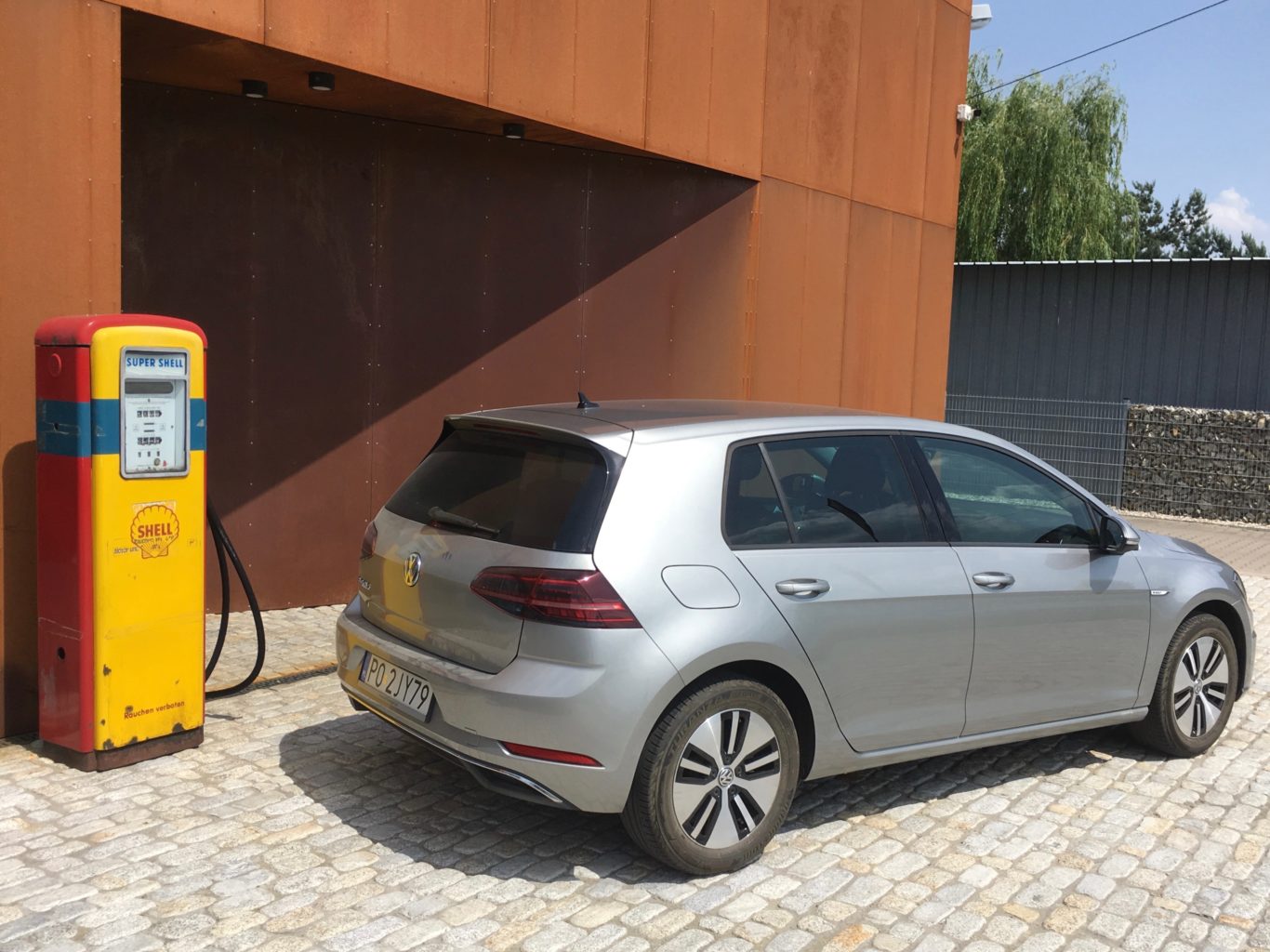
Looking at the car, it takes a moment to notice the blue styling details, such as the inserts in the headlights and the stitching on the steering wheel. The easiest way to recognise the e-Golf is by its Astana wheels. They look good and also contribute to economical driving.
You cannot pull away with a door open, which protects against accidents or damage to the car, although when manoeuvring slowly, for example when reversing up to a charger, it ought to be allowed.
LEDs are used extensively in the new e-Golf, above all in the front and rear lights. Their pleasant light, close in colour to daylight, provides excellent illumination of the road. In addition, the distinctive C-shaped daytime running lights give the car an appealing charm when seen from the front. This design should also improve the car's visibility. The LED rear light panel improves visibility too. Remember that LEDs rarely fail and have a long service life.

The test car was fitted with a reversing camera but had no parking sensors. I think a combination of both systems would work best. It must be said that the camera fitted delivers an image of superb resolution.
The Volkswagen handles very well, even though it is an adaptation of an existing conventional model. With heavy batteries placed at the rear of the car and a somewhat disturbed weight distribution, the suspension components have been adapted so well that the car's road behaviour is still close to neutral..
CCS charging and energy consumption

There are several ways to charge the lithium-ion battery. If you charge the Volkswagen e-Golf from a household socket, a full charge from completely flat will take around 17 hours. If you install the optional AC wallbox (11 kW), you increase charging efficiency and cut the time to around 5 hours 20 minutes. AC charging at public charging stations takes just as long, because of the on-board charger fitted. The e-Golf will be ready to go again fastest if you use public DC charging stations. I used stations in the GreenWay network, of which there are already more than 100 across Poland. A flat battery will be 80% full after just 45 minutes. The car is designed for rapid charging using CCS Combo. This is the most promising charging system for electric cars in Europe, especially after the recent decisions by Jaguar and Tesla to have their cars charged using this very system.
Tests show that energy consumption will vary from around 12 kWh/100 km in city driving, without air conditioning and with energy recovery, to 22 kWh/100 km in low or very high temperatures and driving outside town. Once again it turns out that electric cars do not like motorway speeds, because at top speed (140 - 150 km/h) the car will need as much as 30 kWh/100 km. Remember that the battery capacity is 35.8 kWh.
Test summary
With the e-Golf, Volkswagen has blazed a trail, gained a great deal of experience and got customers and dealers used to electric drive. But this is only the prelude. A whole range of ID models is waiting on the starting line; designed from the outset as zero-emission vehicles, they will form the core of this respected German brand's line-up.